
Pagaya (PGY), failed breakouts and market volatility | Radar 91
Volume 91

We Knew Better. We Did It Anyway.
Last week, we preached patience. This week, we ignored our own advice, and the market collected.
The tape was brutal and a good deal more volatile than we expected walking in. The Nasdaq put up its worst week in over a year, down more than four percent, with several red sessions stacked into Friday’s close. The S&P 500 had its ugliest week since early June and closed back under its 50-day moving average, the kind of level that quietly reshapes how the next few weeks trade. The only major index left standing was the Dow, up a fraction on the week, carried by exactly the slow defensive names everyone wrote off in the spring.
Now the part we’ll own.
Coming off a week where we’d started giving back some of our lead over the Nasdaq, we made a decision. We pushed the accelerator. Genius move!
Monday set the trap cleanly.
The market poked above the recent highs and looked, for a few hours, like it finally wanted to break out. Then it rejected them outright. The next session gapped down hard, and the semis led the bleeding. The Semiconductor Index had its worst run in over a year, as the whole AI complex unwound on a report that OpenAI might push its IPO into next year. A Fed still flirting with a hike, a wobble in the Iran ceasefire late in the week, quarter-end rebalancing sloshing money around. Anything crowded got sold.
Not the week to be reaching for size.
Most of the time, the right move when you’re slightly behind is the boring one. Protect what you’ve built, go tactically near full cash, and let the market show its hand before you commit a dollar. We know this. We’ve known it for years. And we still let the anxiety of trailing the index crawl into our heads. Beating the benchmark every year is the job, and we hold ourselves to it without excuses. But we’re human, and enough time in the trenches teaches you that the emotions never actually leave. They just go quiet and wait for the worst possible moment.
Putting the portfolio and the numbers out in public keeps us disciplined. It also leaves the door cracked for the occasional emotional spike nobody asked for, usually right when the scoreboard is in plain view. This was one of those weeks.

The rotation underneath the headline was loud. Money poured into the traditionally defensive corners. Healthcare had its best week since 2022, up more than seven percent. Real estate and utilities each picked up roughly three to four. Six of the eleven S&P sectors actually closed green, which tells you the damage was concentrated in tech, not spread across the whole market. Those defensive corners are the ones worth watching while tech and everything AI-adjacent catches its breath.
Which brings us to the trade we’re least proud of.
Flex Ltd (FLEX) sits right next to the research we’ve been buried in lately, and to the piece we just published. We liked the setup. We bought it on Wednesday, a healthy position with the risk kept tight, stop parked just beneath support. By the next morning, we were sitting in clean profit on a gap up. It felt right.
Two days later, the whole position was gone. Half sold at breakeven, the other half taken out at the original stop. FLEX is high-beta and chip-adjacent, and the moment the semis rolled, it rolled right alongside them. That is the entire market this week, compressed into one trade.

Difficult. Volatile. Choppy. A tape that punishes size and pays for patience, where the honest answer is usually to do less, or nothing at all, until the market actually commits to a direction worth trading.
So we go back to the patient, and a little bored. It pays better, and we know it.
Here’s a look at this week’s market health, with a breakdown of index and sector performance.



We’re currently building the beta version of our app, and it’s already live.
It is not a generic solution for every market participant, but a platform built specifically for swing trading, momentum strategies, and short to medium-term investing.
You can already sign up, access the beta, and start using it today.
As previously stated, all paid subscribers will receive full access to the platform at no additional cost.

Latest articles:
Each stock carries a risk badge: ⚠️ High | 📊 Medium | 🛡️ Low.
Based on volatility, float, technicals, and fundamentals. Size your positions accordingly.
📈 Free Setup: Make It Count
PGY: Pagaya Technologies Ltd ⚠️
What they do: An AI-powered credit underwriting platform
Why watch? Five consecutive quarters of GAAP profitability are a hard fact to argue with, yet the short interest in Pagaya sits above 15%. That disconnect between the operating reality and the market’s positioning is exactly the kind of setup worth paying attention to.
To understand what Pagaya actually does, it helps to know what traditional credit underwriting misses. Most lenders still rely heavily on FICO scores and a handful of standard financial variables to decide who gets a loan and at what rate. Pagaya’s AI model analyzes a much broader set of signals in real time, making instant creditworthiness decisions that go well beyond what a credit score captures. The company does not originate loans itself. It embeds its decision engine into a partner’s existing origination flow so that every applicant the partner sees gets run through Pagaya’s model first. The partner gets better approval rates and lower default risk. Pagaya earns a fee.
Q1 2026 results came in slightly below revenue expectations, but the composition of the beat and miss matters more than the headline. EPS of $0.73 beat by $0.17, and revenue still grew 9.64% year over year. For a company that was not profitable until 2025, that trajectory is remarkable.
The partner network is expanding rapidly: Upstart, GLS, Sezzle, and Upgrade’s Flex Pay product were all onboarded in the last 6-12 months, bringing the total to five new partners in that window. Additional regional banks are reportedly in the queue. Each new partner that integrates Pagaya’s underwriting engine deepens the moat because switching out an AI credit model that is embedded at the origination layer is operationally painful and carries real default-rate risk if done carelessly.
The Sezzle partnership is worth understanding specifically. Sezzle’s core product is a pay-in-four installment offering, which by its nature caps the purchase size it can support. By connecting to Pagaya’s underwriting infrastructure, Sezzle can now extend financing on significantly larger purchases, which expands its addressable market without taking on additional credit risk it cannot price properly.
Technical Outlook: The stock is approaching the $16.00 level again, which has acted as major monthly resistance throughout 2024. The pattern that has formed since mid-April is a long, drawn-out handle on what reads as a cup-and-handle base. These extended handles can be frustrating, but they tend to build into cleaner breakouts because weak holders gradually exit during the consolidation period. A break above $16.00 on meaningful volume would be a significant technical event for this name and could mark the beginning of a genuine Stage 2 uptrend.



Why We Don’t Wait for Sunday
Markets don’t move on your schedule. The best low-risk entries don’t announce themselves politely and wait for the weekend newsletter.
They show up when they show up. And if you’re not positioned, you miss them.
Paid members get real-time alerts: exact entries, stops, position sizing, and the thesis behind every trade. The same information we use to manage our own capital.
Free members get just one pick on Sunday.
Does that sound like an edge to you?
What’s Inside Premium
Free Access to TradeDeck
Premium members get early access to TradeDeck, the trading platform we’re building. The value of the platform alone already exceeds the cost of the subscription.
Watchlist Elite (5-7 Stocks)
Each selection undergoes rigorous financial analysis, technical evaluation, and strategic assessment.
Full Portfolio Transparency
Every position we hold. Entry price. Current P&L. Stop level. Real money, real risk.
Real-Time Trade Alerts (Chat Access)
This is where the edge lives. Exact entries, stops, and position sizing. Real-time. No lag
Quick Picks (5 Names)
Additional setups that just missed our main criteria but are worth watching.
Chat Access
See our thought process in real time. Ask questions. Watch how we manage risk.
The Tools We Actually Use
Member discounts on TC2000, Fiscal.ai, and other platforms. Same tools, better pricing.
What Paid Members Say:
We’re entrepreneurs first, traders second. We’ve sat in the CEO chair. We know what real execution looks like and how to spot it.
€39/month or 299€/year. Less than one losing trade. Cancel anytime.
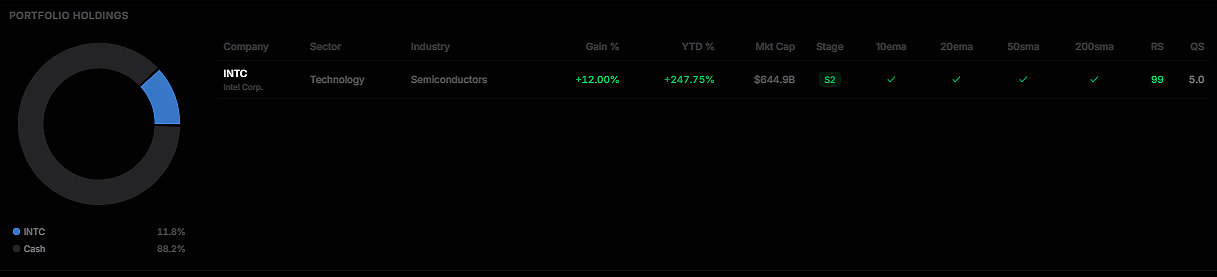
Portfolio updates and new positions:

💎📈 Watchlist Elite: Premium Market Movers
AMPG: AmpliTech Group Inc ⚠️
What they do: A manufacturer of radio frequency and microwave signal processing components
Why watch? Forty-six employees. A $127 million market cap. A headquarters in Hauppauge, New York, that most investors have never heard of. On paper, AmpliTech looks like a company you scroll past without a second thought. Then you read the one sentence that changes everything: it is the only company in the world certified by the O-RAN Testing and Integration Centre to manufacture the 64T Massive MIMO radio for Open RAN 5G networks.
A brief explanation helps here. O-RAN, which stands for Open Radio Access Network, is a relatively new architecture that lets mobile operators mix equipment from different vendors when building 5G infrastructure, rather than being locked into a single supplier like Ericsson or Nokia. That open market creates a real window for specialized manufacturers to sell directly to carriers who previously had no alternative. The 64T Massive MIMO radio is a specific type of antenna system that uses 64 transmitters and 64 receivers simultaneously to dramatically increase network capacity and coverage in dense urban environments. The OTIC certification is the regulatory and technical gate that proves the hardware works within the O-RAN ecosystem. Nobody else has cleared that gate for this specific product. Replicating the certification process would take competitors years, and the clock does not start until they decide to try.
The financial picture has shifted sharply in a short period. Revenue grew 165% in fiscal year 2025, and that momentum carried into Q1 2026 with a further 48.6% increase. Gross margins expanded from 33% to 48% in a single year, meaning gross profit nearly doubled while revenue increased by roughly 50%. The business is not just growing faster. It is keeping significantly more of what it earns. The balance sheet is clean: no debt, and $18.4 million in cash.
The letter of intent pipeline is the part of the story that reframes the valuation entirely. The company has disclosed a $40 million LOI already in progress and referenced an additional $70 million LOI on its most recent earnings call. That is $140 million in identified near-term business against a market cap of roughly $127 million. Full-year 2026 revenue guidance stands at $50 million, implying the stock trades at approximately 2.5 times forward sales. For a company growing at this rate with no debt and a certified monopoly on a specific piece of critical network hardware, that is not a stretched multiple. Production shipments have already started.
The supplier relationships deserve a separate mention. AmpliTech has already qualified for the procurement chains of Lockheed Martin, Boeing, Raytheon, and NASA. They require years of security clearances, technical audits, and product validation at every level of the supply chain. Most companies in this size bracket never get that conversation started. AmpliTech is already supplying products to those programs.
The European opportunity is the catalyst that remains entirely unpriced. European carriers are under regulatory mandate to remove Huawei equipment and transition to Open RAN standards. Deutsche Telekom, Vodafone, and Orange all need certified O-RAN hardware to fulfill that mandate. AmpliTech presented directly in front of all three at MWC Barcelona. A single European contract announcement would be a company-defining event for a business of this size.
The risk is real and worth stating plainly. A 46-person company guiding for $50 million in annual revenue, when Q1 alone produced $5.35 million, means the overwhelming majority of the year needs to arrive in the back half. Revenue concentration of that magnitude in Q3 and Q4 is the central execution risk. The thesis is compelling. The delivery at this scale remains unproven.
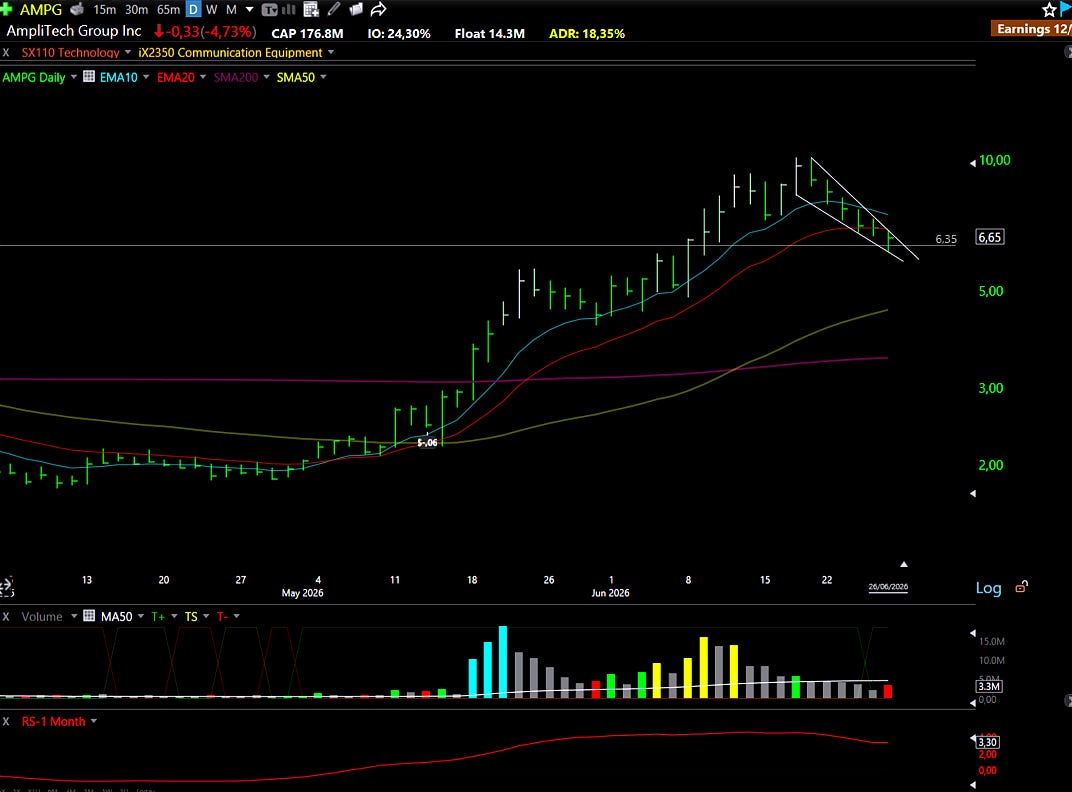
Technical Outlook: This is a name where the setup demands patience and disciplined position sizing. The stock is early-stage and thinly traded, which means entries need to be sized to reflect that reality. The stock is actually sitting near support (6.35), a key level on the monthly chart.
FRD: Friedman Industries Inc 📊
What they do: A steel processing and distribution company
Why watch? Friedman Industries is not a story stock. It does not have an AI angle, a defense narrative, or a founder with a social media following. What it has is four consecutive quarters of sequential revenue growth, a profit inflection that caught the market off guard, and a recent acquisition that meaningfully expanded its operational scale.
The Q4 fiscal 2026 results, reported on June 11th, told the story clearly. Revenue came in at $191.8 million, the latest step in a progression that has gone $134.8 million, $152.4 million, $168 million, and $191.8 million across four straight quarters. That kind of steady sequential acceleration in a commodity-adjacent business does not happen often. Earnings per share reached $1.30, against $0.43 in the prior quarter. Net income was $9.2 million. EBITDA came in at $15.2 million. Gross margins expanded to 11.2% from 6.6% a quarter earlier, and operating margins moved from 2.3% to 6.2%. The company also printed record quarterly sales volume, up 6% sequentially and 14% year over year.
The acquisition of Century Metals is the structural driver underneath those numbers. It added approximately $111 million in annual revenue capacity, expanded processing capability, broadened the regional footprint, and deepened customer relationships across the distribution network. The volume growth the company is now reporting is the integration of that acquisition beginning to show up fully in the income statement.
Steel processing is not a glamorous business. That is exactly why a small company can sit in the middle of it for years, execute quietly, improve margins, and go completely unnoticed until an earnings report forces a reassessment. The stock moved 31% on the day results were announced, which suggests the market was not paying attention before that moment.
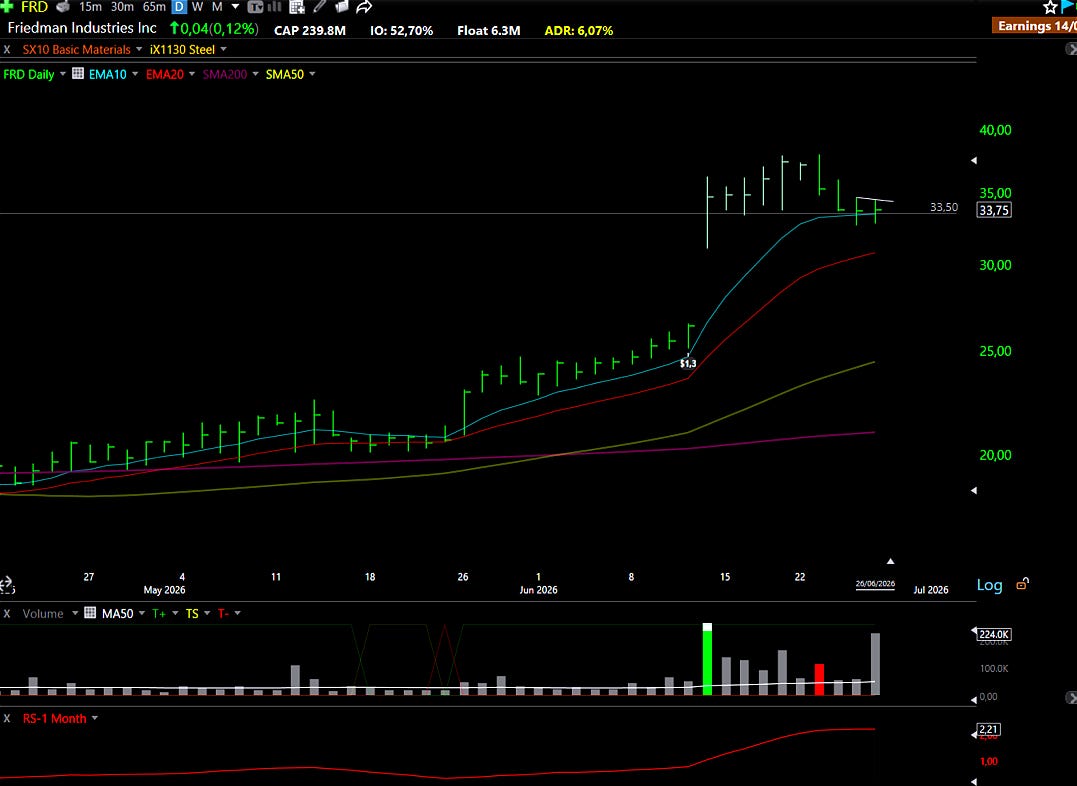
Technical Outlook: After the gap up on earnings, the stock has been consolidating calmly and is now testing the 10-day EMA on low volume. Tight price action on declining volume near a key moving average after a strong earnings-driven move is a textbook continuation setup. The $33.50 level is the near-term daily support to use as a reference. The stock is trading at all-time highs, which means there is no overhead resistance above current levels. The caveat worth keeping front of mind is liquidity. The float is small, and daily volume is limited on a normal session, so position sizing should reflect that. This is a real business with genuinely good earnings in a sector that has nothing to do with the broader market narrative, which makes it worth watching closely next week.
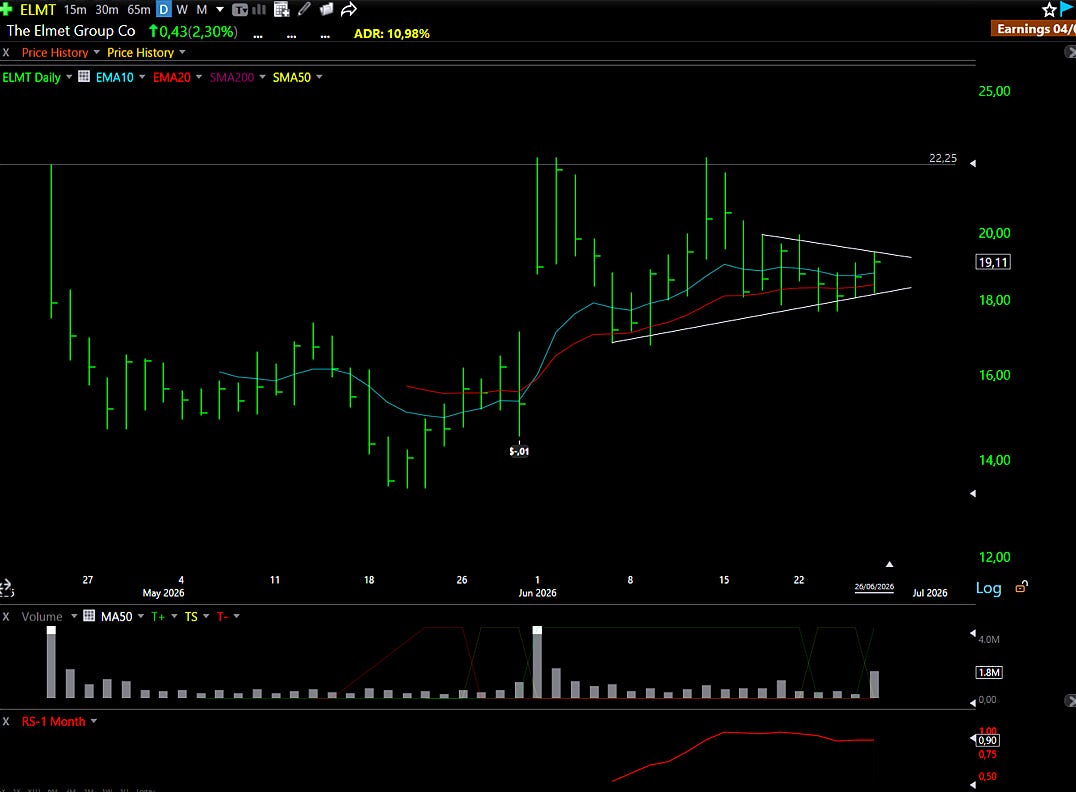
ELMT: The Elmet Group Co ⚠️
What they do: The only fully integrated, American-owned manufacturer of tungsten and molybdenum products
Why watch? Elmet has been in business for more than 90 years. It is based in Portland, Maine, makes materials that most investors have never thought about, and recently went public almost entirely under the radar. It may also be positioned in front of one of the most durable supply chain trends of the next decade.
The two metals at the center of the business, tungsten and molybdenum, share a characteristic that makes them strategically important: they are extraordinarily difficult to replace, and their global supply is heavily concentrated in China. Tungsten has the highest melting point of any metal and is essential for armor-piercing munitions, aerospace components, semiconductor manufacturing, industrial cutting tools, and high-performance engineering applications. Molybdenum has the sixth-highest melting point of any element, exceptional radiation absorption properties, and a density that provides meaningful shielding at manageable thickness. Both are classified as critical minerals by Western governments specifically because of China's concentration and the absence of adequate Western alternatives. Elmet is the alternative.
The satellite infrastructure angle is the piece of the thesis that most investors have not yet connected. Every satellite operating in low Earth orbit is continuously bombarded by gamma rays from the sun, cosmic rays from deep space, and energetic protons trapped in the Van Allen radiation belts that surround Earth. Without physical shielding, the electronics inside would be destroyed within months. The solution is a machined enclosure made from a material dense enough to absorb that radiation while remaining light enough to reach orbit without consuming the entire launch mass budget. Molybdenum is that material, and it needs to be machined to extraordinarily tight tolerances because it has to survive a rocket launch and then operate flawlessly in a vacuum for a decade or more. Radiation shielding is not optional. It is not a feature that gets cut when budgets tighten. It is the physical reason a satellite functions rather than becoming an expensive piece of orbital debris. Every Starlink unit, every Amazon Kuiper terminal, every OneWeb satellite, every classified government platform in LEO requires engineered molybdenum enclosures around its electronics. Elmet is the only American-owned company making those components at scale.
The company holds 20 U.S. and international patents in the additive manufacturing of refractory metals. Those patents were filed years before the current satellite propulsion and LEO infrastructure market existed in anything like its present form. Elmet built the capability before the customers arrived. The customers are now arriving in volume.
The strategic supply chain positioning reinforces the long-term story further. In 2024, the company signed a five-year offtake agreement to purchase tungsten concentrate from EQ Resources’ Barruecopardo mine in Spain, one of the fastest-growing Western tungsten producers, at an estimated contract value of approximately A$30 million. In 2026, Elmet exercised its option to purchase an additional 20 million shares of EQ Resources, bringing its total ownership to 23.65 million shares. This is not a passive financial investment. It is deliberate vertical integration into the upstream supply chain, reducing dependence on the same Chinese sources that Western governments are actively working to move away from. Already profitable, growing fast, with a record defense backlog.
Technical Outlook: As a recent IPO, the chart is still establishing itself, and the ADR can be very wide. Moves in either direction can be sharp and fast, so position sizing matters more here than in most setups. The stock is beginning to surf the 10 and 20-day EMAs with some constructive compression developing above them. The clean breakout level is above $20.00, but an earlier entry on a break of Friday’s highs is worth monitoring for those comfortable with the volatility profile.
FLR: Fluor Corporation 📊
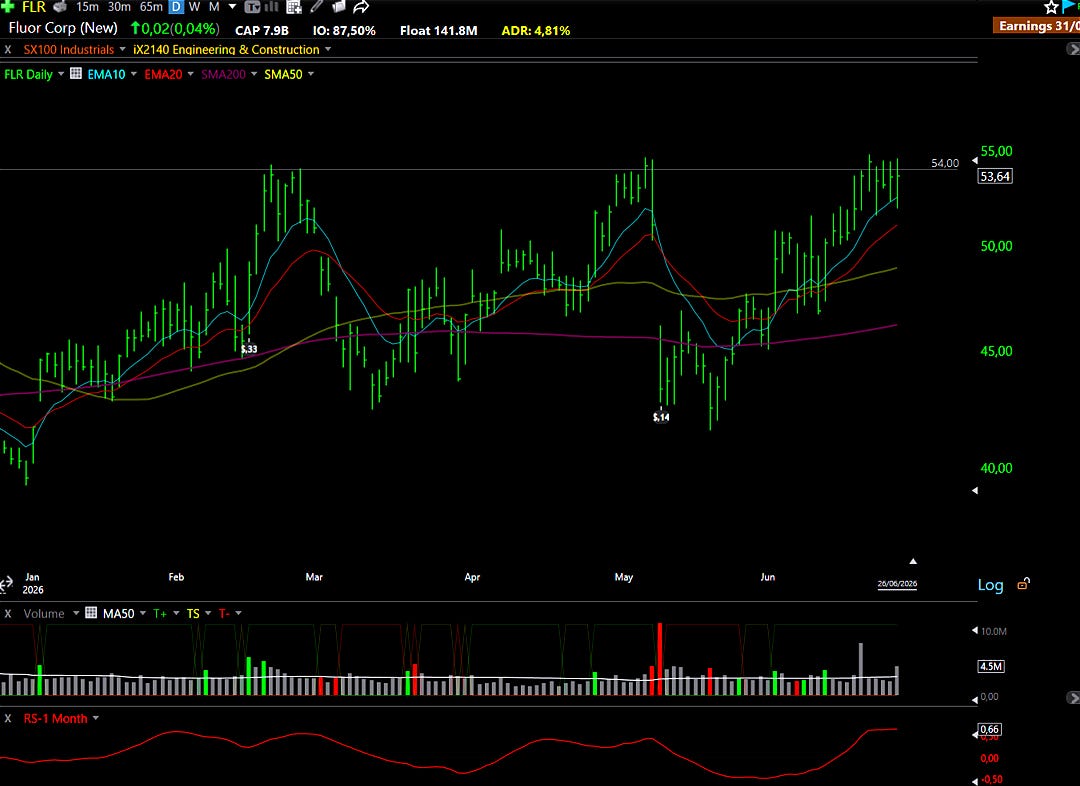
What they do: One of the largest engineering, procurement, and construction companies in the world.
Why watch? Fluor is the company that gets called when someone needs to build something that has never been built before at that scale, or something so technically complex that only a handful of firms in the world can manage it from concept to commissioning. Advanced nuclear plants. Semiconductor gigafactories. Liquefied natural gas terminals. Grid-scale power infrastructure. These are the projects that take years to plan, decades to pay back, and require a very specific kind of organization to execute without destroying the client’s budget in the process.
The business went through a painful restructuring over the past several years, driven in large part by losses on fixed-price contracts where inflation and supply chain disruptions wiped out margins on projects that were priced years earlier. Management made a fundamental strategic change: the company largely stopped bidding on fixed-price work. The current backlog of $25.7 billion is 82% reimbursable, meaning the client bears the cost risk when material and labor prices move. That structural shift changes the quality of the earnings significantly. A company with a fixed-price backlog is carrying inflation risk. A company with a reimbursable backlog is not.
The NuScale divestiture removed a significant source of both capital and uncertainty. Fluor sold 71 million NuScale shares in February 2026 for $1.35 billion and completed the sale of the remaining 40 million shares in April for $473 million. The combined proceeds gave management meaningful financial flexibility, and they have been directing it toward aggressive stock repurchases.
The structural demand backdrop is what makes the backlog credible rather than aspirational. Technology companies are under enormous pressure to secure power for AI data centers, and the grid infrastructure to support those loads simply does not exist in most of the locations where that compute is being deployed. Fluor is building power plants and upgrading transmission infrastructure for exactly those customers. The signed backlog of $25.7 billion is work that already exists and is waiting to be executed.
Technical Outlook: The weekly chart shows three separate attempts to break above the $54.00 resistance level in 2026, none of which held. Three tests of the same level without resolution is a pattern that typically ends one of two ways: a clean break that triggers real follow-through buying, or a rollover. Given the backlog, the cash flow profile, and the structural demand environment the company operates in, the setup leans toward the former. When the break comes, the move should be meaningful. The stock is choppy by nature and does not trend in a particularly linear fashion, so positions need room to breathe. Tight stops on this name tend to get picked off before the thesis plays out.
ADEA: Adeia Inc ⚠️
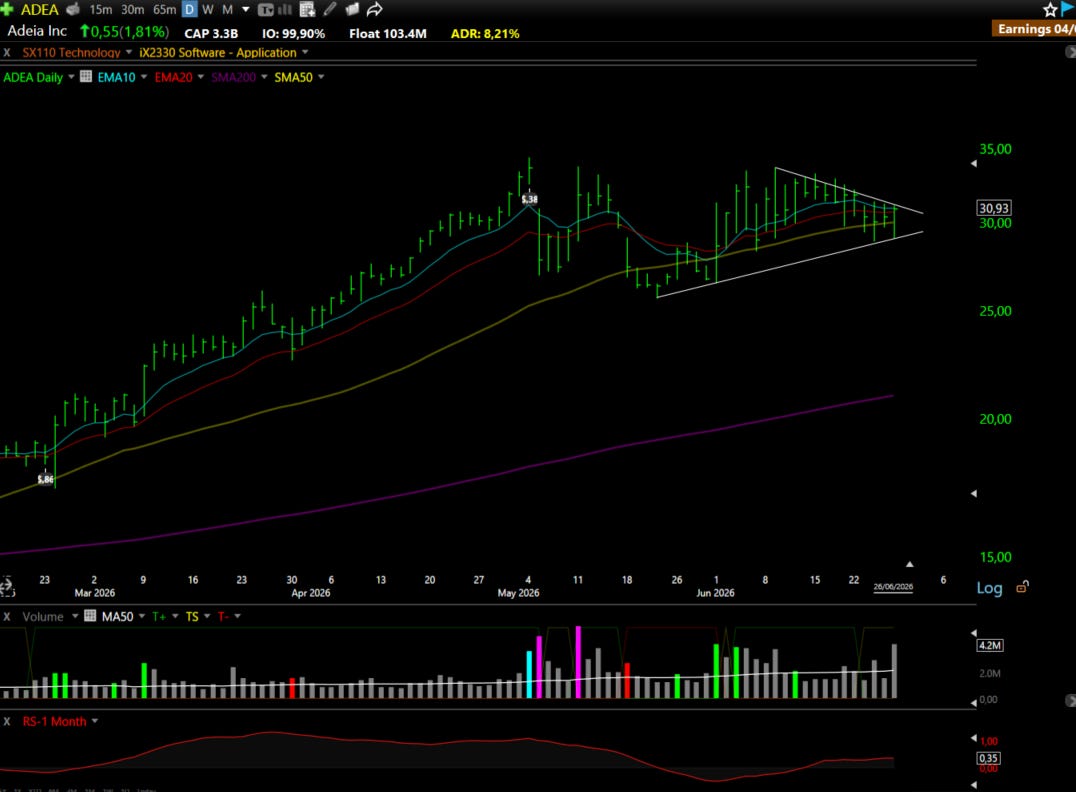
What they do: An intellectual property licensing company
Why watch? Adeia is not a chipmaker. It does not fabricate silicon, assemble packages, or compete for manufacturing contracts. It owns the patents that govern how chips get stacked on top of each other at the microscopic level, and it collects licensing fees from the companies that build. That business model is worth understanding precisely because most investors do not immediately recognize how defensible it is.
Hybrid bonding is the technology that allows chips to be joined face-to-face, with copper pads bonding directly across the interface at densities that traditional wire bonding or flip-chip methods cannot approach. The result is dramatically shorter electrical interconnects, lower power consumption, and much higher bandwidth between chips. High-bandwidth memory, the specific type of stacked DRAM that AI accelerators like Nvidia’s H100 and H200 require to operate at their rated performance, depends on hybrid bonding to achieve the data transfer rates those chips need. Without it, the performance characteristics that make those accelerators useful for AI training and inference are not achievable through any current alternative.
Adeia’s patents do not cover just one step in this process. They cover many of the technically difficult ones that make hybrid bonding manufacturable at high yield, which is the part that actually matters commercially. The portfolio addresses surface preparation before bonding, mitigation of probe-related pad damage, protective material flows during processing, annealing conditions, diffusion barrier structures, different pad profiles and pitches for different chip geometries, through-silicon via interface layouts, and three-dimensional processor architecture. A competitor trying to design around this portfolio does not face one obstacle in isolation. It faces many simultaneously, across different stages of the manufacturing process. Designing around surface preparation does not solve the barrier material problem, and solving both of those does not address pad layout. The breadth of coverage is the moat.
The licensing business already covers the memory industry comprehensively. Micron, SK Hynix, Kioxia, and SanDisk, representing over 90% of global DRAM production, are all under license. The recent AMD settlement converted what had been a legal dispute into a formal licensing relationship, adding to the semiconductor portfolio’s credibility and demonstrating that the IP holds up when challenged.
The timing element that makes this worth watching now is the renewal cycle approaching in 2027. The existing agreements with Micron and SK Hynix are structured as flat-fee deals, meaning Adeia receives the same payment regardless of how many chips are actually produced under those licenses. Those contracts are expected to come up for renegotiation around 2027, exactly as HBM4, the next generation of high-bandwidth memory that relies even more intensively on hybrid bonding, begins its commercial ramp. The negotiation moment arrives precisely when Adeia’s IP becomes more critical, not less. If any portion of those flat fees converts into per-unit royalties on a volume basis, the financial impact is disproportionate to what the change might sound like, described in words. A small per-chip fee multiplied across billions of chips per year, on a cost structure that is almost entirely fixed with virtually no cost to serve each additional unit, falls directly to the bottom line. One contract conversion could materially reprice the whole company.
Technical Outlook: The stock has held the $29.00 level on two separate tests during a week when the broader market was under pressure. Holding support in a weak tape is a signal worth noting. The 10, 20, and 50-day EMAs are currently converging into an unusually tight cluster just below the price, which signals that a directional move is developing and likely approaching. When three major moving averages compress this closely together, the next impulse tends to be sharp in whichever direction the price breaks. The setup favors patience, but the compression suggests the window is narrowing.
ERII: Energy Recovery Inc 📊
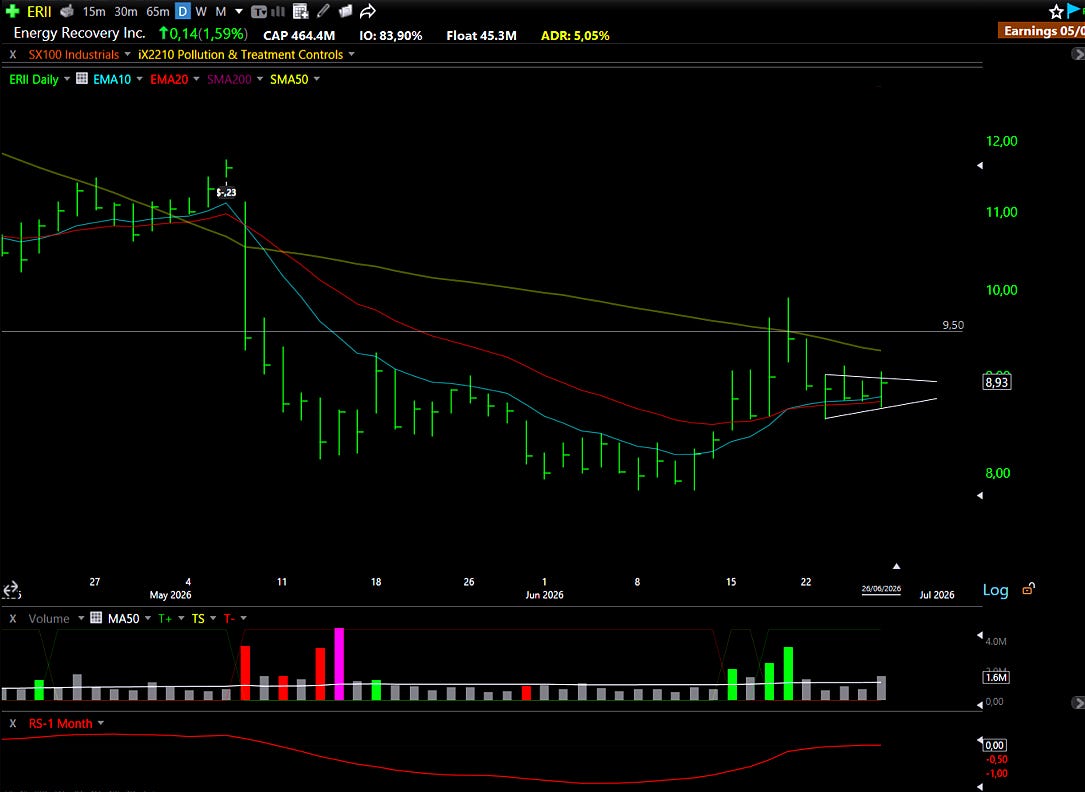
What they do: An industrial technology company whose core product dramatically reduces the energy cost of seawater desalination
Why watch? Energy Recovery has spent the past several months being repriced for the wrong reasons, which is exactly the kind of setup worth paying attention to.
The product at the center of the business earns its place in the water infrastructure stack by solving a fundamental physics problem. Seawater reverse osmosis works by forcing seawater through semi-permeable membranes under extremely high pressure, separating the salt from the water. The concentrated brine discharged from that process still carries most of the pressure energy that was used to push the seawater through. In traditional systems, that energy is simply wasted. The PX Pressure Exchanger captures it and transfers it directly back into the incoming seawater stream before it enters the high-pressure pumps, cutting the plant’s total energy consumption by up to 60%. That is not a marginal efficiency improvement. In many geographies, it is the difference between desalination being economically viable at scale and being prohibitively expensive. The product commands gross margins above 60%, accounts for over 90% of revenue, and has no meaningful competition in its specific niche. The business has the economics of a high-margin IP licensing operation despite being classified and priced as an industrial manufacturer.
The stock has fallen approximately 50% from its February highs, and the reasons are specific and largely temporary. The Middle East represents roughly half of the company’s revenue, and that concentration became acutely problematic when the Iran conflict disrupted project timelines and forced management to remove full-year guidance entirely. Two consecutive earnings reports that disappointed against already-reduced expectations, combined with CEO and CFO departures in close succession, compressed the valuation multiple aggressively. The market sold the uncertainty, not the business.
What the selloff missed is that the underlying demand drivers are not just intact but growing. Q1, historically the company’s weakest seasonal quarter, still grew 20% year over year. The net loss reported for that quarter came from a one-time charge related to terminating the CO2 refrigeration side project, a capital allocation decision to stop pursuing a product line that was consuming resources without producing returns. Strip that charge out, and the core business performed as expected. Q4 2025 was a record quarter at $66.9 million in revenue with a 67% gross margin. The balance sheet is a genuine fortress: $77 million in net cash, a 9x current ratio, minimal debt, approximately $27 million in trailing free cash flow, and a buyback program running at roughly a 9% yield on the current share price. The company is paying you to wait.
Four structural vectors make the current price genuinely interesting beyond the Middle East situation normalizing. Global water scarcity is intensifying as rivers and aquifers decline while population growth, industrialization, and AI infrastructure all pull harder on a shrinking supply, with desalination as the primary engineered backstop. The conflict itself demonstrated that water infrastructure is a strategic military asset, and the Gulf states that had plants damaged are now under direct pressure to harden, decentralize, and build more capacity rather than less, which means more PX sales into exactly the region where the stock has been punished. The Gulf AI data center build-out, which PwC projects will triple to roughly 3.3 gigawatts of compute capacity by 2030, requires enormous cooling water volumes in a region where up to 90% of fresh water comes from desalination, making Energy Recovery’s product the constraint on where that compute can actually be deployed. Management is not telling that story yet, but it is there. And the industrial wastewater segment, which the company has carved out as its own reporting unit at roughly 6% of current revenue, addresses the other end of the AI water story: semiconductor fabs and data centers discharge process water that requires treatment before release, using the same pressure exchange technology at the same margin profile.
Against peers in the water technology sector, Xylem, Badger Meter, and Franklin Electric all trade at 28 to 31 times trailing earnings. Energy Recovery trades at roughly 24 times, with the highest gross margin in the peer group and the smallest market cap. The gap is almost entirely explained by the Middle East concentration and the leadership transition, neither of which changes the fundamental quality of the product or the demand environment it operates in.
Technical Outlook: The stock is near multi-year lows and sitting in a well-defined technical demand zone. The asymmetry here comes from the balance sheet: with $77 million in net cash and strong free cash flow, the company is not at risk in any scenario that involves normal operations, which removes the tail risk that typically makes deep drawdowns dangerous in small caps. The setup is one where the downside catalyst is already fully reflected in the price, and any normalization of the Middle East situation or announcement of new leadership becomes the repricing trigger.
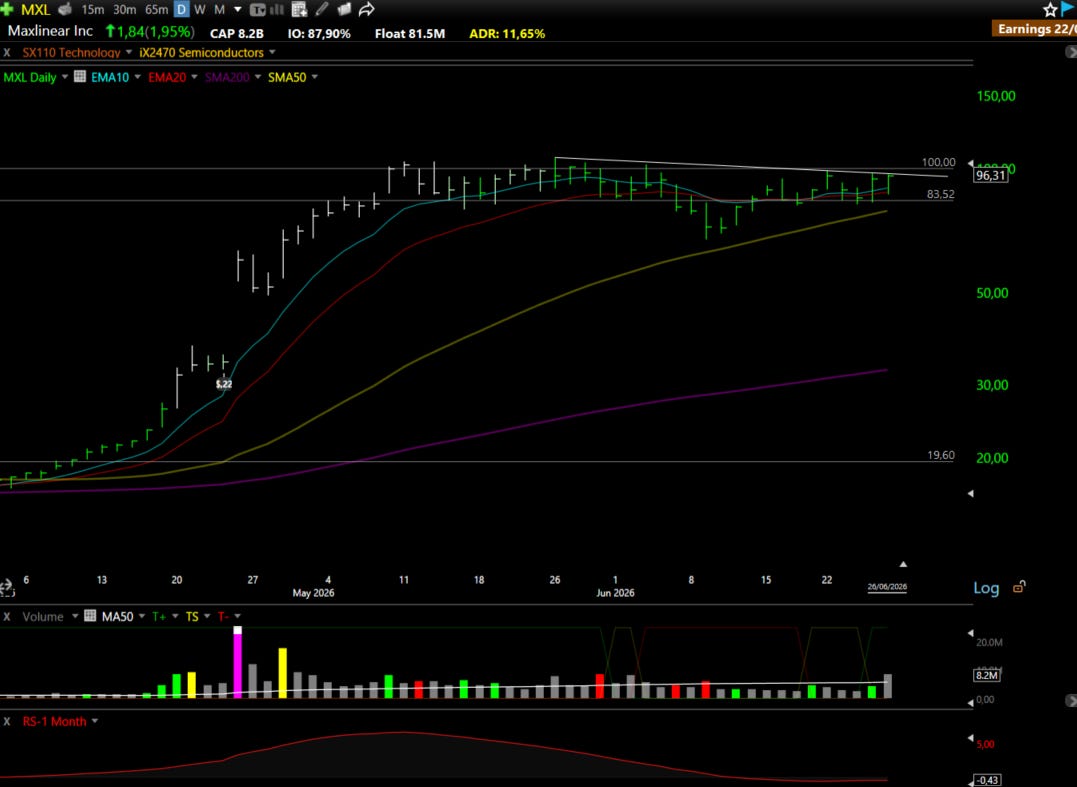
MXL: MaxLinear Inc ⚠️
What they do: A semiconductor company designing high-speed connectivity
Why watch? MaxLinear was built around fiber-optic communications, cable access, and wireless connectivity markets. Those are cyclical by nature, tied to carrier capital expenditure cycles and consumer upgrade patterns, which made MaxLinear an unexciting and volatile name to own. Revenue followed carrier spending, and carrier spending followed the economy. That was the old version of the company. The Q1 2026 numbers made the new version impossible to ignore.
Revenue grew 43% year over year to $137 million. More telling than the headline was the composition underneath it. Infrastructure revenue, covering the data center connectivity products, grew 136% year over year and crossed over to become the company’s single largest revenue category in a single quarter. That is not a gradual mix shift playing out across multiple years. That is a business changing its fundamental identity, with the income statement confirming it in real time.
To understand why the data center exposure matters as much as it does, it helps to think about what an AI compute cluster actually requires beyond the GPUs that capture most of the attention and headlines. Every rack of AI accelerators needs high-speed optical links to move data between chips across the network fabric, copper interconnects for scale-up traffic within the rack itself, fast storage pathways to keep the compute continuously fed, and efficient control-plane connectivity to manage the whole system. MaxLinear designs chips that sit at each of those bottlenecks: 1.6T optical interconnects, copper retimers for scale-up architecture, storage accelerators, and hyperscale PON designs. The company is not adjacent to the AI infrastructure buildout. It is embedded in the layer that makes the whole thing function.
Management guided Q2 revenue to a midpoint of $165 million, a 52% year-over-year increase, and raised the full-year optical data center revenue outlook to between $150 and $170 million on the back of stronger customer orders and better forward visibility into production ramps at hyperscale customers. Before April, the market could still argue this was a small semiconductor company with legacy broadband exposure enjoying some cyclical tailwinds. After the Q1 report, the market had to start valuing it as an AI connectivity company with real production ramps running at scale. The multiple has not fully caught up to that reframe yet.
The float is not large, which cuts both ways. When this name moves, it moves fast, and it does not give second chances on entries.
Technical Outlook: The stock made a 30% move off its lows before being rejected by the 50-day moving average, which represents meaningful overhead resistance at these levels. It has since pulled back and reclaimed both the 10 and 20-day EMAs. The $9.00 to $9.10 range on the daily chart is the resistance level that matters most. Two or three more sessions of tight consolidation above the moving averages, with the 10-day EMA continuing to act as a floor, would be the ideal condition before a push through that level. We attempted an entry on this name previously and were stopped out too early. The setup is developing into something cleaner now, and the small float means the move, when it comes, will not be gradual.
These tickers below didn’t make the main cut, but they’re on our radar for a reason. We’ve vetted them; now you decide if they fit your game.
More opportunities, less noise.
⚡📋Scanned Stocks: Quick Picks
GNTA - Genenta Science SPA
KMX - Carmax Inc
ENPH - Enphase Energy Inc
NUCL - Eagle Nuclear Energy Corp
SABR - Sabre Corp
"The trick of successful investors is to sell when they want to, not when they have to."
Seth Klarman
Disclaimer: This analysis is for informational purposes only and should not be considered financial advice. Always conduct your research and consult with a licensed financial advisor before making investment decisions.
Questo pezzo era gratuito. Il prossimo arriva domenica.This piece was free. The next one lands on Sunday.
Dieci nomi con i livelli, la lettura del mercato, la chat con le posizioni in diretta. Con l'abbonamento leggi tutto; senza, ricevi la parte gratuita via email.Ten names with their levels, the market read, the chat with live positions. Subscribers read everything; free readers get the free part by email.