
Hut 8 (HUT), AI data centers and swing-trade stops | Radar 90
Volume 90
The Stop That Aged in Six Days
Some weeks you trade the market. This week, the market traded us.
Four sessions, no Friday, Juneteenth closing the books early. The tape never sat still long enough to build anything on. Monday opened with a rip: a US-Iran peace framework crossed the wires, the Strait of Hormuz reopened, oil tumbled, and the Nasdaq ran more than two percent before most people finished their coffee. By Tuesday, the enthusiasm was already thinning. Then, Wednesday handed everyone the bill.
Kevin Warsh ran his first meeting as Fed chair, and instead of the dovish tone the room was leaning toward, the committee held rates but flagged that it was ready to hike later this year.
Stocks hated it. The Nasdaq and S&P sold off hard into the close. Thursday clawed a good chunk of it back, small caps leading, chips ripping, but the message was already clear. This was a week to keep your hands still, not to play hero.
We came in with two positions. We leave with one.
The size is still respectable, but it’s a single name now, and we’re fine with that. In a tape swinging on peace deals and Fed dot plots, forcing a second position just to feel busy is how you hand back a year of careful work in one bad afternoon. We’d rather be patient and a little bored.
Which brings us to the part we want to be honest about.
Our edge over the Nasdaq this year has narrowed, and we feel it. The last stretch has rewarded aggression, and our read of this market has been cautious. Sometimes too cautious. In a few of those moments, we had no better option.

Want the perfect example?
We have been in Bloom Energy (BE) since April.
Clean trend, good thesis, no complaints. When BE lost its 20 EMA, we did exactly what the rules say and closed it with profit locked in. Textbook. Then it lost the 50 SMA too, and for about a day, we felt like geniuses.
Six sessions later, it printed a fresh all-time high.

That’s the whole picture, right there. A market that takes your most disciplined decision and makes it look timid. There’s no clever fix. You either abandon the risk profile that’s kept you alive for years, or you accept that in a momentum tape like this one, doing the right thing sometimes looks like leaving money on the table. We’ll keep doing the right thing.
Now the good news- and there’s real good news.
This was our strongest research week in a while. The watchlist going out is genuinely fresh, not the same ten or twelve names every account on the timeline is recycling. We spent time in corners most people aren’t looking at yet, and a few of these setups have us properly interested.
We also finished something bigger.
Next week, we will publish good research on a trend we think will matter over the next few years, featuring names that actually have exposure to it. The only hint you get: it’s about chips, and it has nothing to do with the AI trade everyone’s already crowded into.
Choppy week behind us. A far more interesting one ahead.
Here’s a look at this week’s market health, with a breakdown of index and sector performance.



We’re currently building the beta version of our app, and it’s already live.
It is not a generic solution for every market participant, but a platform built specifically for swing trading, momentum strategies, and short to medium-term investing.
You can already sign up, access the beta, and start using it today.
As previously stated, all paid subscribers will receive full access to the platform at no additional cost.

Latest articles:
Each stock carries a risk badge: ⚠️ High | 📊 Medium | 🛡️ Low.
Based on volatility, float, technicals, and fundamentals. Size your positions accordingly.
📈 Free Setup: Make It Count
HUT: Hut 8 Corp ⚠️
What they do: An energy infrastructure platform
Why watch? The narrative around Hut 8 changed completely earlier this year, and the market is still in the process of catching up with what the company has actually built.
The model is deceptively simple. Instead of raising capital to build a data center and then hoping to find a tenant, Hut 8 secures large-scale power capacity first, before committing to any specific use case. Power, not land and not buildings, is the genuine bottleneck in AI infrastructure. By starting there, the company can develop sites with real flexibility baked in: if an AI tenant is not immediately available, the capacity generates revenue through Bitcoin mining in the interim, eliminating the speculative risk that plagues most development-stage infrastructure plays.
The model has now been proven at scale across two campuses within roughly five months. Beacon Point in Nueces County, Texas, delivered a 15-year, 352 MW IT lease with a base-term contract value of $9.8 billion, rising to $25.1 billion if all renewal options are exercised. The tenant is described as a high-investment-grade company deploying dedicated compute for AI training and inference at hyperscale. River Bend in Louisiana follows the same triple-net, take-or-pay structure with Fluidstack, which carries a financial backstop from Google covering all lease obligations. Together, the two campuses bring total contracted AI capacity to 597 MW with an aggregate base-term contract value of approximately $16.8 billion and an expected average annual NOI of approximately $1.1 billion once stabilized.
Triple-net and take-or-pay are terms worth understanding here. Triple-net means the tenant covers operating costs on top of rent, so nearly all lease revenue converts directly into cash flow for Hut 8. Take-or-pay means the tenant is contractually obligated to pay whether they use the capacity or not. Combined, these structures are some of the strongest contractual protections available in commercial real estate.
The near-term financial picture is messier. Q1 2026 revenue came in at $71 million versus $21.8 million in the prior year, but the net loss widened to $253.1 million, almost entirely explained by $295.7 million in primarily unrealized losses on digital asset holdings. The underlying cash generation story and the contracted revenue base are real. The headline losses are real too, driven largely by Bitcoin price movements rather than operational deterioration.
The valuation reflects a lot of anticipated future growth already. The stock is not cheap relative to current earnings. What the market is pricing is the conversion of the development pipeline into contracted cash flows, and that conversion has been executing faster than most expected.
Technical Outlook: The stock has returned over 200%% year to date, and the chart reflects it. Since April, the 10 and 20-day EMAs have been tracking closely underneath price, with the stock surfing the moving averages rather than breaking away from them. That kind of tight relationship between price and the short-term EMAs during a sustained advance signals institutional accumulation rather than speculative chasing. The theme around AI data centers, energy infrastructure, and neoclouds has been one of the most consistent sources of leadership in the current market cycle, and as long as that rotation continues, names like Hut 8 tend to attract incremental capital.



Why We Don’t Wait for Sunday
Markets don’t move on your schedule. The best low-risk entries don’t announce themselves politely and wait for the weekend newsletter.
They show up when they show up. And if you’re not positioned, you miss them.
Paid members get real-time alerts: exact entries, stops, position sizing, and the thesis behind every trade. The same information we use to manage our own capital.
Free members get just one pick on Sunday.
Does that sound like an edge to you?
What’s Inside Premium
Free Access to TradeDeck
Premium members get early access to TradeDeck, the trading platform we’re building. The value of the platform alone already exceeds the cost of the subscription.
Watchlist Elite (5-7 Stocks)
Each selection undergoes rigorous financial analysis, technical evaluation, and strategic assessment.
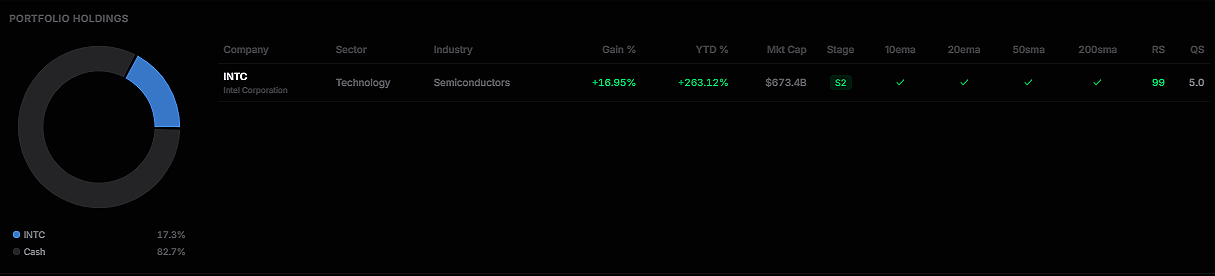
Full Portfolio Transparency
Every position we hold. Entry price. Current P&L. Stop level. Real money, real risk.
Real-Time Trade Alerts (Chat Access)
This is where the edge lives. Exact entries, stops, and position sizing. Real-time. No lag
Quick Picks (5 Names)
Additional setups that just missed our main criteria but are worth watching.
Chat Access
See our thought process in real time. Ask questions. Watch how we manage risk.
The Tools We Actually Use
Member discounts on TC2000, Fiscal.ai, and other platforms. Same tools, better pricing.
What Paid Members Say:
We’re entrepreneurs first, traders second. We’ve sat in the CEO chair. We know what real execution looks like and how to spot it.
€39/month or 299€/year. Less than one losing trade. Cancel anytime.
Portfolio updates and new positions:

💎📈 Watchlist Elite: Premium Market Movers
KEEL: Keel Infrastructure Corp ⚠️
What they do: A North American digital and energy infrastructure developer
Why watch? The setup here is similar to Hut 8 in structure but meaningfully earlier in the execution cycle, which is both the risk and the reason the potential upside is larger.
When you name a company Keel, you’re committing to be foundational, to be the base that everything else depends on. That framing from the CEO is more than marketing. The company spent the past two years dismantling its Bitcoin mining identity (previously Bitfarms) entirely: exiting Latin American operations, redomiciling to the United States, building an infrastructure finance team led by veterans from Lazard and Bank of America, and focusing the development pipeline on what management describes as some of the highest-demand, most supply-constrained HPC and AI markets in North America.
The asset is the power. Keel controls a 2.2 gigawatt development pipeline across Washington state, Pennsylvania, and Quebec, with grid interconnections already in place. The three near-term sites in Washington are Panther Creek at 350 MW, Sharon at 110 MW, and Moses Lake at 18 MW. AI data center colocation currently runs roughly $150 to $200 per kilowatt per month at market rates. Panther Creek and Sharon alone represent close to 460 MW of near-term capacity. Leased at those rates, that is somewhere between $830 million and $1.1 billion in annual recurring revenue.
The math on the full pipeline is harder to ignore. CEO Ben Gagnon has told the market the 2026 priority is unambiguous: sign three leases by year-end, one at Panther Creek, one at Sharon, and one at Moses Lake. Each signed lease converts speculative development into contracted cash flow and re-rates the value of the entire pipeline behind it. Data center operators with contracted hyperscaler revenue tend to trade at six to seven times sales. Apply a conservative multiple to 2.2 gigawatts fully leased, and the numbers become significant.
Liquidity stands at $533 million, which the CFO has stated is sufficient to fund development through lease execution at all three near-term sites and cover G&A through 2028. Q1 revenue came in at $37 million, down 23% year over year, with a net loss of $145 million, reflecting the wind-down of Bitcoin mining and the cost base of building an infrastructure development organization. The losses are structural to the transition and expected.
The risk is timing. Keel does not need to invent a product. It does not need to win a technology race. It needs to sign leases. Every month those leases are delayed is another month of cash burn against a balance sheet that is well funded but not infinite.
Technical Outlook: Both KEEL and HUT are in the same sector, and the chart pattern reflects this. KEEL has been surfing the 20-day EMA since April, building a larger and longer base than HUT in the process. A bigger base typically produces a more powerful breakout when it resolves. On the weekly chart, $6.60 is a key level from October 2025, and $6.35 is the immediate daily resistance. Those $0.25 between the two levels represent concentrated selling pressure that buyers need to absorb and clear with conviction before the next leg develops.
NTAP: NetApp Inc 📊
What they do: A data management and storage infrastructure company
Why watch? In a sector dominated by high-beta names promising future revenue, NetApp is doing something different. It is actually delivering it.
The company has executed a credible transition from legacy storage hardware to what it now describes as an intelligent data infrastructure platform. The fiscal year 2026 results confirm that this repositioning has moved from narrative to numbers. Revenue grew from $1.6 billion in Q1 to $1.9 billion in Q4, an 18.8% increase, with gross margins holding stable at 70.1%, record EPS of $2.03, operating cash flow of $950 million, and free cash flow of $900 million. These are not the results of a company caught in a slow-growth commodity storage cycle. They are the results of a business that moved up the value stack and is now capturing demand across multiple vectors simultaneously.
The operational core is the all-flash storage portfolio. Enterprises replacing traditional spinning disk infrastructure with flash are doing so at the scale that multi-year AI infrastructure investment cycles demand, and NetApp’s competitive positioning in that transition has driven both the volume growth and the pricing power visible in the results. On top of that, first-party public cloud services add a recurring revenue layer that improves forward visibility and supports a platform narrative with an actual contract structure behind it.
AI is the growth vector the market is paying attention to, and it deserves both optimism and appropriate caution. The demand signal is real: enterprise customers are actively investing in data infrastructure to support AI workloads, and NetApp sits at the junction of where that data lives and where it needs to go to feed AI systems. Management’s technical depth in hybrid cloud and enterprise AI is a genuine competitive asset. The outstanding question is whether a single strong fiscal year is sufficient to underwrite the valuation the market is assigning to that story. More proof points are needed.
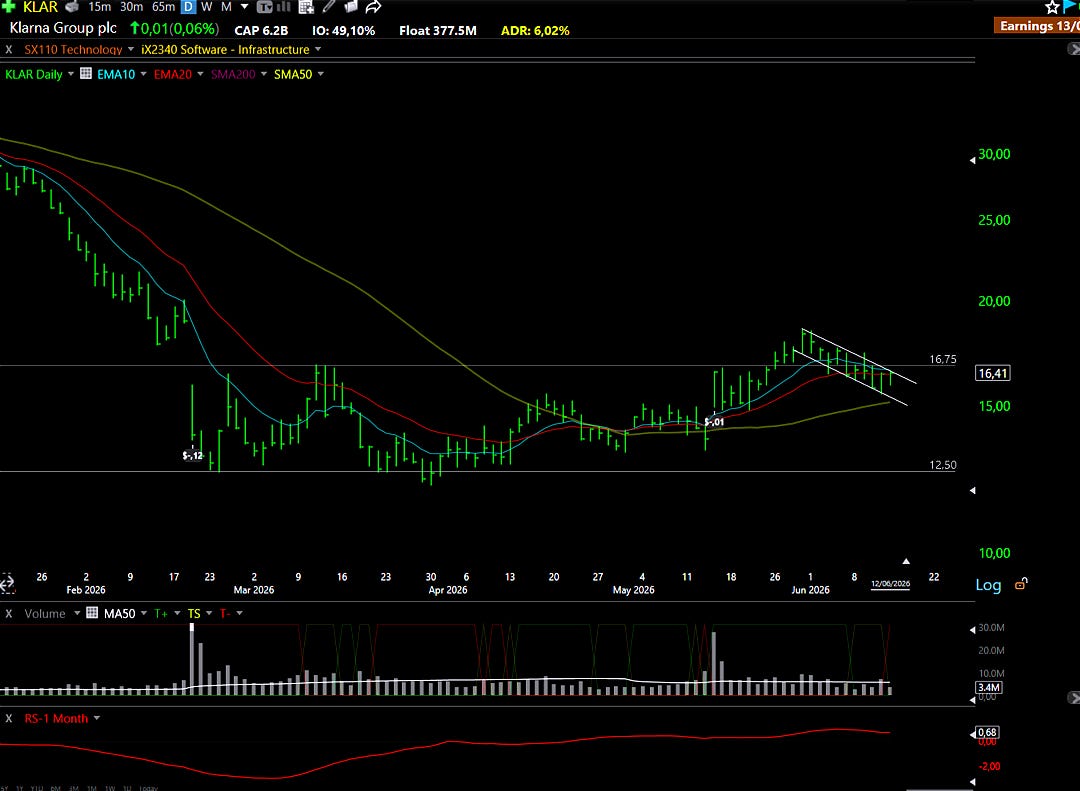
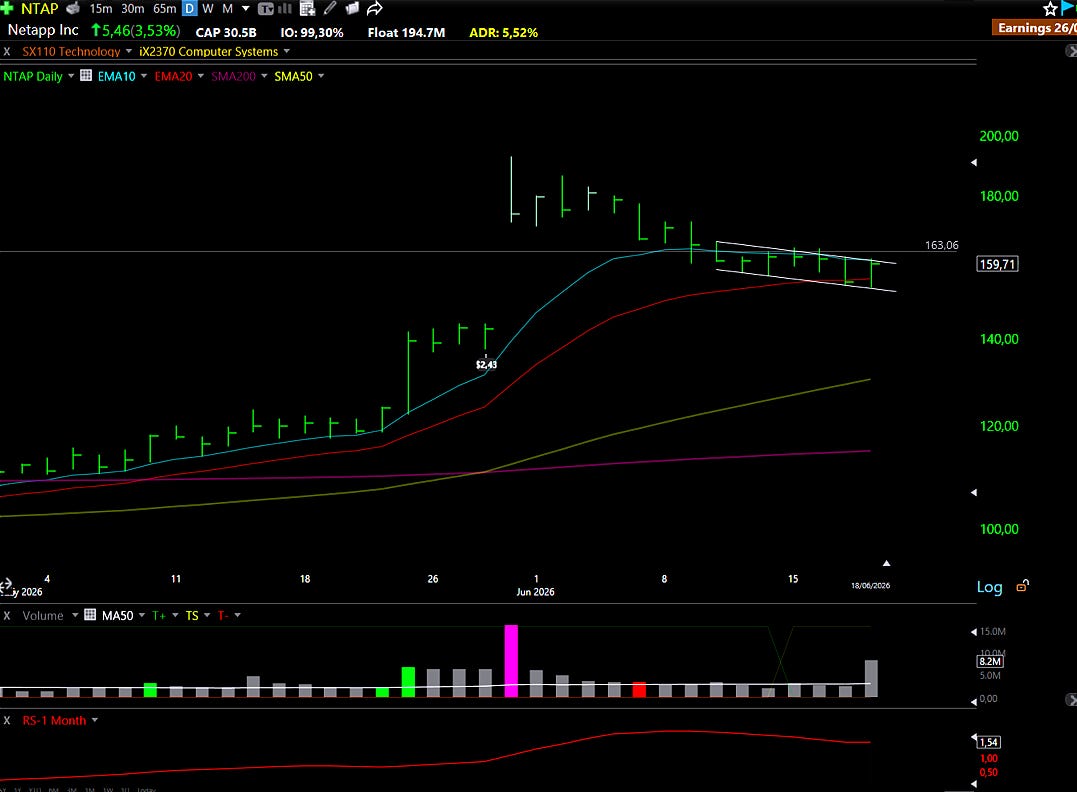
Technical Outlook: After what was clearly an overextended post-earnings surge, the stock pulled back nearly 20% and found its footing precisely on the rising 20-day EMA, which is where you want to see support arrive in a healthy trend. Friday printed a hammer candlestick on above-average volume directly at that level. A hammer is a single-session reversal pattern: the stock opens, sells sharply through the session, and then recovers to close near the highs of the day, leaving a long lower wick as evidence that buyers absorbed the selling pressure and pushed back. The low of that candle is the line in the sand for the bull thesis. A couple of additional tight sessions around the 20-day EMA would tighten the risk profile further before the stock chooses direction.
LWLG: Lightwave Logic Inc ⚠️
What they do: A materials technology company
Why watch? This one requires some technical context to understand why it matters, because the business model is not intuitive at first glance.
Every AI data center is essentially a problem of moving enormous volumes of data between chips, between servers, and between buildings at speeds that conventional electronics cannot sustain without consuming power that nobody can afford to waste. The piece of hardware that converts electrical signals into optical signals — and back again — is called a modulator. How fast it switches, and how much energy it burns doing so, are the two numbers that matter most. Silicon photonics, the dominant technology today, is approaching its physical limits at the data rates hyperscalers are now demanding. Lightwave Logic uses proprietary organic polymers instead of silicon to build modulators that move data faster while drawing less power per bit.
The commercial model is asset-light by design. The company supplies the polymer material to production foundries, licenses the intellectual property and reference designs so that customers can integrate polymer-enabled modulators into their own chip designs, and collects royalties tied to production volumes. If foundries adopt the platform broadly, the economies of scale without Lightwave owning a single factory.
The foundry partnerships being built right now are the milestones that matter most. In March, Lightwave Logic signed a development agreement with Tower Semiconductor to integrate its electro-optic polymer modulator designs into Tower’s PH18 silicon photonics process, targeting modulators with 110GHz-plus bandwidth for 200G and 400G per-lane applications. GlobalFoundries followed with an integration of Lightwave Logic’s platform into its GDSFactory PDK, enabling chip designers to incorporate polymer modulators directly into their photonic integrated circuit designs for tape-out on GF’s 300mm silicon photonics process, with validation tape-outs targeting 200G and 400G per lane.
A fourth Fortune Global 500 company has advanced to Stage 3 of the company’s design win cycle, which is the prototype-to-product stage where a customer is actively developing devices for eventual production. The competing approaches in lithium niobate and silicon photonics exist, but nobody has commercialized a polymer-based modulator at production scale yet. If Lightwave Logic’s technology qualifies first at a hyperscaler-adjacent customer, the requalification cycle for optical interconnect suppliers is slow and painful enough that multi-year exclusivity tends to follow.
Revenue is still in the low single-digit millions. This is a development-stage story trading on a roadmap and a technology platform, not a P&L. The honest read is that first meaningful production-volume revenue is targeted for 2027 per management guidance, and the path to get there runs through the foundry partnerships and customer prototype completions happening in the second half of 2026.
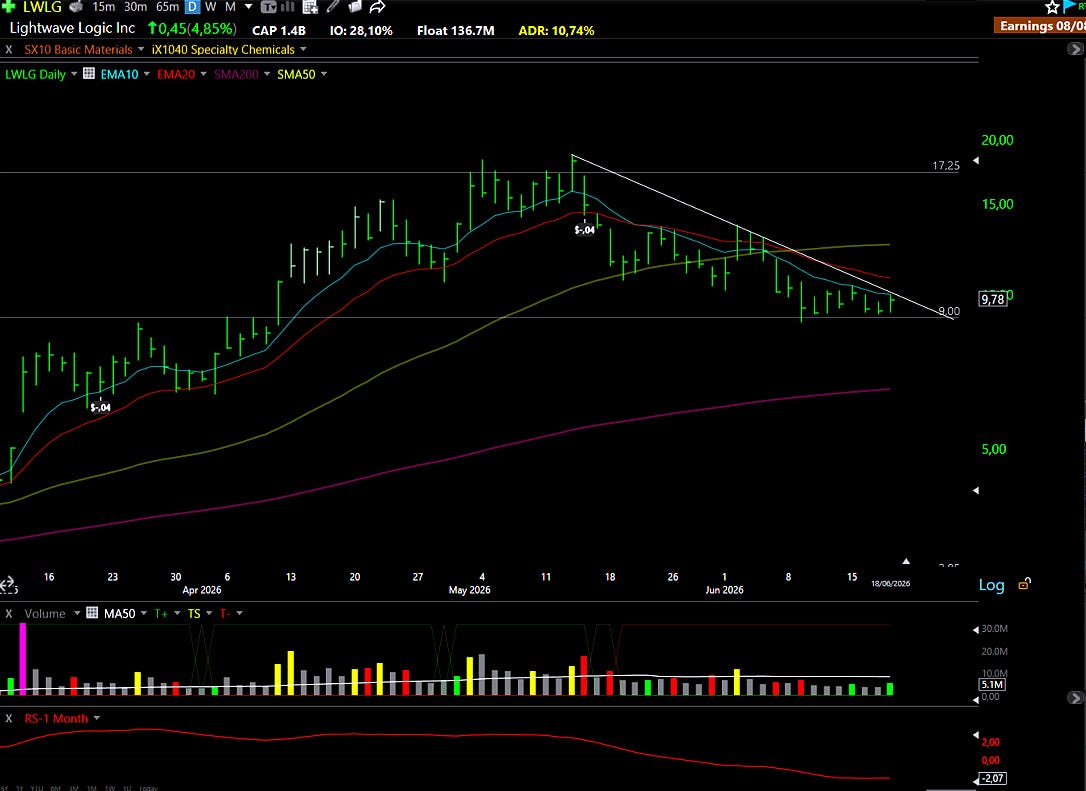
Technical Outlook: The stock lost nearly half its value in under two months after an aggressive run that left it significantly overextended. The correction was proportional to the excess, not to any change in the underlying technology story. Price is below all key moving averages, which is not the typical setup we look for, but the $9 level on the monthly chart is a major structural support that has absorbed selling twice in recent history. That floor needs to hold. A clean break of $10 on meaningful volume would clear the descending trendline on the daily chart and open the path toward a new uptrend. We were researching this company in the $3s and missed the move. We are not going to miss it again if the chart gives us the signal.
MNTS: Momentus Inc ⚠️
What they do: A small-cap space infrastructure company
Why watch? This is a tactical trade on a theme, not a long-term thesis on the company.
Momentus sells access to space. Its Vigoride platform is best described as a service vehicle in orbit: customers who need to test a payload, run a mission, or move a satellite to a specific orbit can use Vigoride instead of building a dedicated satellite from scratch. The addressable market includes government agencies, defense research labs, universities, and early-stage space companies that need orbital access without the overhead of full spacecraft development. Q1 2026 revenue came in at $3.2 million, up from $0.3 million in Q1 2025, with gross profits of $1.8 million. Growth of that magnitude from a near-zero base is genuinely meaningful, even accounting for the low absolute numbers.
The setup here is almost entirely about what happened to the broader space sector after the SpaceX IPO. The listing of SPCX pulled enormous amounts of capital into everything space-adjacent and then, as the initial frenzy settled, triggered an equally aggressive selloff across the group. Names ranging from established companies to highly speculative plays dropped anywhere from 30% to 65% in a matter of weeks. Momentus was caught in that correction regardless of its own results.
The argument for a position is straightforward: the space theme has not stopped being real simply because the IPO created a short-term distortion. If the sector finds its footing next week and capital starts flowing back in, the most volatile names tend to recover the hardest. Momentus, with its high average daily range, fits that profile. The safer way to play the same theme is through Rocket Lab (RKLB), which is a substantially more established business with real recurring revenue. We are watching MNTS specifically because the ADR creates the possibility of a sharp move in a short window.
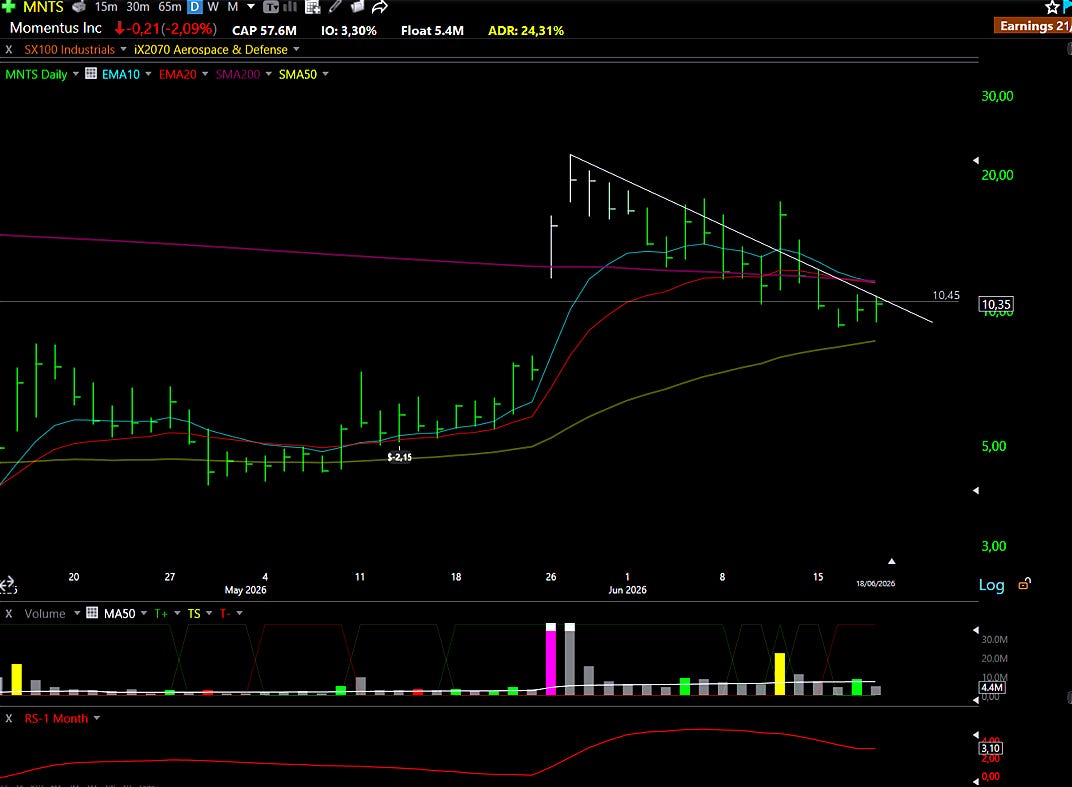
Technical Outlook: The daily chart shows a clear descending trendline that has capped every rally attempt during the selloff. Two consecutive inside days on Thursday and Friday (sessions where price stayed entirely within the range of the prior day) signal that selling pressure has compressed the stock into a coil. If the price can exit that range to the upside with volume and the space theme recovers, the move can be fast and significant. This is a short-duration tactical setup, not a position to build a conviction narrative around.
IPWR: Ideal Power Inc ⚠️
What they do: A semiconductor company
Why watch? To understand why this company matters, you need to understand what is happening to the physical infrastructure of AI data centers right now, because the problem Ideal Power is trying to solve did not exist at scale a couple of years ago.
AI racks used to draw somewhere between 10 and 50 kilowatts of power. NVIDIA’s Rubin Ultra generation is pushing toward 600 kilowatts per rack, with the roadmap pointing at one megawatt by 2030. At that density, the traditional 400V AC power delivery architecture that has run data centers for decades breaks down entirely. Too much current means too much copper, too much heat, and too many losses in the wiring itself. The industry’s answer is to convert everything to 800V DC power distribution, which cuts current requirements dramatically and makes the physics work again at the power levels the new GPU generations demand.
800V DC solves one problem but creates another. Alternating current, which is what comes out of the wall, naturally crosses zero 50 or 60 times per second, which gives mechanical circuit breakers a clean moment to interrupt the current and extinguish any arc safely. Direct current has no such zero-crossing. When a fault hits in an 800V DC system, the arc is continuous, it is energetic, and a mechanical breaker reacts in tens of milliseconds — far too slowly. At 800V across a 120 kilowatt rack, that is not an equipment problem. It is a fire. So every 800V DC data center now needs solid-state circuit breakers that react in microseconds rather than milliseconds. NVIDIA’s own rack architecture lists them as required infrastructure.
This is the socket B-TRAN is designed to win. B-TRAN is a bidirectional semiconductor power switch protected by 103 issued patents. The key innovation is that where conventional power switches only allow current to flow in one direction, B-TRAN flows both ways through a single device, replacing what would otherwise require four separate conventional components. Fewer components mean less heat generated, less space consumed, and less energy wasted. In its target applications, B-TRAN wastes roughly a quarter of the energy a conventional setup does. For a solid-state circuit breaker, which spends nearly 100% of its operating life in the closed position waiting for a fault that may never come, efficiency during standby is the entire economic argument. The device that runs coolest wins the socket.
The commercial progress in 2026 has been the fastest the company has made since its founding. On May 14, Ideal Power signed a letter of intent with an industry partner to co-develop a B-TRAN-enabled solid-state circuit breaker prototype for evaluation by a US hyperscaler that is building on NVIDIA’s Rubin Ultra 800V architecture, with prototype delivery targeted for the end of Q4 2026. The lead Asia customer is simultaneously developing a low-current solid-state circuit breaker prototype for 800V AI data center and energy grid applications, also expected in Q4 2026, with two additional projects now initiated with that same customer covering medium-current breakers for data centers and energy storage. Stellantis’ deliverables for EV applications remain on track for completion by mid-2026.
The CEO, David Somo, spent eleven years at ON Semiconductor before joining Ideal Power specifically to convert laboratory milestones into production orders. That background matters because the gap between a functioning prototype and a repeating purchase order in power semiconductors is where most small companies get stuck. The qualification cycle for safety-critical components in data center infrastructure is slow and unforgiving, and navigating it requires the kind of customer relationships and process credibility that comes from years inside the industry rather than from a great patent estate alone.
The balance sheet is clean: $16.4 million in cash, no long-term debt, and a Q1 net loss of $3.6 million. At the current burn rate, the runway extends well beyond the Q4 2026 prototype deliveries that represent the next major commercial inflection point. Revenue today is effectively zero. The entire thesis rests on the prototype evaluation converting into a production order, and on that order establishing B-TRAN as the default protection standard for 800V AI data center infrastructure. If that transition happens, the addressable market scales automatically with every new hyperscale deployment. If it does not, this remains a technology company with excellent patents and no revenue.
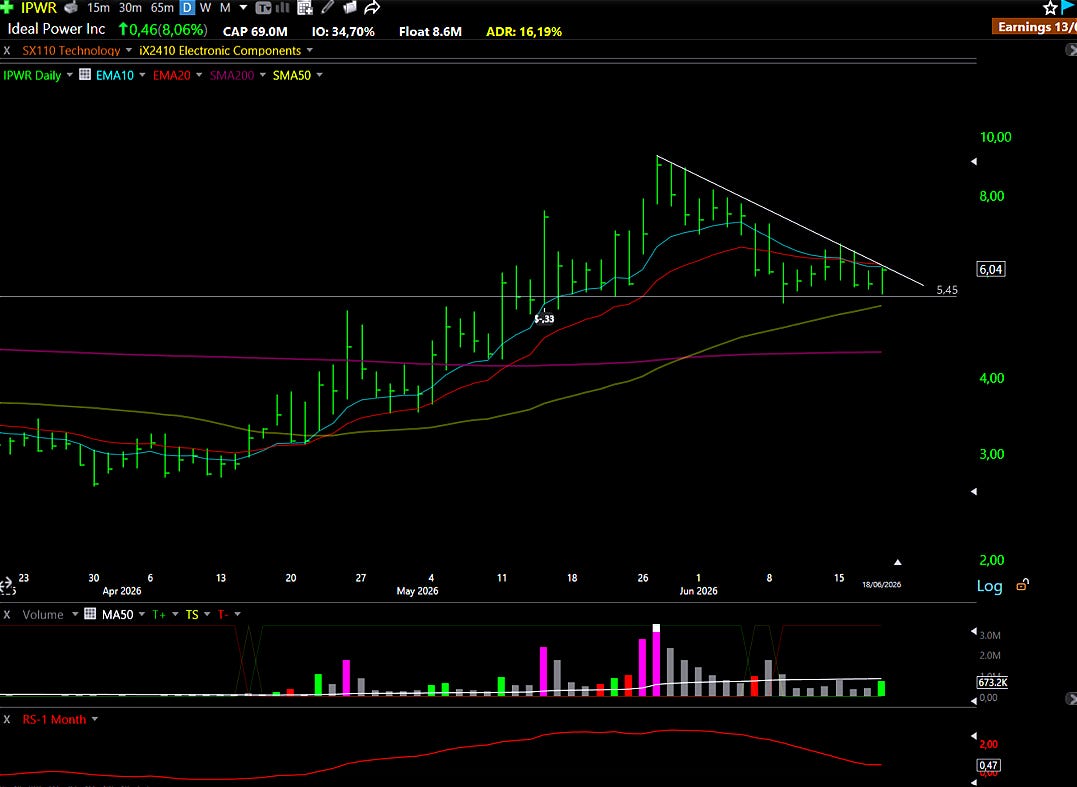
Technical Outlook: After running hard from the lows, the stock gave back roughly 40% before finding its footing. The $5.45 level is the key structural support, a zone that acted as resistance through February 2026 and has now flipped to support. That level was tested once two weeks ago and held, and tested again on Friday and held again. Two successful tests of the same support with diminishing selling pressure each time is constructive behavior. A clean break of the descending trendline on the daily chart with volume would be the trigger to watch: it would reclaim the 10 and 20-day EMAs and signal that the stock is ready to attempt a new leg of the uptrend. Until that break comes with convincing volume, the setup is building but not yet confirmed.
OCC: Optical Cable Corp ⚠️
What they do: A specialty manufacturer of fiber optic and copper data communication cables
Why watch? This is the kind of company that appears on nobody’s radar until the order backlog tells a different story.
Optical Cable Corporation was founded by engineers who trained under Charles Kao, the physicist who pioneered fiber optic communication and won the Nobel Prize in Physics for it. The company’s tight-buffered fiber optic cable technology was originally developed for military applications, which means the engineering DNA here runs deep. Today, that heritage shows up in niche product differentiation and manufacturing leverage that larger commodity cable producers cannot easily replicate.
The Q2 2026 earnings made the case that something structural is shifting in the order book. Revenue reached $22.2 million, up 26.6% year over year and 35% sequentially from Q1, with gross profit increasing 42.4% as manufacturing operating leverage kicked in. The order backlog grew 82% since Q4, reaching $13.3 million, and management explicitly cited data center demand as the primary driver. That backlog trajectory is not consistent with a company catching a one-quarter bump. It is consistent with a company entering an extended demand cycle.
The broader context supports the order velocity. Optical fiber cable has emerged as a critical bottleneck constraining AI data center deployments in 2026, with shortages expected to persist well into 2027. Global demand for fiber optics surged 76% year over year as hyperscale data centers consume five to ten times more fiber infrastructure than conventional deployments. OCC is a small, specialized manufacturer sitting directly in the path of that demand wave, with the kind of niche positioning and customer relationships that large procurement teams in a supply-constrained environment tend to reach for.
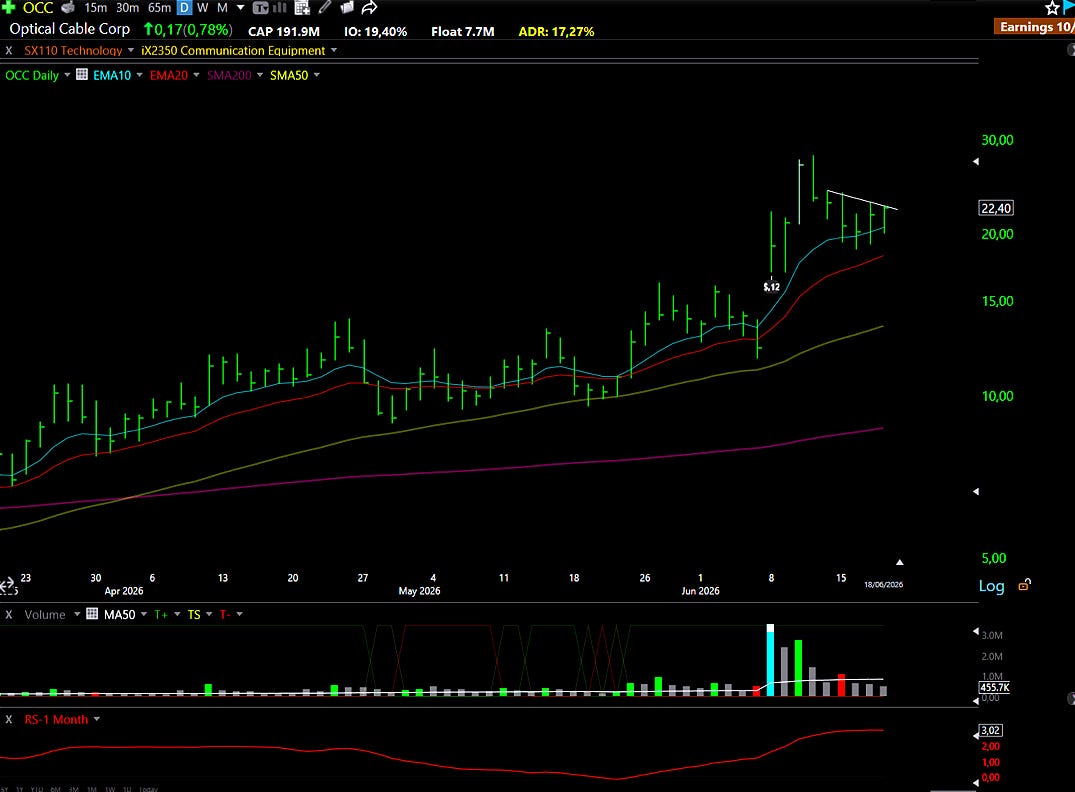
Technical Outlook: The stock printed more than a 100% move on the earnings report. Price is now in its first consolidation since that gap, having bounced once off the 10-day EMA and settled into a tight range. This is exactly the spot to consider an entry if you missed the initial move: the gap has been partially digested, the 10-day EMA is rising into price from below, and the first test of that moving average held cleanly. Another couple of sessions of tight consolidation would tighten the risk profile further. The entry level is well defined, the stop is clear, and the theme behind the company’s order book acceleration has not changed.
BBCP: Concrete Pumping Holdings Inc 📊
What they do: The largest concrete pumping service provider in the US
Why watch? The company nobody is watching just beat estimates by $10 million and turned positive on earnings per share. That combination in a sector the market has abandoned tends to get attention eventually.
Concrete pumping is exactly what it sounds like: specialized equipment that pumps concrete from a mixer truck to where it needs to go on a construction site, whether that is thirty feet up a residential foundation or across a large infrastructure project. The barrier to entry is equipment-intensive and operationally demanding, which is why Concrete Pumping Holdings has built a market leadership position across two countries without attracting the kind of competition that commoditized sectors typically generate.
Q2 2026 revenue came in at $106.8 million, above the $94 million reported a year earlier and $10.1 million above analyst consensus. EPS flipped from negative $0.01 to positive $0.04. Management pegs the core addressable market at approximately $1.85 billion. At current revenue levels, the company holds a meaningful share of that market, and the path to taking more of it runs through the same catalysts driving the rest of the construction-adjacent complex: residential activity recovering from rate pressure, infrastructure spending continuing its multi-year deployment, and data center construction creating demand for concrete work that did not exist at this scale two years ago.
The sector tells the story as clearly as the company’s own numbers. Everything related to housing, construction, and building materials has been showing signs of a cyclical bottom in recent weeks, with names across the group starting to find buyers after extended periods of rate-driven neglect. When a sector turns, the smaller companies with operational leverage tend to move more than the large caps that led the selloff.
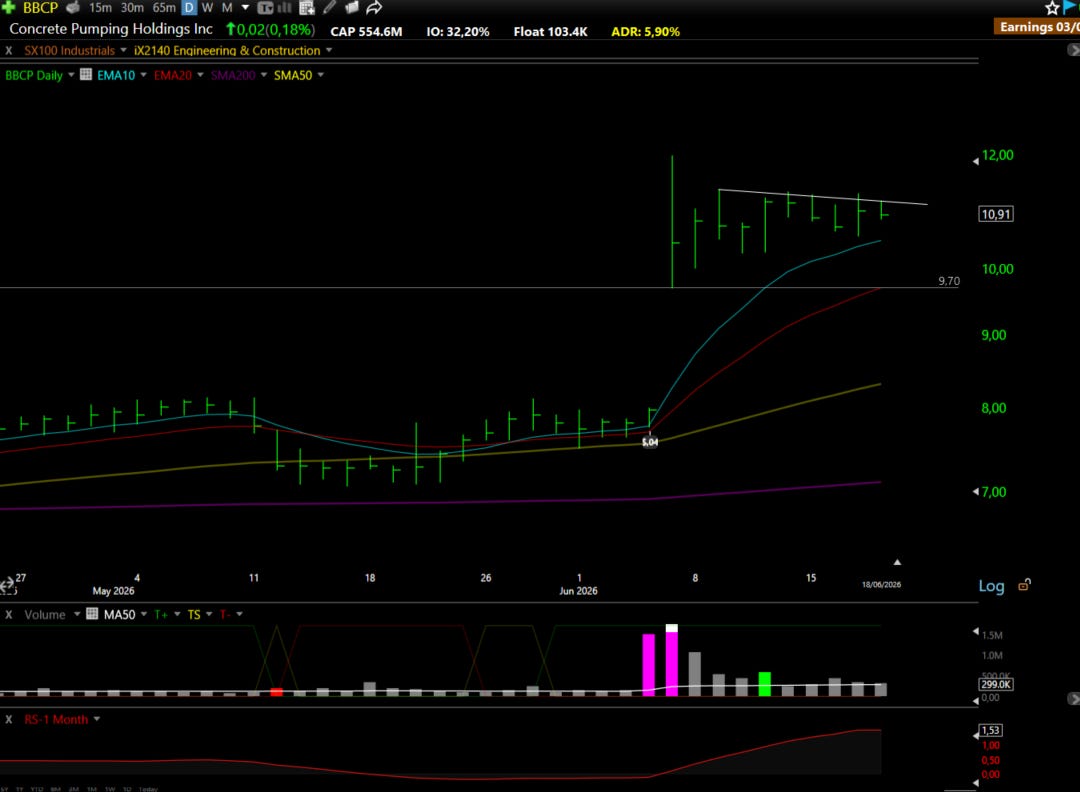
Technical Outlook: The stock made a 50% move on the earnings report and is now in its first consolidation after the gap. We are still early in the post-earnings digestion, and the ideal setup involves a first clean test of the 10-day EMA before committing to a full position. The broader sector setup adds conviction to individual stock setups here: when housing and construction stocks all find their footing at the same time, the sector rotation tends to carry individual names further than the fundamentals alone would justify in the near term. Patient entry on the pullback to the 10-day EMA would define the risk clearly and position for the next leg.
These tickers below didn’t make the main cut, but they’re on our radar for a reason. We’ve vetted them; now you decide if they fit your game.
More opportunities, less noise.
⚡📋Scanned Stocks: Quick Picks
SWMR - Swarmer Inc
SNOW - Snowflake Inc
ENPH - Enphase Energy Inc
SG - Sweetgreen Inc
INFQ - Infleqtion Inc
"Investment and speculation are said to be two different things, and the prudent man is advised to engage in the one and avoid the other. This is something like explaining to the troubled adolescent that Love and Passion are two different things."
Fred Schwed Jr.
Disclaimer: This analysis is for informational purposes only and should not be considered financial advice. Always conduct your research and consult with a licensed financial advisor before making investment decisions.
Questo pezzo era gratuito. Il prossimo arriva domenica.This piece was free. The next one lands on Sunday.
Dieci nomi con i livelli, la lettura del mercato, la chat con le posizioni in diretta. Con l'abbonamento leggi tutto; senza, ricevi la parte gratuita via email.Ten names with their levels, the market read, the chat with live positions. Subscribers read everything; free readers get the free part by email.