
Microfluidic cooling for AI chips and data centers | X-Ray 31
AI Doesn't Die From a Chip Shortage. It Dies From Heat.

Microfluidic Cooling: The Wall Everyone Will Hit.
The AI boom doesn’t die from a shortage of chips. It dies from heat.
Every new GPU generation runs hotter than the last. Every quarter, the market obsesses over silicon, power contracts, and data center square footage, and somehow keeps skipping the one physical constraint sitting underneath all of it. You can buy all the Blackwell and Rubin you want. If you can’t pull the heat off the die fast enough, the chip throttles, the rack underperforms, and the megawatts you paid for sit there cooking.
Cooling used to be an afterthought, the boring part of the bill of materials. It has now moved to the center of data center economics. And the most interesting fix on the horizon, the one Microsoft put a flag on last September, is microfluidics. Cooling that runs inside the chip.
This piece is for the retail investor who keeps seeing “microfluidic cooling” in headlines and wants to know what it is, how big the prize is, and whether there’s a way to actually own it.
We’ll keep the science plain.
Then we’ll put the lens on the two listed names worth watching, sitting at opposite ends of the same trade.
Fair warning up front. This is a fresh, high-risk theme with no clean way in yet.
That’s exactly why it’s worth understanding before the crowd does.
What This Technology Actually Is
Start with the problem in human terms.
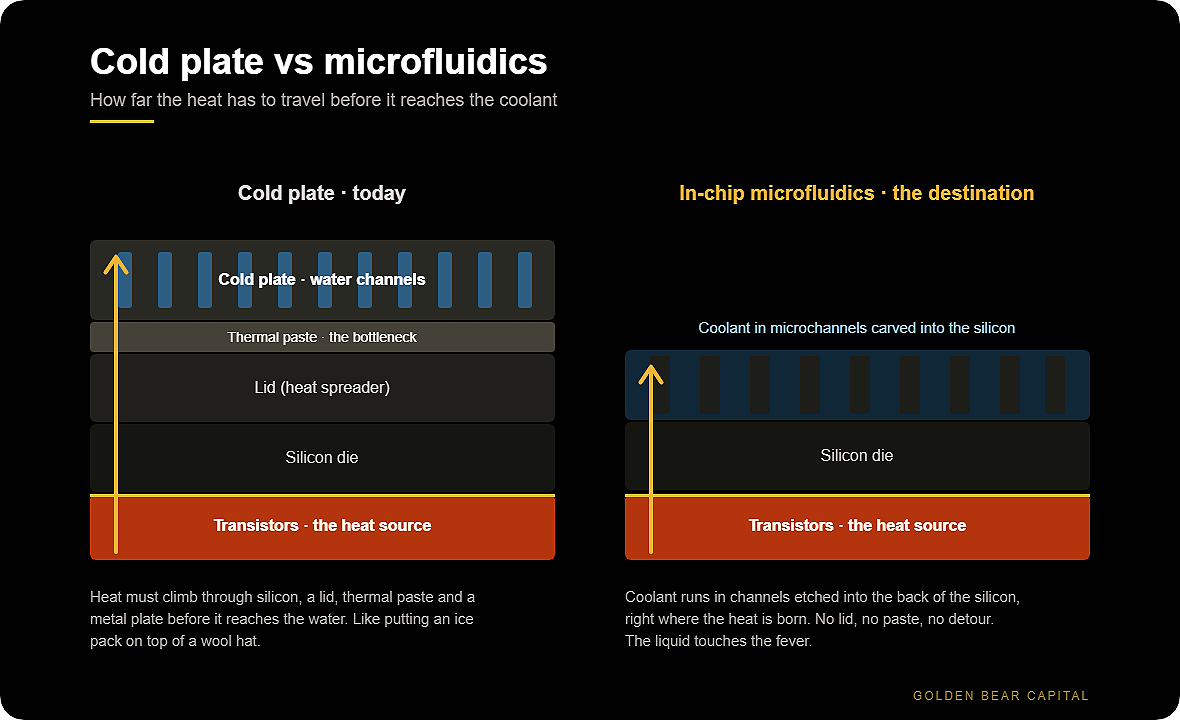
A modern AI chip is a tiny city that runs a fever. The transistors generate heat, and that heat has to get out, or the city melts. For years, the answer was air: fans blowing across metal fins. Then came the cold plate, which is the standard today. Think of a cold plate as a metal block with water channels that you bolt onto the top of the chip. The water carries the heat away.
Here’s the catch. The cold plate sits on the outside. Between the hot transistors and the cooling water, there are several layers: the silicon itself, a lid, and a layer of paste. Heat has to crawl up through all of that before it ever reaches the water. It’s like trying to cool a fever by putting an ice pack on top of a wool hat. It works, but you’re fighting the insulation the whole way.
Microfluidics throws out the hat. Instead of cooling from the outside, you carve microscopic canals directly into the back of the silicon and run coolant through them, right where the heat is generated. No lid in the way. No paste bottleneck. The liquid touches the fever.
The clever part is the shape of the canals. Microsoft, working with the Swiss startup Corintis, used AI to map the unique hot spots on a chip and then designed channels that branch like the veins in a leaf, steering more coolant to the hottest zones and less to the cool ones. The result, in their lab tests, was heat removal up to three times better than the best cold plates, and a peak silicon temperature drop of around 65 percent.
Against plain air cooling, the gap is even wider. In the Microsoft test, microfluidics cut chip temperatures by more than 80 percent. A cooler chip runs faster, fails less, and lets the operator raise the coolant temperature itself, which slashes the energy wasted on chillers and the water burned in cooling towers.
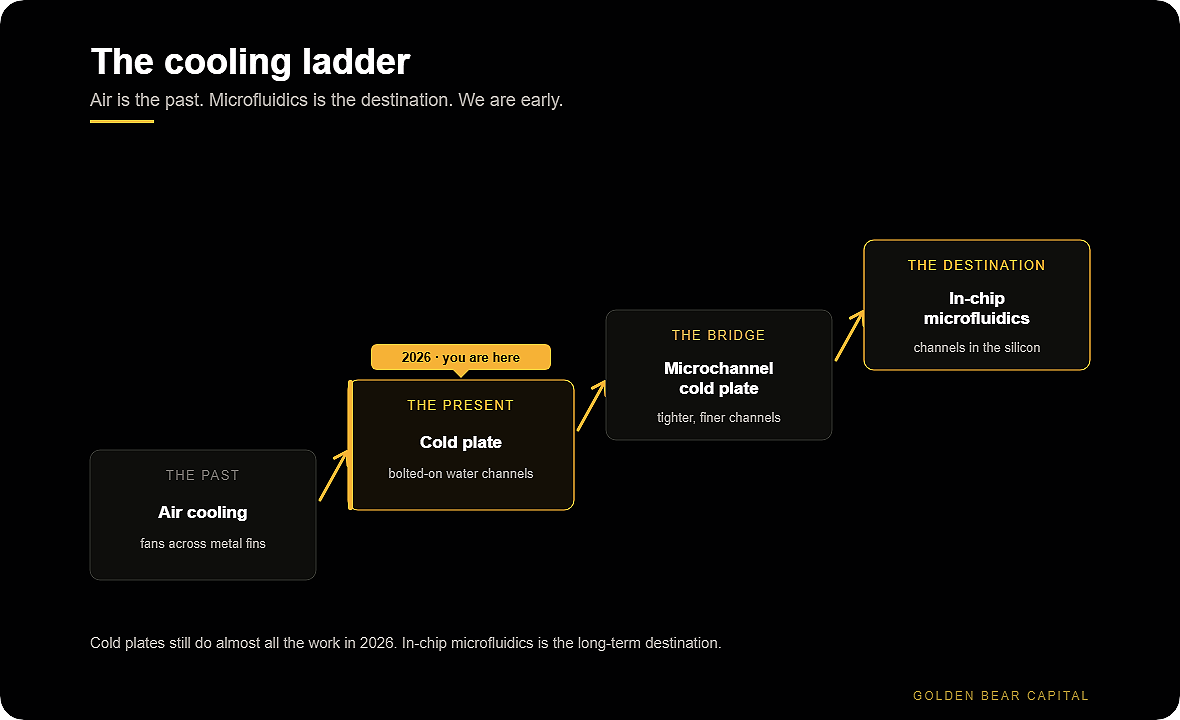
So there’s a ladder here, and it matters for everything below.
Air cooling is the past. Cold plates are the present. Microchannel cold plates, where the channels get tighter and finer, are the bridge.
And in-chip microfluidics, channels etched into the silicon itself, is the long-term destination. We are early on that ladder. Cold plates still do almost all the work in 2026.

Why The Heat Wall Is Not Hype
The numbers tell you why this is coming, whether anyone likes it or not.
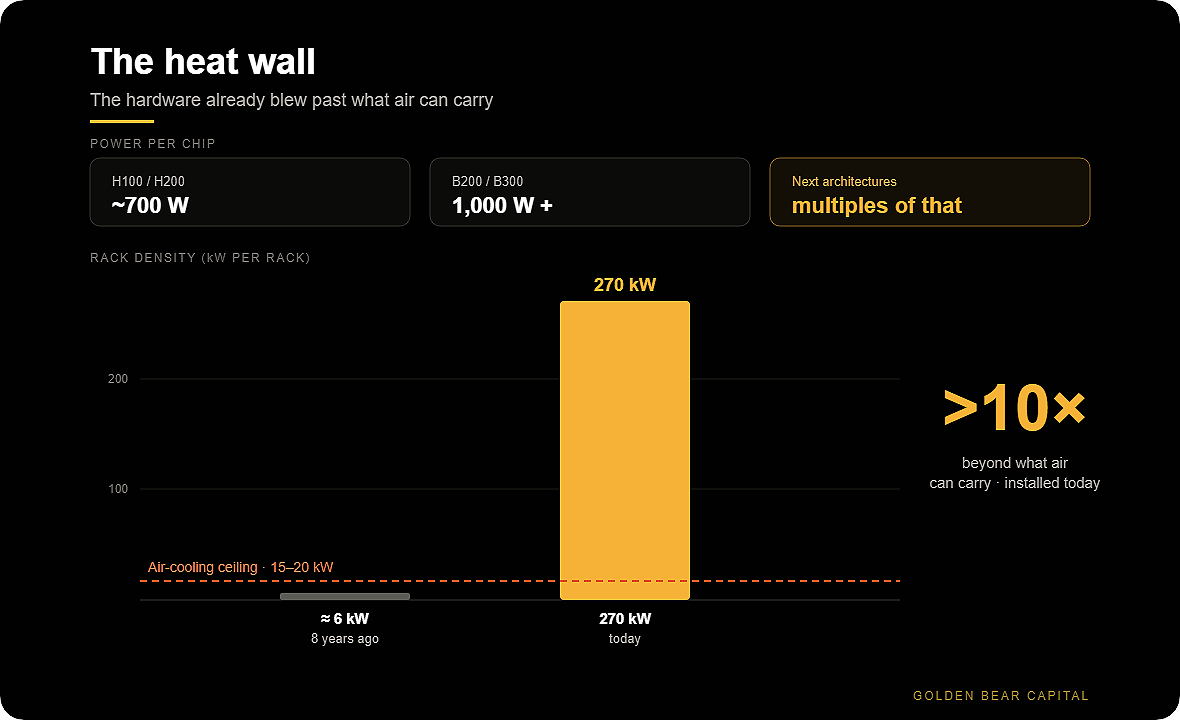
Chip power is exploding. NVIDIA’s H100 and H200 drew roughly 700 watts. The B200 and B300 push past 1,000 watts. The next architectures are designed to draw multiples of that.
Rack density is the part that should make you sit up. Dell’s global industries CTO put it bluntly: racks averaged about 6 kilowatts eight years ago, and racks are now shipping at 270 kilowatts.
Air cooling tops out somewhere around 15 to 20 kilowatts per rack. Do the math. The hardware has already blown through what air can carry by a factor of more than ten. That isn’t a forecast. That’s installed today.
This is why liquid cooling has stopped being optional.
NVIDIA’s reference designs for current and next-gen systems specify liquid cooling, which effectively forces it on anyone deploying the hardware. Direct liquid cooling already runs a far more efficient facility, with a power usage effectiveness in the 1.10 to 1.35 range against 1.55 to 1.67 for air, a 30 to 40 percent efficiency gain.
Industry surveys put liquid cooling in roughly 19 percent of data centers today, with another third planning it within two years.
Microfluidics is what comes after the cold plate hits its own ceiling. And the people building the racks know it. Microsoft is already deploying direct-to-chip cooling across its fleet and testing microfluidics inside Azure. The chip cooling roadmap and the chip power roadmap are now the same conversation.
The Prize: How Big Is The TAM
Let’s frame the money in three rings, from widest to most specific.
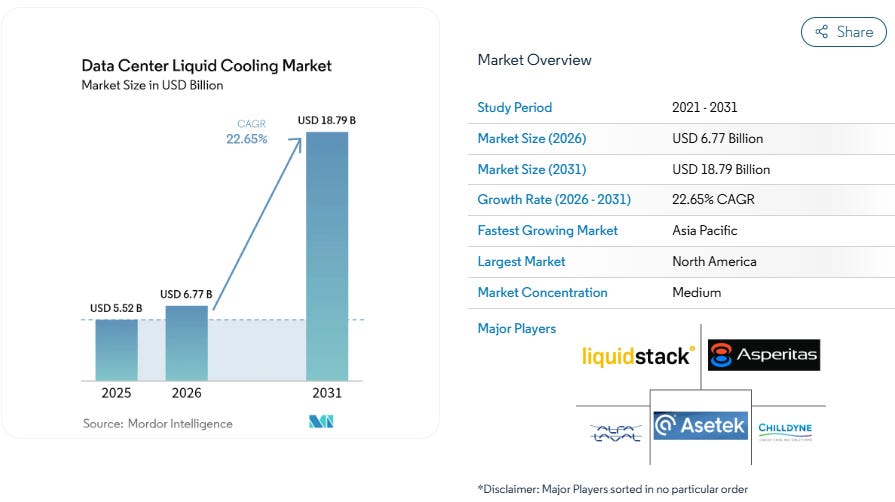
The widest ring is data center liquid cooling overall. That market was about USD 5.52 billion in 2025, is tracking to roughly USD 6.77 billion in 2026, and is forecast to reach USD 18.79 billion by 2031, with a compound growth rate of around 22.65 percent. Direct-to-chip already holds the largest slice, nearly 43 percent.
The narrow ring, the one that maps to this thesis, is microfluidic chip cooling specifically.
A June 2026 Fact.MR report puts that market at USD 384.3 million in 2025, growing to roughly USD 2.86 billion by 2036, a 20 percent compound rate and a 6x expansion over the decade. The named players read like a who’s who of the theme: Vertiv, Schneider Electric, Microsoft, CoolIT, LiquidStack, Corintis, TNO, and Frore Systems.
The third ring is the honest one.
In-chip microfluidics, the version where coolant runs inside the silicon, is a rounding error today. It is a pilot-stage technology with a handful of validated demos. Analysts at IDTechEx now treat it as its own chapter in their 2026 to 2036 thermal management report, and even the bulls describe it as a critical pathway rather than a near-term volume market.
So the shape of the opportunity is a small base growing fast, sitting downstream of a much larger and already-exploding liquid cooling build-out.
Translation for positioning: you are early, the pure category is tiny, and the way to play it is through the picks and shovels and the proxies, not a clean pure-play, because the cleanest pure-play isn’t even listed. More on that below.
The Catch Retail Needs To Hear First
There is no pure, liquid, listed microfluidic-cooling stock you can just buy.
The two companies furthest down the in-chip path are either private or buried. Corintis, the Microsoft (MSFT) partner, is private. JetCool, which does a related “microjet” approach, got swallowed by Flex Ltd (FLEX), where it’s a speck inside a giant.
The closest things to public exposure are proxies at different distances from the bullseye.
Which brings us to the two we actually want to talk about.
One gives you a small, direct, listed line into the glass and the microstructuring that this technology leans on. The other gives you a large, liquid operator that has quietly bought a venture stake in the purest private name in the space. Same room. Two very different doors.

Idea One: Planoptik (ETR: P4O)
The 98-person German company that makes the structured glass in the AI packaging world is pivoting toward.
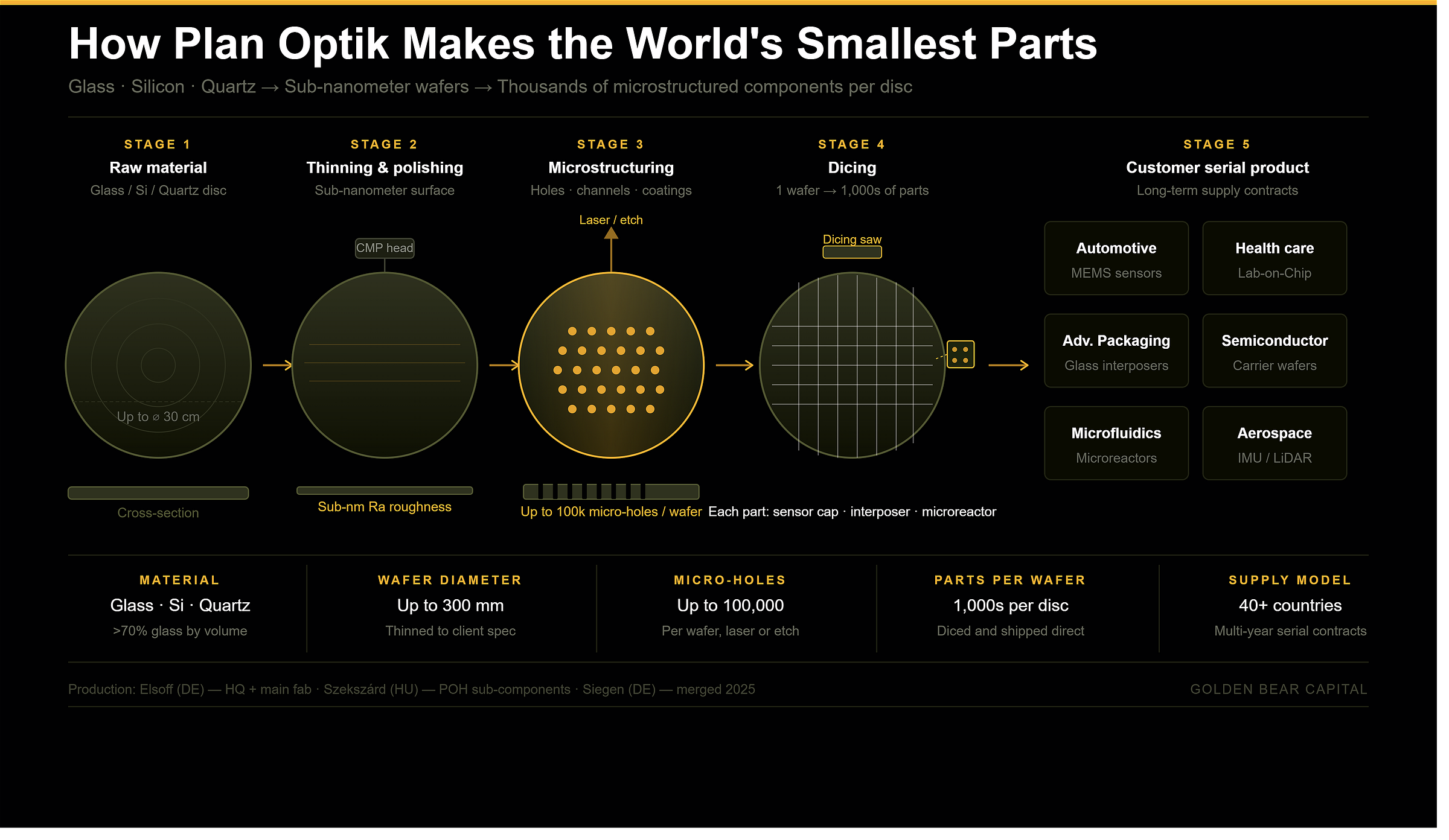
Plan Optik is a structured-wafer maker in Elsoff, Germany. It takes discs of glass, glass-silicon, and quartz up to 30 centimeters across, polishes them to a smoothness measured in fractions of a nanometer, then carves them with microholes, microchannels, and through-vias. Customers in over 40 countries build those structured parts into their own products. It has done this for more than 20 years.
For this thesis, ignore the noise and look at what the company actually does, because the retail story floating around (P4O equals microfluidic cooling) is half right and half lazy. Let’s separate the two halves cleanly.
The half that is overstated. Plan Optik has a “Microfluidics” segment. But read the filings: that segment is medical, pharma, and chemistry.
Lab-on-chip, microreactors, micro-nozzles, inhalers, dosing pumps. It is not, today, a chip-cooling product line. Anyone telling you P4O sells cooling for GPUs is skipping the fine print.
The half that is real and more interesting. The genuine AI angle is the Advanced Packaging business and the underlying capability. Plan Optik makes tiny glass micro-circuit boards with drilled holes, plated with copper, used to stack and wire chips together in the tightest possible space. Those holes are called through-glass vias.
Glass is taking over here because it is hard, dimensionally stable under heat swings, and electrically insulating, exactly the properties advanced chip packaging needs as packages get bigger and denser. Intel and Samsung are pivoting toward glass substrates. Plan Optik openly describes itself as early-stage in this market, in a sub-segment it thinks can grow faster than advanced packaging overall.
Here is the connective tissue to the cooling theme, and it’s the part worth underlining. In-chip microfluidic cooling needs exactly the skill set Plan Optik already sells: structured glass and silicon, microchannels, through-vias, wafer bonding, sub-nanometer polishing, and dicing. The company even ships carrier wafers with up to 100,000 microholes to the largest semiconductor makers. This is not a company that sells GPU coolers. It is a company that owns the glass-and-microstructuring toolbox that the next cooling generation will draw from. That is a transferable-capability bet, not a product bet. Be precise about which one you’re making.
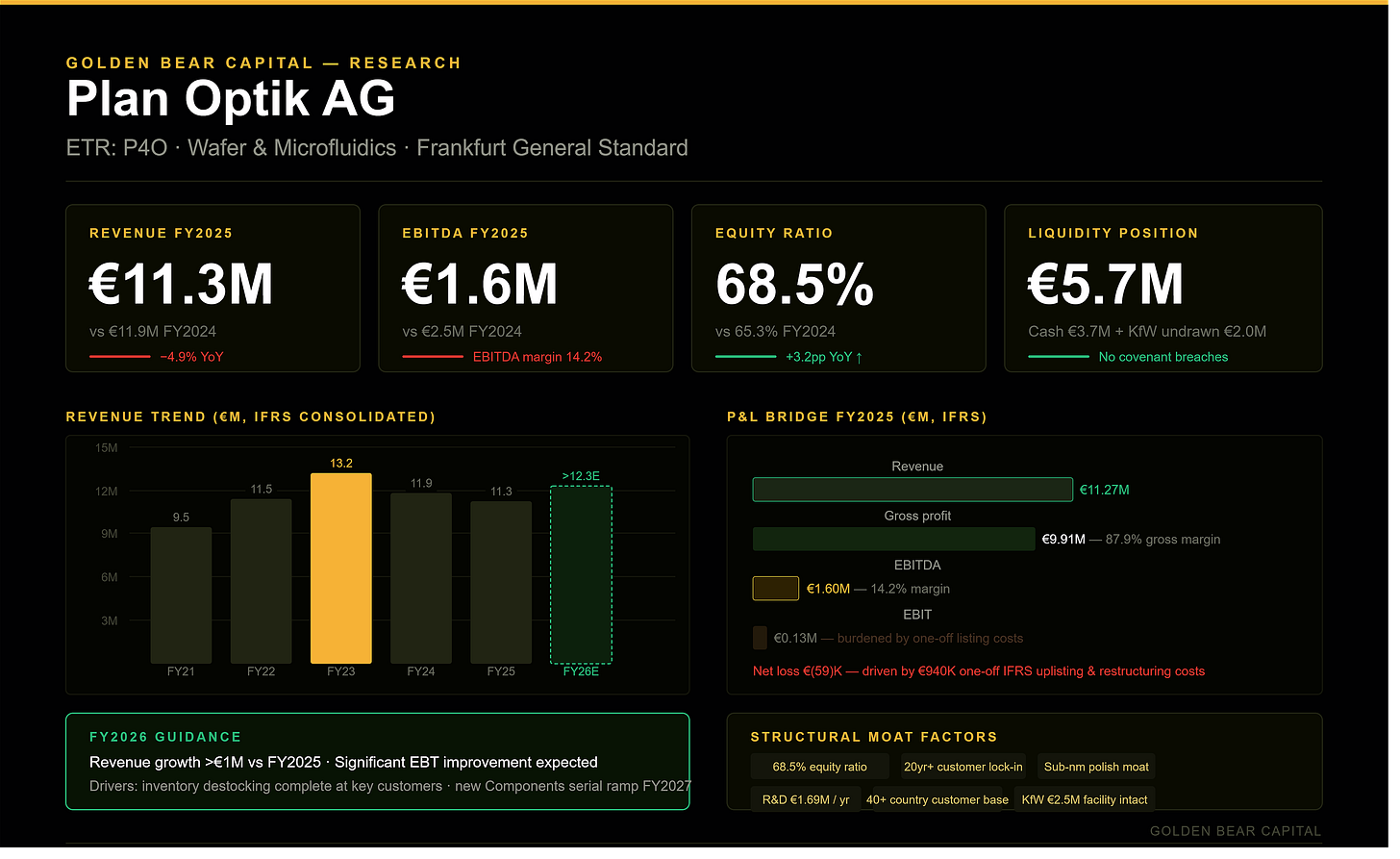
The numbers, plainly. FY2025 was a soft, transitional year, and management says so. Revenue came in at EUR 11.27 million, down from EUR 11.86 million in 2024 and EUR 13.25 million in 2023. EBITDA was EUR 1.60 million, a 15.3 percent margin, down from EUR 2.51 million. The company printed a tiny net loss of EUR 0.06 million, basically breakeven. EPS was minus one cent.
Two things dragged the year. First, big customers and their customers were burning down inventory, and auto-sensor demand stayed weak. Second, and this is the important nuance, 2025 was loaded with one-off costs: the uplisting to the Regulated Market (General Standard) in Frankfurt on 9 September 2025, the switch to IFRS accounting, and a group restructuring that merged the subsidiaries into one company. Strip those out, and the underlying business held roughly flat in a bad macro.
The balance sheet is the quiet strength. Equity ratio of 68.5 percent. Cash of EUR 3.73 million against financial debt of only about EUR 1.6 million, plus a EUR 2.5 million development loan mostly undrawn. This is not a company about to run out of road. With around 4.5 million shares and a price that has swung between roughly EUR 3.20 and EUR 16.00 over the past year, the market cap sits in the rough neighborhood of EUR 45 to 55 million depending on the day.
Why it could be disruptive. Plan Optik runs a model with low variable cost. Material is only about a fifth of revenue, and most of the cost base is fixed. That cuts both ways. In a downturn, revenue drops hit profit hard. But in a ramp, incremental revenue falls almost straight to the bottom line. Management guides for a small step up in 2026, then a real acceleration from 2027 as new “Components” customers move into series production. If even one of those programs scales the way management hopes, a company this small can re-rate violently. There is also a tell in the boardroom: a supervisory board member runs an emerging-growth business unit at FormFactor, a US semiconductor test company. That is not a random résumé for a glass-wafer microcap.
Now the risks, and they are not small.
The thesis stretches.
The cleanest part of the bull case (glass substrates for advanced packaging) is real but early and not yet a revenue driver. The cooling angle is a capability, not a product. If you’re buying P4O thinking you own a GPU-cooling pure-play, you’ve mispriced what you own.
The microcap problem.
This is a thinly traded name with a tight shareholder register. Roughly half the stock sits with a handful of insiders and large holders. That makes the float small and the moves brutal in both directions. The stock already ran more than 160 percent in a year before pulling back around 30 percent from its EUR 16 high. You are not early to the chart. You may be early to the fundamentals.
Key-person and concentration risk.
The company is run by a single management board member. Three customers make up over EUR 4.9 million of revenue. Lose one program or one person, and the picture changes fast.
The timeline.
Management’s own guidance says the meaningful revenue jump is a 2027 story. You are paying today for a ramp that hasn’t started.
Bear / Base / Bull, P4O.
Bear: macro stays soft, the 2027 ramp slips, and an illiquid microcap that already tripled drifts back toward the single digits where the float gives out.
Base: revenue ticks up past EUR 12 million in 2026, the glass-substrate story keeps drawing retail, and the stock chops in a wide range while it waits for proof.
Bull: one or more series programs scale into 2027, the advanced-packaging glass narrative gets real revenue behind it, and a EUR 50 million company with operating leverage and a clean balance sheet re-rates hard. The catalyst to watch is the H1 2026 trading update in late summer, then any concrete advanced-packaging or microfluidics design win.
Idea Two: Applied Digital (Nasdaq: APLD)
The AI data center operator that bought a front-row seat to the purest cooling startup in the space.
Applied Digital is a different animal entirely. It builds and operates large AI data centers, which it calls “AI Factories,” after spending its early life as a crypto-mining host and then pivoting hard into AI infrastructure. It did not abandon the old business: it still runs 286 megawatts of bitcoin hosting in North Dakota that quietly throws off the highest return on assets in the company, nearly USD 14 million of segment operating profit in the latest quarter. But the story now is the AI build-out. Its flagship campus, Polaris Forge 1 in North Dakota, is one of the only 100-megawatt direct-to-chip liquid-cooled facilities running in the world today, and it is fully energized.
There is a structural wrinkle worth knowing before you read the numbers.
In May 2026, the company hived off its cloud arm, folding it into a separately listed vehicle called ChronoScale (Nasdaq: CHRN) that Applied Digital still owns roughly 97 percent of. The point of the split was to leave APLD itself as a cleaner, pure-play data center landlord. So the headline financials now run through the landlord, not the cloud.
The operating numbers are large and loud.
In the fiscal third quarter ended 28 February 2026, revenue hit USD 126.6 million, up 139 percent year over year and well ahead of the roughly USD 75 million consensus. The GAAP net loss was USD 100.9 million, but that’s heavily distorted by stock-based comp and write-downs, including a one-off charge tied to reclassifying the cloud business; on an adjusted basis, which strips out that cloud unit, the company posted USD 33.2 million of net income (nine cents a share) and USD 44.1 million of adjusted EBITDA. Cash sat around USD 2.1 billion, debt around USD 2.7 billion, and equity around USD 1.6 billion.
Now the part that has moved fastest, and the part that an earlier read of this thesis understated. The backlog is the real story, and it has roughly doubled in a few months.
Across the spring of 2026 Applied Digital signed a run of fresh 15-year take-or-pay leases with US-based high investment-grade hyperscalers: a 300-megawatt deal at a new southern campus called Delta Forge 1 in April, a second 300-megawatt lease with the same tenant at Polaris Forge 3 in May, the deal that pushed the company past 1 gigawatt of contracted capacity, and a 210-megawatt lease at a fifth campus, Delta Forge 2, in June.
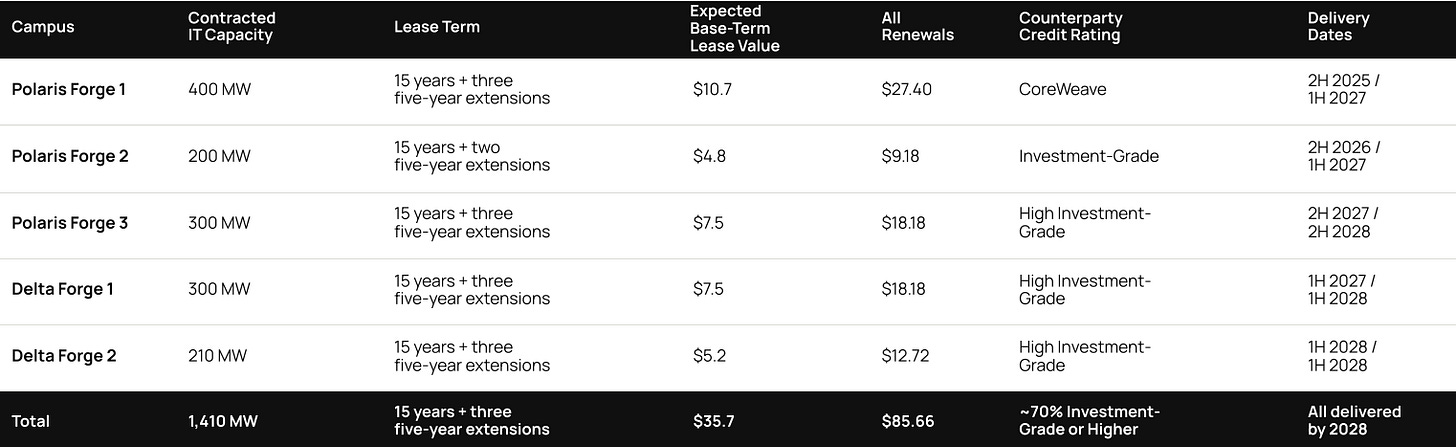
Stack those on top of the original anchors, CoreWeave’s 400 megawatts at Polaris Forge 1 (roughly USD 10.7 billion of base-term revenue) and an investment-grade hyperscaler’s 200 megawatts at Polaris Forge 2 (roughly USD 4.8 billion), and the portfolio now stands at five campuses, about 1.41 gigawatts of contracted critical IT load, roughly 2.15 gigawatts of gross utility power, and around USD 36 billion of contracted base-term lease revenue. Run all the renewal options out to 30 years, and management puts the headline figure near USD 86 billion. Roughly 70 percent of that contracted revenue sits behind investment-grade hyperscaler credit.
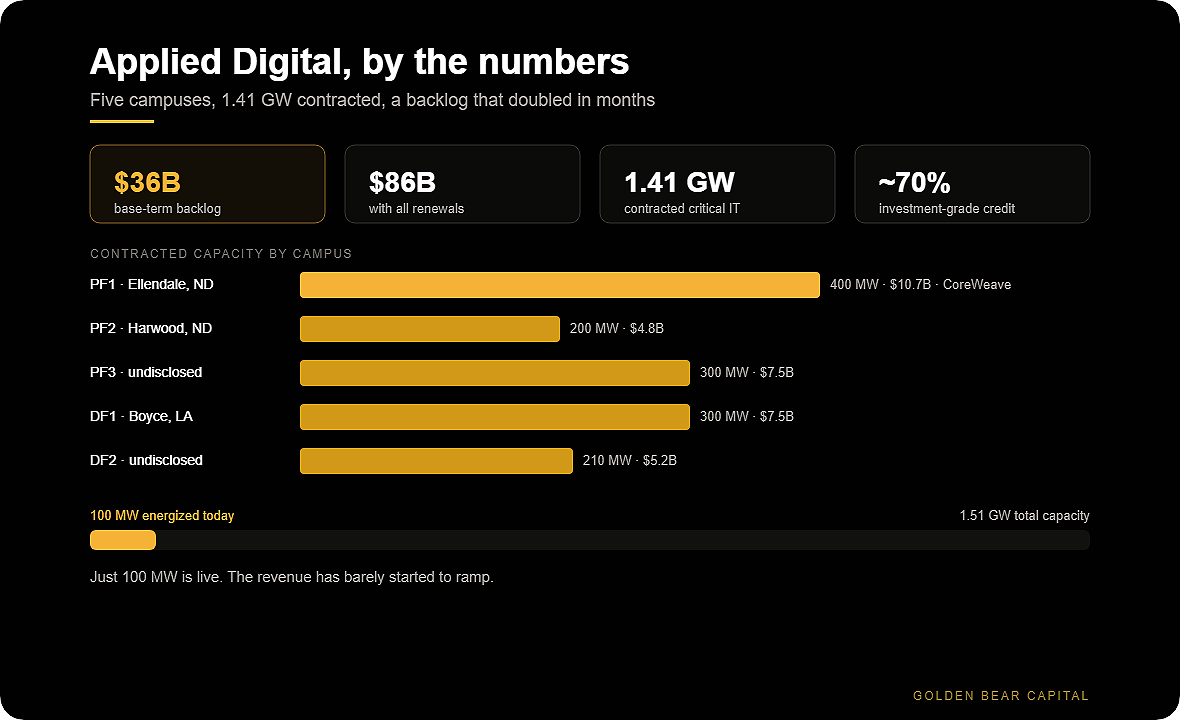
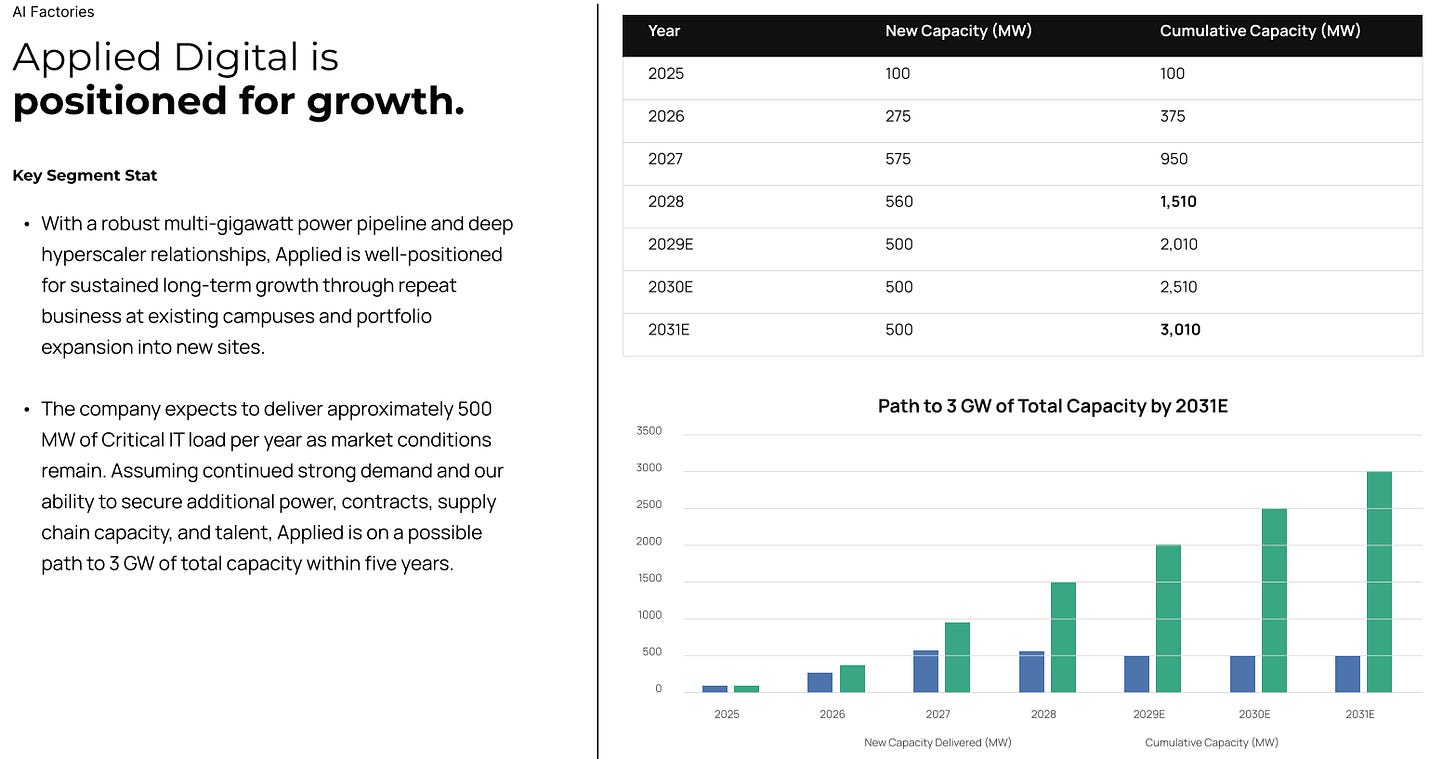
The gap between that backlog and what’s actually live is the whole investment case. Today, just 100 megawatts is operational out of roughly 1.51 gigawatts of total current capacity, with the rest under construction and already contracted, and the bulk scheduled to be energized by 2028. Management guides to roughly 500 megawatts of new critical IT load coming online per year and floats a path to 3 gigawatts of total capacity by 2031, against a power pipeline that runs to about 3 gigawatts of active sites and more than 5 gigawatts in earlier-stage discussions. Expected stabilized site NOI margins sit in the mid-to-high 80s percent, and management talks about roughly USD 2 billion of average annualized NOI once the contracted book is built, repeating a target of more than USD 1 billion of NOI within five years. The revenue, in other words, has barely started to ramp.
So why does a data center landlord show up in a cooling article?
In December 2025, Applied Digital wrote a USD 15 million check and led a USD 25 million round into Corintis. That stake is the cleanest listed thread to the purest private name in microfluidics; the USD 15 million split is broken out in Applied Digital’s fiscal Q2 2026 results.
The Real Asset Here: Corintis
If you want to understand the microfluidic theme, you have to understand Corintis, because it is the company the whole sector keeps pointing at.
Corintis is a Swiss startup spun out of EPFL in Lausanne, founded in 2021 by Remco van Erp, Sam Harrison, and Elison Matioli. It is the firm Microsoft (MSFT) partnered with for the September 2025 breakthrough.
Its core product is a microfluidic cold plate whose coolant channels are designed by a generative AI engine to match each chip’s specific heat map. It can be deployed two ways: as a drop-in replacement for a standard cold plate or integrated right inside the GPU package. The validated performance, up to 3x lower temperatures than standard cold plates, is the number the entire industry now quotes.
Where are they on the curve? Corintis has produced more than 10,000 copper cold plates and is ramping toward a million units a year by the end of 2026. That’s the volume business. Separately, it runs a prototype line in Switzerland, building channels directly inside chips, in small quantities, to prove the concept before handing it to chipmakers and cold-plate manufacturers. That second line is the in-chip future. It’s a demo today, not a revenue stream.
The cap table tells you who believes. Corintis has raised about USD 58 million in total. The Series A, USD 24 million, led by Berlin’s BlueYard in September 2025, valued it at near USD 400 million post-money. Then Applied Digital led the follow-on. And the board includes Lip-Bu Tan, who is now CEO of Intel (INTC), plus Geoff Lyon, the founder of cold-plate pioneer CoolIT. When the CEO of Intel and the founder of a cooling incumbent are both on your board, the industry is telling you something!
The revenue model is the boring, durable part: Corintis sells cold plates, design software, and cooling IP to chipmakers and data center operators.
Now the honest read on APLD as a way to play this. The Corintis stake is a USD 15 million venture position inside a company carrying billions in assets, billions in debt, and a USD 36 billion lease backlog. It is a call option, a signal, a strategic toehold. It is not the reason the stock moves, and the clearest tell is that the cooling investment does not even appear in Applied Digital’s own June 2026 investor deck: fifty-plus slides on power, leases, financing, and campuses, with no Corintis logo anywhere in sight. If you buy APLD, you are buying an AI data center operator with real revenue, real leases, and real leverage that happens to own a smart little stake in the cooling future. Size the thesis accordingly.
The risks of APLD.
It’s a leveraged operator, not a cooling play. The thing that drives the stock is lease execution, power delivery, and construction timelines across more than 1.4 gigawatts of contracted build-out. Delays or cost overruns compress site margins. The Corintis exposure barely registers in the P&L.
Debt and dilution.
This is a capital-hungry model that funds growth by issuing securities, and the pace of issuance through 2025 and 2026 is the thing to watch. As of the February quarter-end the balance sheet carried about USD 2.7 billion of debt against USD 2.1 billion of cash, but that figure is already stale: after the quarter the company priced USD 2.15 billion of 6.75 percent senior secured notes for Polaris Forge 2, then in June priced another USD 1.59 billion of 7.0 percent notes to fund a fourth building at Polaris Forge 1, added a USD 550 million revolving credit facility and a USD 300 million bridge, and all of that sits on top of the USD 5 billion Macquarie preferred-equity facility (at a 12.75 percent paid-in-kind rate) it is drawing down campus by campus.
Project-level debt at this scale is normal for a data center developer, but it is debt, and the interest cost is real.
GAAP losses and noise.
The headline numbers swing hard on stock comp and write-downs. You have to look through the adjusted figures and the backlog, which requires trusting management’s framing.
Bear / Base / Bull, APLD.
Bear: capital markets tighten, a build slips, and a debt-heavy operator with thin GAAP profitability gets repriced on execution risk.
Base: leases energize on schedule, revenue ramps as the next buildings come online through 2026 and 2027, and the stock tracks the backlog.
Bull: the contracted 1.4 gigawatts energize on time, the multi-gigawatt pipeline keeps converting into investment-grade leases, the company hits its contract-quality and NOI targets, and the Corintis stake turns into a real strategic and financial asset if microfluidics goes mainstream. The catalysts: each building’s ready-for-service date, new hyperscaler leases, and any Corintis commercial milestone, the big one, a Corintis IPO.
Two Doors, Same Room
Put them side by side, and the contrast is clean.
Plan Optik is the small, direct, pick-and-shovel door. You’re buying a real, listed company that physically makes the structured glass and microchannels the next cooling generation depends on, at a market cap that a serious investor can move. The reward is leverage: a EUR 50 million company with a clean balance sheet and a 2027 ramp can re-rate in a way a multi-billion-dollar name never will. The price you pay is purity and liquidity. The cooling link is a capability bet, not a product, and the float is thin enough to hurt.
Applied Digital is a large, liquid, indirect door. You’re buying a scaled AI infrastructure operator with roughly USD 36 billion of contracted revenue and a venture stake in Corintis, the single purest name in microfluidics. The reward is that you ride the entire AI data center build-out while holding a free-ish call option on the cooling future. The price you pay is dilution of the theme: the cooling exposure is a rounding error inside a leveraged real-estate-meets-compute machine.
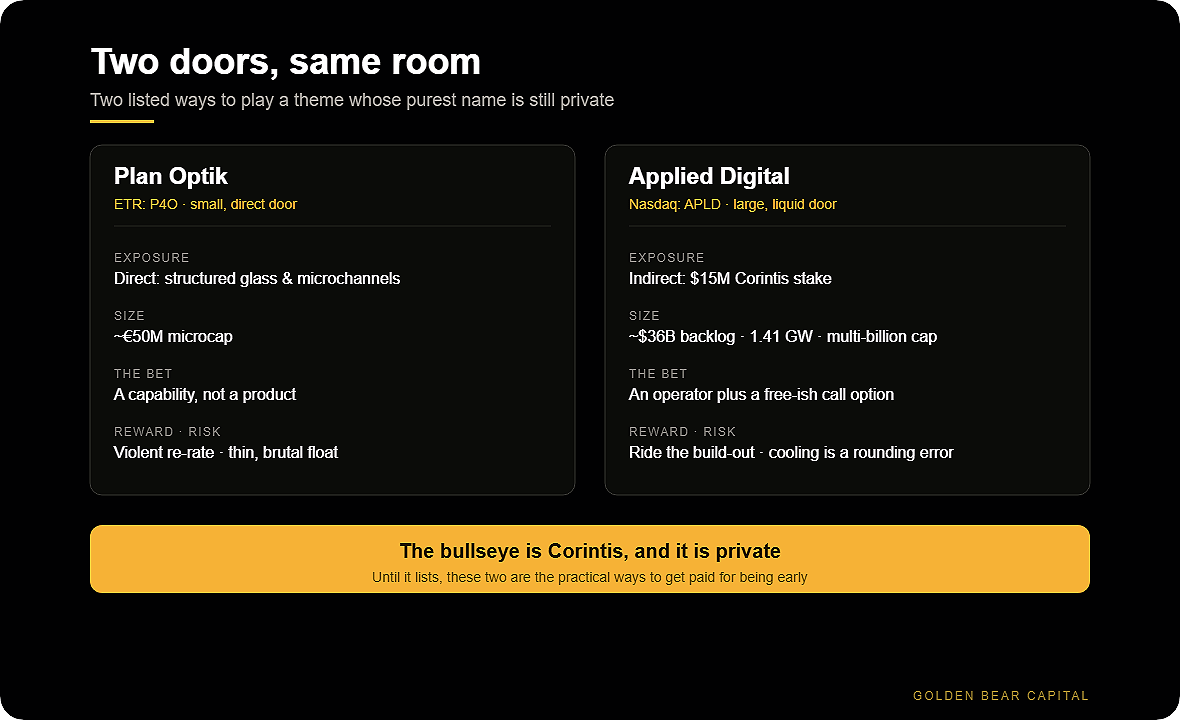
Neither is a pure microfluidic-cooling stock, because that stock isn’t public yet. Corintis is the bullseye, and it’s private. Until it lists, these two are the practical ways to get paid for being early.
This is a fresh, high-risk theme.
In-chip microfluidics is a 2027 to 2030 mainstream story, not a 2026 revenue event, and both of these names have already moved. P4O has tripled and given some back. APLD has run with the AI infrastructure tape. Chasing either at the highs is how you end up holding a theme you were right about and a position you were wrong about. The play is to build the watchlist now, understand the mechanics cold, and let the tape hand you the entry. For P4O, that means waiting for the stock to stop discounting a ramp that hasn’t started, ideally on a real advanced-packaging or microfluidics design win. For APLD, it means buying execution, lease energizations, and pullbacks, with the Corintis stake as upside you didn’t pay much for.
The heat wall is not a maybe.
It’s physics, and the GPUs already broke through what air can carry. The fix is coming. The trade just isn’t sitting in a tidy ticker yet. That gap, between an obvious problem and the absence of a clean way to own the solution, is usually where the interesting money gets made.
Disclaimer: This analysis is for informational purposes only and should not be considered financial advice. Always conduct your research and consult with a licensed financial advisor before making investment decisions.
Questo pezzo era gratuito. Il prossimo arriva domenica.This piece was free. The next one lands on Sunday.
Dieci nomi con i livelli, la lettura del mercato, la chat con le posizioni in diretta. Con l'abbonamento leggi tutto; senza, ricevi la parte gratuita via email.Ten names with their levels, the market read, the chat with live positions. Subscribers read everything; free readers get the free part by email.