
What to bring to a 1:1 trading review

You join the call with a folder of fifty screenshots and a question about consistency. Ten minutes in, the conversation is still trying to work out which chart came first. Most of that preparation could have happened before the invitation went out.
A useful educational review starts with one bounded question and the evidence to examine it. Three well-chosen examples usually give the conversation more to work with than a tour of every position you have held.
Pick the question before the examples
'Make me a better trader' gives nobody anything to review. 'I keep changing my invalidation after entry' gives you a decision to inspect. So do 'I cannot cut my scan results down to a list I can review' and 'my written plan and my actual exit keep diverging'.
Choose the question that causes you the most confusion, and keep it to one. A call can examine a process. It cannot establish that a whole strategy has an edge from a handful of charts.
Bring one complete trade
The first chart should show what you could see when you made the decision. Add the date, timeframe, market context and the note you wrote at the time. If you wrote no plan before entering, say so instead of reconstructing one from the outcome.
Explain what you meant to do and what happened. Keep order execution apart from chart levels, because an assumed stop price and an actual fill are different observations. Black out account numbers, balances and anything else the educational question does not need.
Add a comparison case and a trade you skipped
The second example should make the question harder, not repeat it. If the first one involved changing an exit, pick another case where you followed the written rule. That helps separate the rule from the times you departed from it.
The third can be a trade you considered and passed on. Explain the evidence that kept you out. Looking only at completed trades leaves out the selection decisions that shape the whole record, including the times when doing nothing was the plan.
Three examples are a preparation format. They are no rule about how much evidence proves an investment claim. They make the conversation specific enough to show what work is still needed.
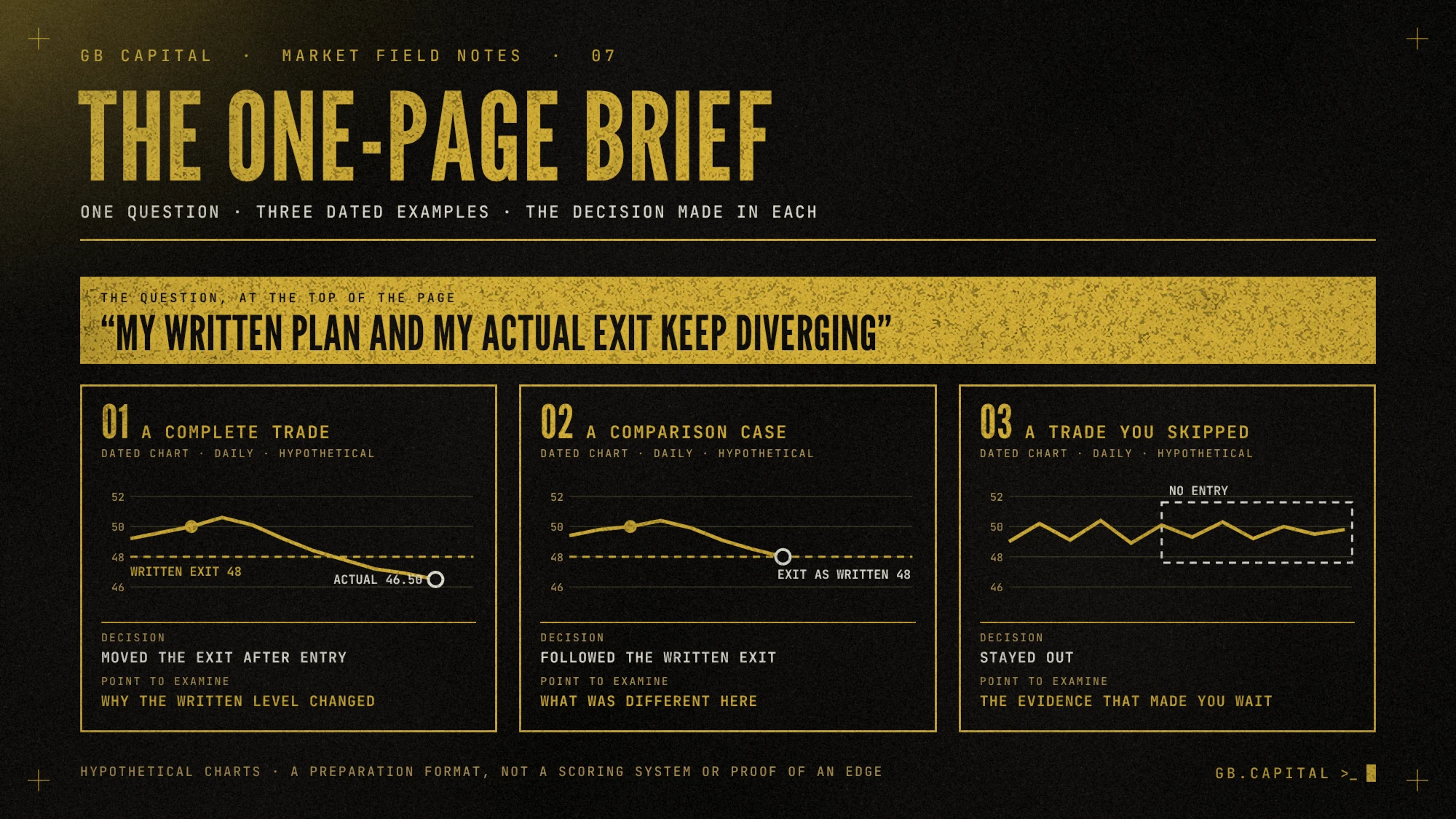
Write a one-page brief
Put the question at the top of a page. Under it list the three examples, the decision made in each and the point you want to examine. Say which platform you use if the question depends on software, and separate an installation problem from a process problem.
For a TC2000 installation problem with our supplied setup, email support is already included with the product, so you do not need a paid call just to ask how to import what you bought.
Course call or separate 1:1 session?
The Operator's Playbook includes one 50-minute educational call. The separately bookable 1:1 session is a different offer: 55 minutes for €120, with availability, payment and confirmation handled through the booking calendar. If you bought the course, use the delivery instructions or write to invest@gb.capital about your included call before you book a paid session. Mixing up the two durations and booking routes is an easy mistake.
Leave with a task
A good outcome is a clearer process question, a corrected reading of the evidence or a small exercise to complete. Write down what you will test, where you will record the result and when you will review it.
The session is educational. We do not use it to tell you which stock to buy or to promise results. If you want help examining how you make and record decisions, read the details of the separate 1:1 session and prepare the first example before you pick a time.
Educational material, not investment advice or a recommendation.
The included course call must be booked within 90 days of purchase. Email invest@gb.capital with your order reference and three suitable times.