
How to review a losing trading week before changing the strategy

The week ends in the red. By Friday evening you have changed the moving average, loosened one rule and found a new scanner. Monday's process looks different, and the reason the old one lost is still sitting in six rows of the journal.
A losing week is a reason to look at the evidence. On its own it does not name the cause of the losses, and it does not prove the whole approach has to go. Rebuild the decisions before you adjust the rules.
Rebuild the trading journal in the order things happened
For each completed trade, put the original plan next to the actual entry, any changes made during the position, the exit and the costs. Keep the dates and the information you had at the time. A later chart can explain an outcome without proving it was knowable before entry.
Mark missing records. If you never wrote the plan, that is an observation about the process. Do not fill the blank with the plan you wish you had followed and then grade the trade against it.
Planned loss, actual loss and execution differences
A trade can follow its process and lose. It can also break the process and win. Judge every decision by the colour of the journal row and you reward departures that happened to work and abandon decisions you followed consistently.
Find the source of any gap between planned and actual loss. An exit changed with no stated reason, an order entered wrongly and a gap through your stop are three different events. The last can happen even when the order was placed exactly as intended.
A small numerical example
Take six hypothetical trades: two winners of 1.5R and four losers of 1R. The gross total is −1R. Now suppose one of those four losses was actually 3R and everything else stayed the same. The total becomes −3R. That two-R difference tells you which trade to look at. It does not tell you why the larger loss happened.
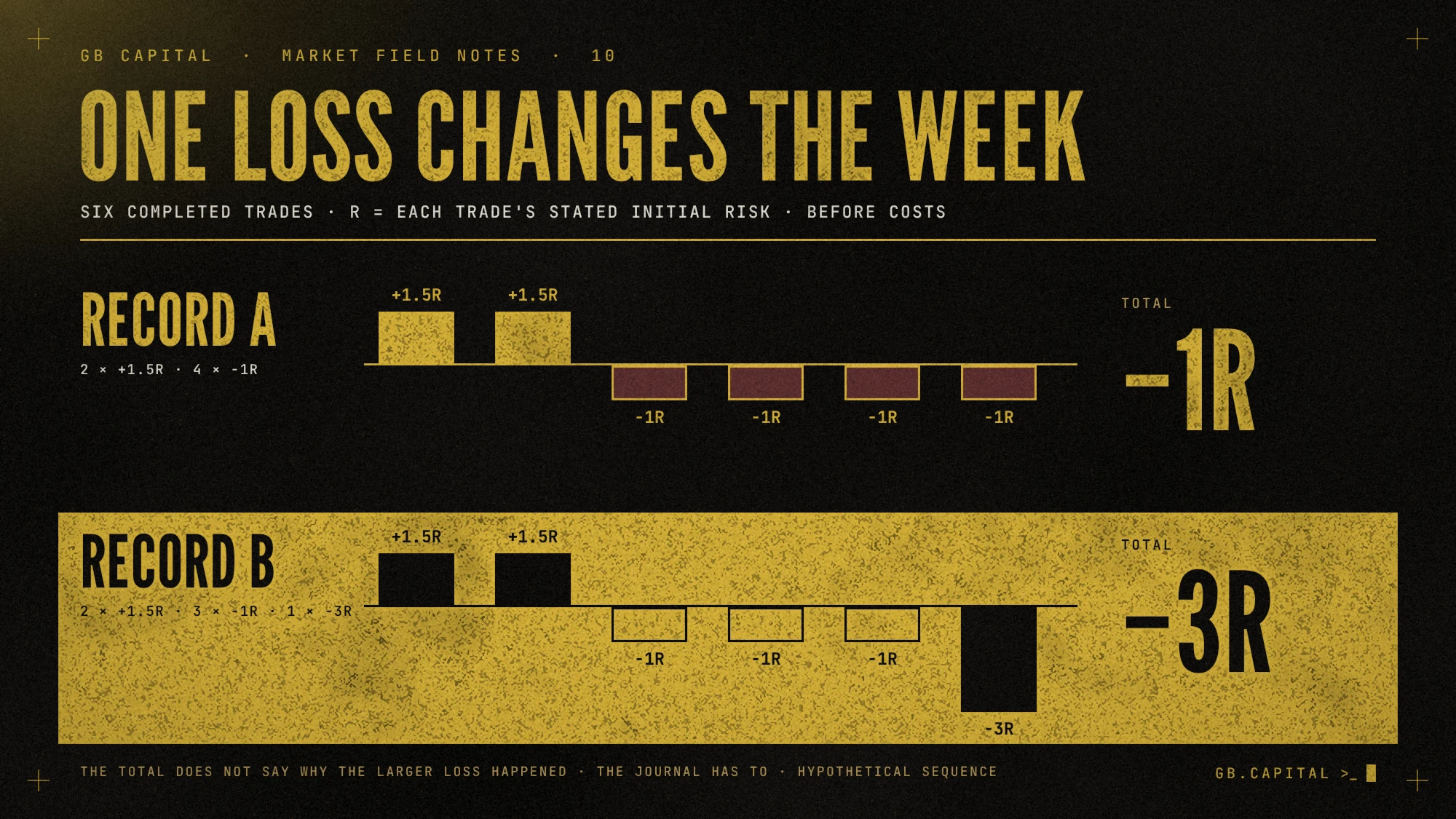
If costs averaged 0.05R per completed trade under a consistent definition of R, another 0.3R comes off either record. Check whether your journal is gross or net first. The cost figure here is for illustration and is no typical brokerage charge.
Six trades say very little about a long-run win rate or the spread of your losses. Use the week to find questions in the record, then review the relevant cases across a broader, coherent sample, and leave one week's percentage out of your forecasts.
Sort what you saw into questions you can investigate
Selection asks whether the idea met the conditions used to enter the queue. Planning asks whether entry, invalidation and quantity were written coherently. Execution asks whether the actual actions matched the plan. Market and event exposure ask what conditions went with the outcomes.
Keep the categories descriptive. 'Bad psychology' for every loss is hard to test. 'Three exits were changed after entry with no note made at the time' names a set of decisions you can reopen.
Choose a review task before a new setting
Write one change as a question you can test. If the issue is missing pre-entry records, the next task may be to complete them consistently in a simulated exercise. If it is gap exposure, look at the event calendar and the assumptions behind the loss budget.
Keep a dated version of every rule change and compare it with the earlier one. Rewriting past trades under the new rule can help you explore an idea, and it is no independent test of future results.
If you want an educational review of a specific process question, the separate 1:1 session gives us a fixed time to go through your examples. Bring the original notes, including the missing fields. For a free starting point, use the expectancy guide to calculate the record without mixing up a high win rate with a positive result.
Educational material, not investment advice or a recommendation. The numerical examples are hypothetical.