
When a watchlist idea stops being a trade

You did the research on Sunday. By Wednesday the stock is higher, the entry you marked is behind it and the next company event is closer. The note is still there, which makes the trade feel unfinished. What is unfinished may be the review, and not the purchase.
A watchlist records reasons to investigate, and those reasons come with conditions. Before you treat an old idea as a current trade, check which conditions still hold and which have changed.
Separate the company idea from the entry and the invalidation
You can still find a company interesting after your entry has passed. That does not make the earlier price, stop or position size available at today's quote. Keep the business question and the trade plan in separate fields so one cannot quietly validate the other. The invalidation is the price or event that would show the idea was wrong: write it next to the entry, and reconsider it when the entry changes.
A hypothetical long plan: entry at $50, assumed exit at $48, so $2 of price distance. At $54 with the same exit the distance is $6. With a $100 loss budget before costs, the first case allows 50 shares and the second allows 16 whole shares. Carry the original 50 shares into the second case and the planned loss is no longer $100.
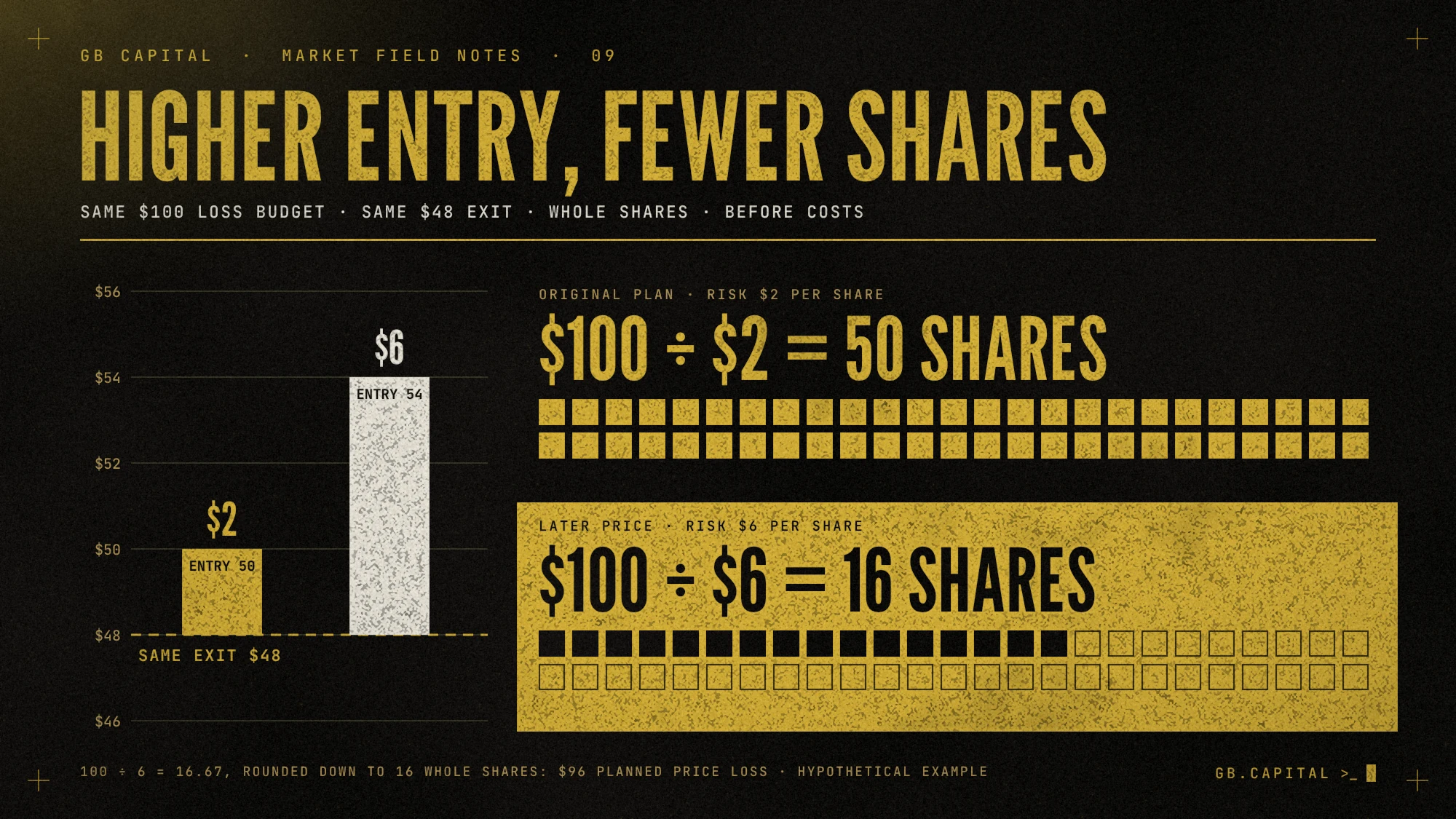
Neither calculation tells you whether the trade is attractive. It shows why quantity and assumptions have to be reviewed when the entry changes. Moving the stop closer just to restore the old arithmetic needs a reason that comes from the plan.
Check whether the catalyst already happened
A scheduled announcement, an earnings report or a business milestone can explain why an idea deserved attention at a particular time. Once the event has happened, replace the expectation with what was actually disclosed. A note written before the result should not read as though it already knew the outcome.
Record the new source and the date. If the result differs from the assumption in your note, name the difference instead of adding another optimistic sentence under the original thesis. If the event is postponed, update both the calendar and the period the idea needs attention for.
Revisit the market context and your other positions
The stock's chart is one part of the review. Check whether the broader conditions used in the original plan still hold, and whether related positions already use up the exposure you were prepared to take. A list made before several new positions were added does not know how the portfolio changed.
You do not need a fresh justification for every daily move. Use the review points you wrote into the process. If your rule is unclear, mark it as an unresolved question and do not pretend a discretionary change followed a rule that did not exist.
Keep, revise, defer or archive
Keep means the relevant assumptions still hold. Revise needs an explicit change and a new calculation. Defer needs a question or event that would bring the idea back. Archive preserves the work once it no longer belongs in the active queue.
These labels organise research and are no trading signals. An archived company can be reviewed again if new evidence appears, and moving it out of the list you inspect every day does not lose the earlier work.
Write down why you passed
When you decline an entry, note the date, the assumption that changed and what would justify another review. That record helps tell a disciplined rejection from a decision you rewrote later because the price went up.
If you want a process that connects market, catalyst, entry, invalidation and review, that is what the written Operator's Playbook covers, and its included educational call can be used on an exercise you found hard. The arithmetic in the example above is in our free position-sizing guide.
Educational material, not investment advice or a recommendation. The numbers in the example are hypothetical.