
A swing trading review routine when you have a full-time job

You have forty minutes after work. The market has produced a full day of price moves, earnings headlines and opinions, and if the first job is deciding what deserves your attention, most of the forty minutes are gone before you open your own notes.
A routine fixes the work in advance. It does not make trading fit every job or schedule. The process still has to account for when you are free, what can happen while you are away and which decisions you cannot monitor.
Build the week around tasks
Separate the work that needs uninterrupted reading from the work that checks an existing plan. A company review, a filing and building a watchlist belong to the first group. Checking whether a scheduled event happened or whether a research question needs updating belongs to the second.
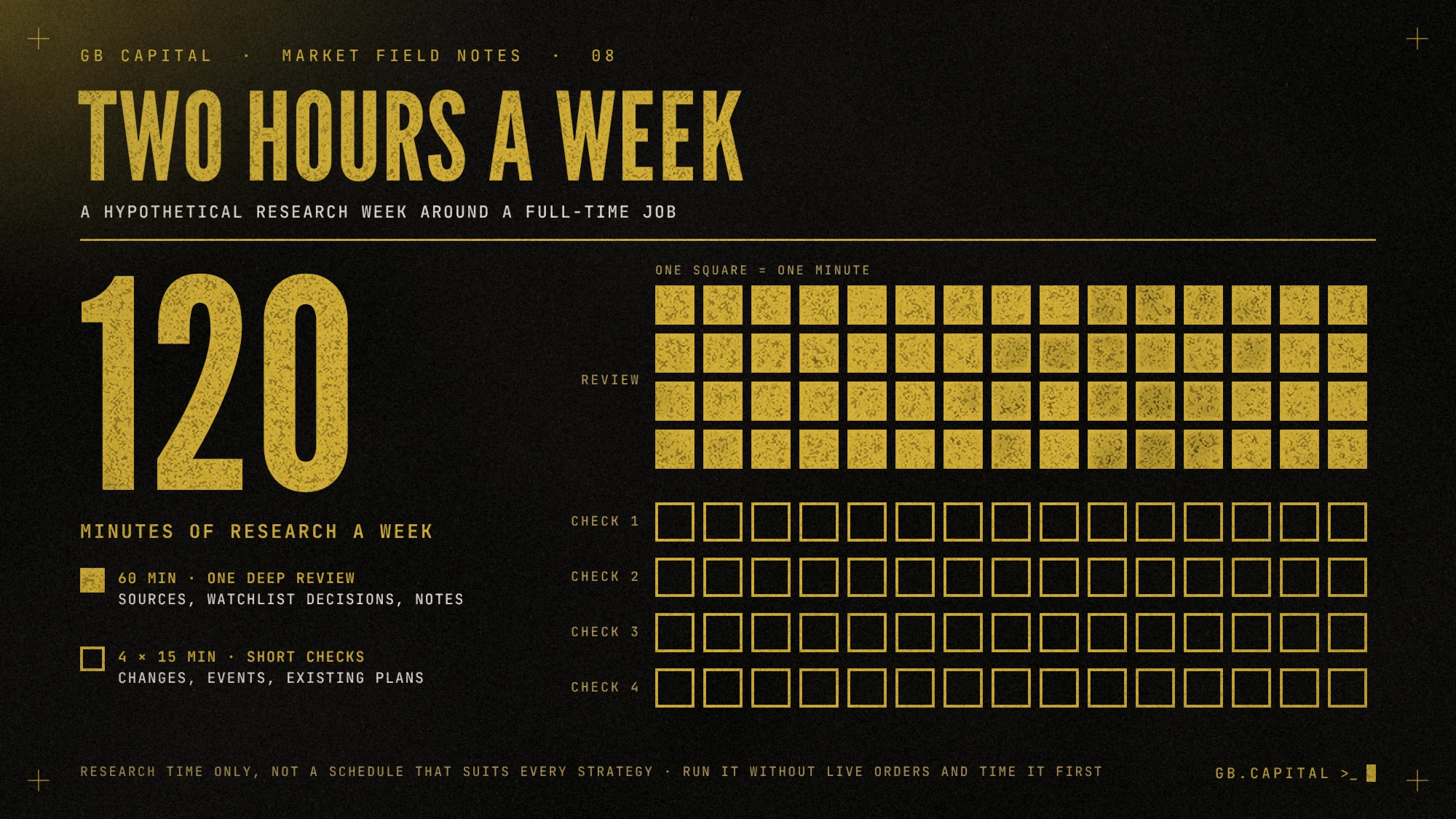
A hypothetical weekly research budget: one sixty-minute main review and four fifteen-minute checks. That is two hours a week, and it is no claim that two hours suffice for every approach. Run the routine without live orders and record how long it really takes before you decide it fits your life.
Give the long review a fixed output
Start with the broad market and the positions or ideas you already follow. Then pick a manageable set of companies for deeper work. End with an active list, the reason for each name and the next event or question to check.
The output is a record you can pick up during the week. If the list still holds more full reviews than your schedule allows, shrink the active queue or raise the time budget. A scanner that produces thousands of matches does not change how many companies you can investigate properly.
Keep the daily check short
Open the existing plan before the news feed. See whether any event or price move changes work you had already scheduled. Write down what changed, what is still uncertain and whether a full review is now needed.
New ideas can go into a discovery queue for the next long session. They do not all have to become tonight's research project. If an idea needs attention your schedule cannot give, record that constraint instead of pretending the same plan can be followed later without adjustment.
What happens while you are at work
A working routine needs an explicit answer to this. Learn which order types your broker offers and when they are active. A price alert is a notification and no exit, and a stop order does not guarantee its trigger price.
Check the calendar for earnings and other company events, using the issuer's own information where you can, and note whether a date is confirmed. A plan built on information from an earlier week may need a fresh look before the event.
Make the software reopen the same work
A saved layout and a short active list make it easier to come back to the task. Keep list names, chart timeframes and notes consistent enough that you can resume after a busy day without rebuilding the environment.
The GB Capital TC2000 setup gives TC2000 users a configured working environment. If the gap is the decision process and not the layout, the written Operator's Playbook is designed to be used beside charts. Neither makes time appear in your diary or removes the need to understand an order.
Check whether the routine fits
After a trial period, compare the planned work with what you finished. Count the unfinished reviews, the checks you missed because of work and the decisions whose assumptions changed while you were away. Those are observations about fit, even if you placed no trades.
Change the workload before deciding you need more tools. A shorter active list and one consistent hour of research may give you a process you can follow. If the demands of the approach still collide with your schedule, that belongs in the decision about whether to use it at all.
Educational material, not investment advice or a recommendation. The two-hour example is hypothetical.