
AfterHours Tales: Naval Ravikant's Harsh Truths in the Markets - ep. 1
The Mindset and Psychology of Financial Success

As traders and investors, we navigate a constant stream of information. Charts flash across screens, news alerts ping our devices, and social media buzzes with market opinions. Yet amid this digital symphony, the greatest insights about successful trading might come from timeless wisdom rather than real-time data.
This article explores the fascinating intersection between ancient principles of mindfulness and the modern practice of trading. Drawing inspiration from Naval Ravikant's and Chris Williamson's thought-provoking discussions (found in this three-hour conversation on YouTube), I've identified patterns and principles that resonate deeply with the trader's journey.
Throughout these lines, Ravikant's most powerful quotes serve as our guideposts. Each quote opens a doorway to deeper understanding, which we'll explore through practical discussion and real-world trading scenarios. Rather than presenting abstract concepts, we've paired each principle with concrete examples from market situations you'll likely recognize—moments of fear during sharp drawdowns, impulses to chase momentum, or the struggle to maintain conviction during market volatility.
As we take this moment to reflect, we're also considering our journey and progress on Substack. To add more value for our subscribers, we've decided to publish a monthly Portfolio recap. This will offer a clear view of our work and management strategies. Additionally, we're exploring the idea of creating a second Portfolio featuring only the most promising companies we believe in—often smaller but with immense potential for future growth.
While this approach carries some risk, it promises an exciting opportunity to see how these selections perform over time. We'd love your feedback on this idea; please feel free to send us your thoughts!
This promotion ended on April 20, 2025. The membership benefits below describe the offer at the time of publication.
This offer applies to both Annual and Founder memberships. Here's what you can expect from us:
As a paid subscriber, you will have access to:
Subscriber-only posts and the full archive
Community membership and real-time chat
Daily or weekly commentary and real-time operations from our swing trading desk
As a Founding member, you will have access to:
Exclusive Email Support for all your questions about trading, investing, and everything you need.
Quarterly Portfolio Reviews
Expert Stock Analysis On-Demand
You will strongly support our development as a team
"If you want to be successful, you must be choosy about your desires."
Naval Ravikant cuts to the heart of why so many people fail to achieve financial success in this profound statement. The modern world bombards us with infinite possibilities and desires – new investment opportunities, business ideas, trading strategies, and financial products appear daily. The instinct is to chase them all, spreading our resources thin and jumping from one hot opportunity to the next.
What Naval illuminates is that success doesn't come from pursuing every financial desire, but from careful, intentional selection of which goals truly matter. This selectivity functions as a filtering mechanism, removing the noise that distracts most investors and entrepreneurs. The paradox of choice applies powerfully to wealth building – having too many options often leads to decision paralysis or scattered efforts that yield mediocre results.
In his 1996 shareholder letter, Warren Buffett argued that investors choosing individual stocks should be able to evaluate selected businesses and know the boundaries of their competence. He did not require expertise in every company or sector.
An investor focusing on dividend growth can study business models, earnings and dividend policy in depth. Specialization alone does not establish superior returns. A concentrated portfolio remains exposed to the fortunes of a few companies.

🌱 Support Our Work: Buy Us a Coffee or Shop Our Services! 🌱
Your small gesture fuels our big dreams. Click below to make a difference today.
[☕ Buy Us a Coffee]
[🛒 Visit Our Shop]

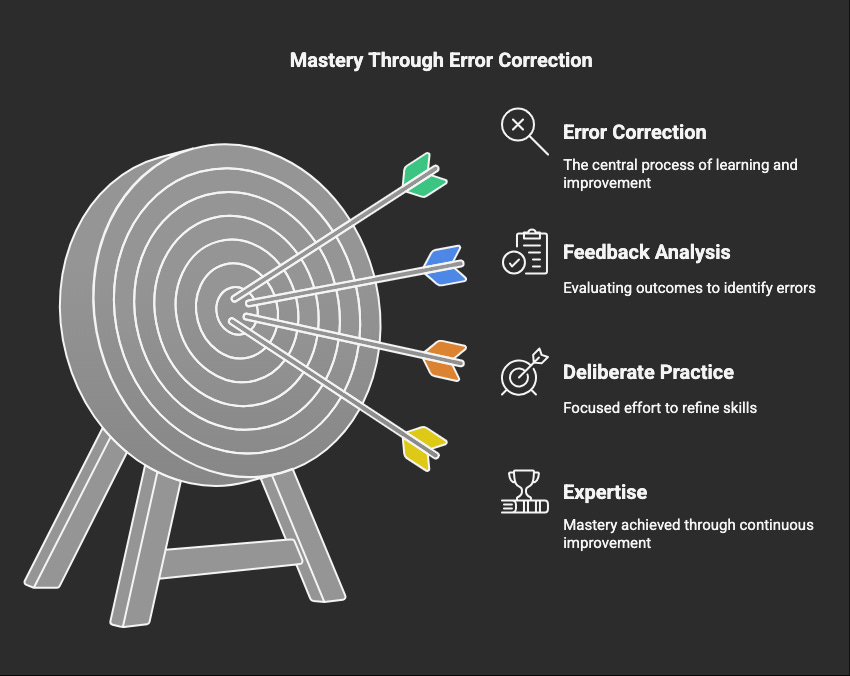
"If you get 10,000 error corrections at anything, you will be an expert at it."
Naval offers a powerful reframing of mastery here. Rather than the popular notion of "10,000 hours of practice," he emphasizes 10,000 error corrections – a crucial distinction that highlights the importance of deliberate, feedback-driven improvement. This perspective is revolutionary for financial skill development, where many practitioners engage in activities without proper feedback loops.
In trading and investing, the path to expertise isn't merely spending time in the market; it's systematically identifying mistakes, correcting them, and refining your approach. Each trade, investment decision, or financial move contains valuable information that, when properly analyzed, creates the foundation for expertise. The harsh truth embedded in this insight is that many market participants never improve because they fail to implement structured error correction – they make the same mistakes repeatedly without learning from them.
This principle applies across every financial discipline. Successful traders meticulously journal their trades and conduct post-mortems on both winners and losers. Value investors analyze their investment theses against actual outcomes to refine their analytical frameworks. Financial advisors solicit client feedback to improve their service models. In each case, the distinguishing factor between mediocrity and excellence isn't time spent, but errors identified and corrected.
In Principles, Ray Dalio describes Bridgewater’s approach to discussing mistakes openly and weighing opinions according to relevant experience and reasoning. Disagreements are examined as part of the decision-making process.
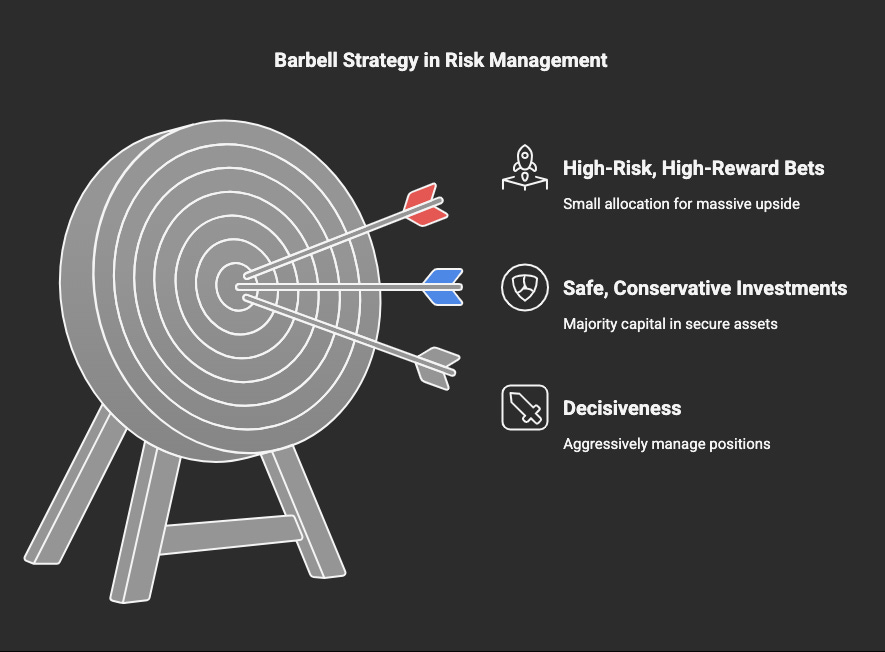
A barbell approach to risk
In the model developed by Donald Geman, Hélyette Geman and Nassim Nicholas Taleb, a barbell combines a lower-risk component with a highly uncertain one.
The allocation starts with constraints on downside losses and then allows risk in the speculative component.
A barbell concerns the portfolio’s allocation between different risk components. Stop-loss and trailing-stop orders can be used to manage exits from positions.
In a 2013 interview, Taleb illustrated the barbell with 70–90% in inflation-adjusted assets and 10–30% in high-risk securities. He framed it as setting a floor on how much one is willing to lose.
"The reason to win the game is to be free of it."
In this deceptively simple statement, Naval reveals a profound truth about the ultimate purpose of wealth accumulation that many successful people discover too late. The game of making money isn't meant to be played indefinitely – the victory condition isn't having the highest score (most money), but achieving liberation from financial concerns altogether.
This perspective fundamentally reframes the objective of financial pursuits. Rather than chasing wealth as an end in itself – an endless treadmill that never satisfies – Naval suggests wealth should serve as a means to freedom, optionality, and self-determination. This insight connects directly to the financial independence movement, where the goal isn't necessarily maximizing returns but reaching a specific threshold of passive income that covers your needs.
In the investment world, this shifts the focus from outperforming benchmarks or accumulating the largest possible portfolio to constructing assets that sustainably generate cash flow with minimal intervention. It suggests that at some point, capital preservation and reliable income become more important than growth and outperformance. For entrepreneurs, it means building businesses not to maximize valuation at all costs, but to create systems that eventually run independently of their time and effort.
The harsh truth embedded here is that many financially successful people remain trapped in the game long after they've "won," continuing to accumulate wealth they don't need while sacrificing time, health, relationships, and meaning – the very things wealth was supposed to enable.
In 2006, Jason Fried and David Heinemeier Hansson sold Jeff Bezos a minority stake from their own holdings in 37signals, the company behind Basecamp. They retained control. The proceeds went to the founders, and the company remained self-funded and profitable, according to Hansson.

"Most of the gains in life come from suffering in the short term so you can get paid in the long term."
Naval here articulates the uncomfortable reality of delayed gratification that underlies virtually all meaningful financial accomplishment. The path to wealth inevitably involves sacrifice, difficulty, and often outright pain before the rewards materialize. This harsh truth directly contradicts the instant gratification culture that permeates modern society.
In the financial world, this principle manifests in countless ways. Saving for retirement means forgoing immediate consumption. Value investing requires the psychological fortitude to buy assets when others are fearful and prices are depressed. Building a business demands years of effort before substantial profits emerge. The stark reality Naval illuminates is that there are no shortcuts – the financial rewards worth having almost always require enduring difficulty first.
At Amazon’s $18 IPO offer price in 1997, a theoretical $10,000 investment would have been worth about $23.95 million at the April 15, 2025 close. The calculation includes the four stock splits and assumes an IPO allocation, fractional shares and uninterrupted ownership, with no fees or taxes.
In April 2025, uncertainty about a US recession was one reason to question confident forecasts. The linked Polymarket contract concerned a recession in 2025. Its prices reflected traders’ expectations and could change as new information arrived.

"The more seriously you take yourself, the unhappier you're gonna be."
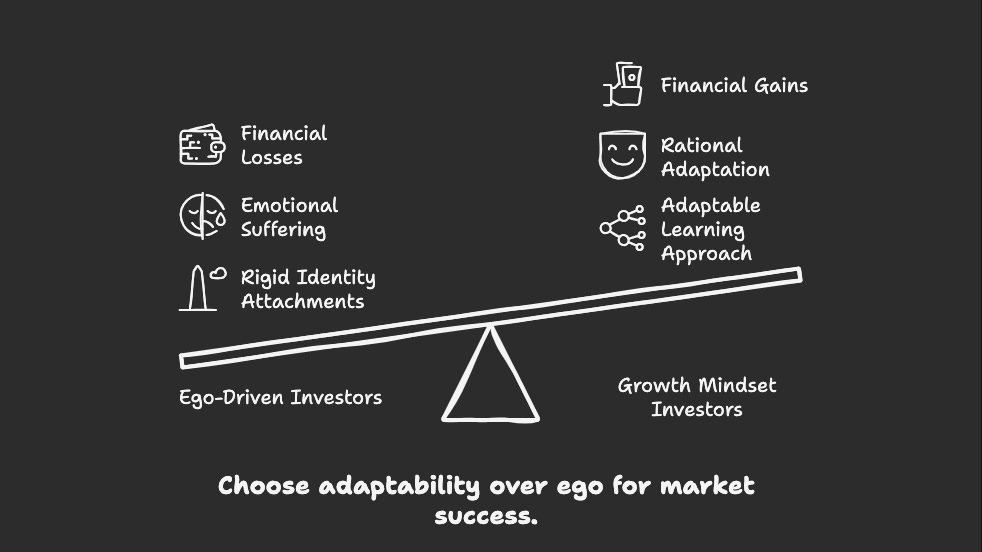
With this insight, Naval highlights the destructive role of ego in financial decision-making. Taking yourself too seriously creates rigid identity attachments to specific strategies, positions, or predictions – attachments that inevitably lead to cognitive biases and emotional suffering when markets move against you.
In the financial world, this manifests as confirmation bias, loss aversion, and the endowment effect – psychological tendencies that destroy returns by preventing rational adaptation to new information. Investors who strongly identify with particular market views often ignore contradictory evidence, doubling down on losing positions rather than accepting they were wrong. Traders who view their win rate as a reflection of their worth make progressively worse decisions as they try to protect their self-image rather than their capital.
The harsh truth is that markets don't care about your ego, identity, or self-image. They ruthlessly punish those who prioritize being right over making money. The most successful investors maintain what psychologists call a "growth mindset" – they see setbacks as learning opportunities rather than threats to their identity, enabling them to adapt quickly and make better decisions.
In its 2017 annual report, issued in 2018, Pershing Square attributed a four-percentage-point drag on PSH’s 2017 gross performance to Herbalife. It described converting the short into put options and then exiting, citing the reduced free float and the risk of remaining short.
Questo pezzo era gratuito. Il prossimo arriva domenica.This piece was free. The next one lands on Sunday.
Ogni domenica analizziamo fino a dieci titoli e pubblichiamo la lettura del mercato. L’abbonamento include tutte le analisi, i livelli operativi e le nostre posizioni in diretta nella chat. La parte gratuita arriva via email.Every Sunday, we analyze up to ten stocks and publish our market view. A subscription includes the full research, price levels and our live positions in the chat. The free section arrives by email.