
MongoDB (MDB): earnings risk and stock setup | Radar 96
Volume 96

Hysteresis
I owe you a week, and I am going to blame furniture.
Moving house in Italy in the second half of August is a decision that says something unflattering about the person making it.
Everyone who could have helped is at the sea.
Everyone who could have connected anything is at the sea.
I am writing this from a folding table, tethered to my phone, because the line is still a promise rather than a service.
So, apologies. One week owed, one week acknowledged, and no padding on top of it.
There is a word for what I have been, and it belongs to a Scottish physicist. In 1881 James Alfred Ewing was watching iron misbehave. Push a magnetic field into it and the iron does not respond on schedule. It arrives late. Bring the field back down to zero and the iron does not return to where it started either. It keeps something. Ewing went looking for a name and took one from Greek: hysterēsis, a shortcoming, a coming late.
The word outgrew the iron. Hysteresis is now what you call any system whose present state depends on the road it travelled and not only on where it happens to be standing. Run it out, bring it back, and the numbers agree while the material does not. The loop leaves a residue.
Which is the only honest way to describe the last three weeks.
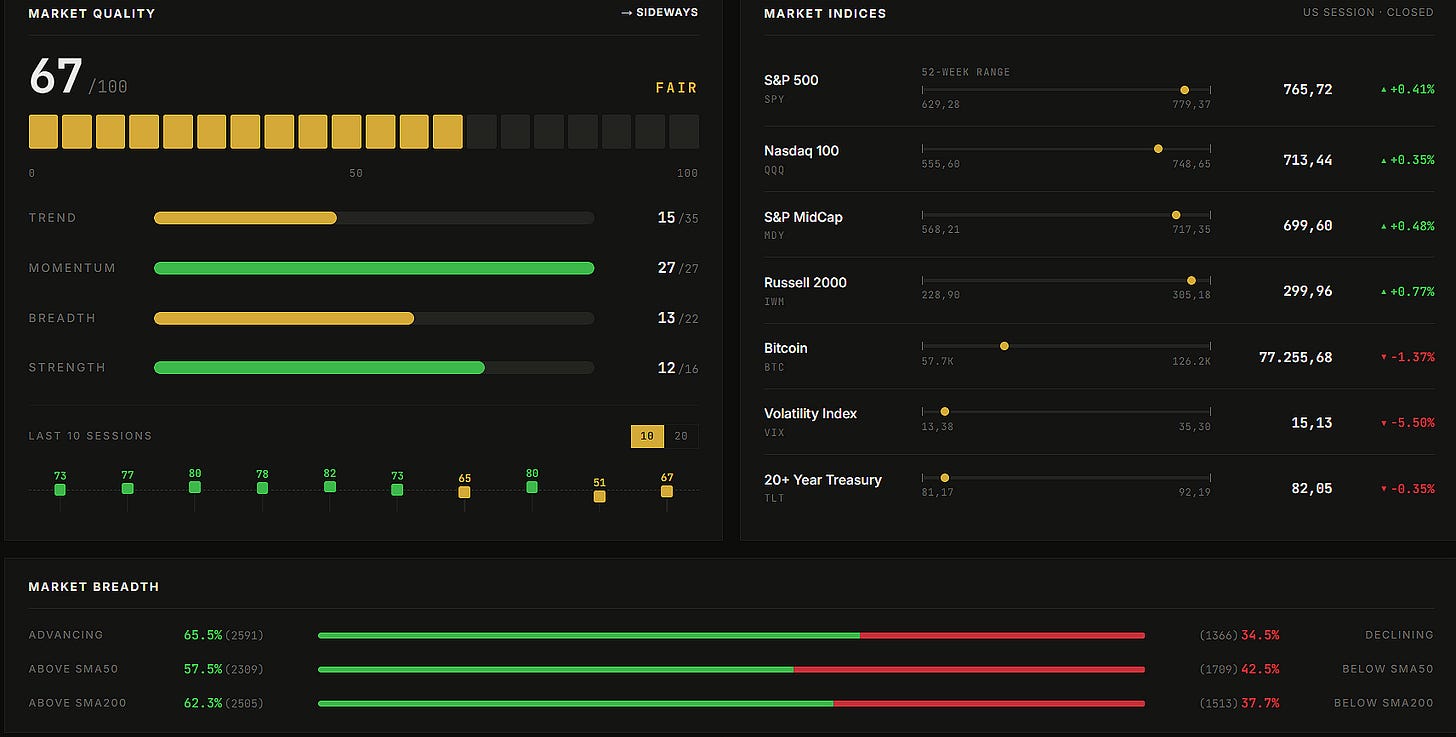
I did unplug, more completely than I planned to. The first thing I did when the screens came back on was pull up the indices, and the first thing I thought was that I had missed nothing. The S&P sits a couple of percent above where we left it in July. The Nasdaq roughly the same. Read the chart with three weeks of blur in your eyes and it looks like the market went to the sea with everybody else.
It did not. It broke out, printed an all time high above 7,800, and then spent the past week handing a good part of that back while the long end of the Treasury curve pushed to yields most desks have not had to price in their working lives, and oil found a geopolitical reason to climb.
Gold, without asking anyone's permission, has strung together five straight weekly gains.

The clearest confirmation came from the newest thing we shipped, the Last 10/20 Sessions read.

Its ambition is deliberately small. It does not forecast anything.
It compresses what the last ten and twenty sessions actually paid into one number out of a hundred, so you can look at the market once in the morning without needing a second screen and a thesis to go with it. And it did the single job we built it for. When it climbed through seventy in early August, the tape behaved: follow through, setups that worked, an environment you can push into. Through the recent stretch it has spent more time under that line than over it, and the chop came straight back. Nothing exotic. A gauge that goes green when the market is willing to pay and red when it is not, and the discipline to believe it rather than negotiate with it.
Now the part I would rather not write, which is precisely why it goes in.
Our system did not flag Moderna.
On the nineteenth, MRNA gapped on Phase 3 data for the cancer vaccine it has been building with Merck and closed up a hundred and seventy seven percent, the largest single day in the stock’s history, on something like twenty eight times normal volume, with a short base underneath it absorbing billions in paper losses. Probably the cleanest news driven episodic pivot of the season. Our screen never sent it.
I spent two nights in the code, angry in the specific way you can only be at something you built yourself.
What I found is worse than a bug and more interesting. The raw score was ninety seven out of a hundred, the highest any name has recorded since the system has existed. Then a filter we wrote, on purpose, took it away, because we had told the machine that biotech moving on clinical news with no economic substance underneath it is usually a trap. That is not an unreasonable thing to tell a machine. Moderna’s last quarter was a loss of several hundred million with operating cash flow pointing the wrong way. On the company, the rule was right.
It was right about the company and wrong about the trade, which is the only variety of wrong that costs money.
The app is in beta and this is what beta actually means. It is already fixed. You will hear the bad ones from us as quickly as you hear the good ones, because a record you only publish when it flatters you is not a record, it is marketing.
One last thing before the charts.
We loved being away, and that deserves saying without qualification, because work that never lets you put it down is not work you chose, it is work that chose you. Three weeks with the screens dark were good.
Coming back was better. That is the part I did not expect to learn.
You can set the whole thing down and pick it up again and discover inside ten minutes that you missed it. Not the money. The whole thing itself!
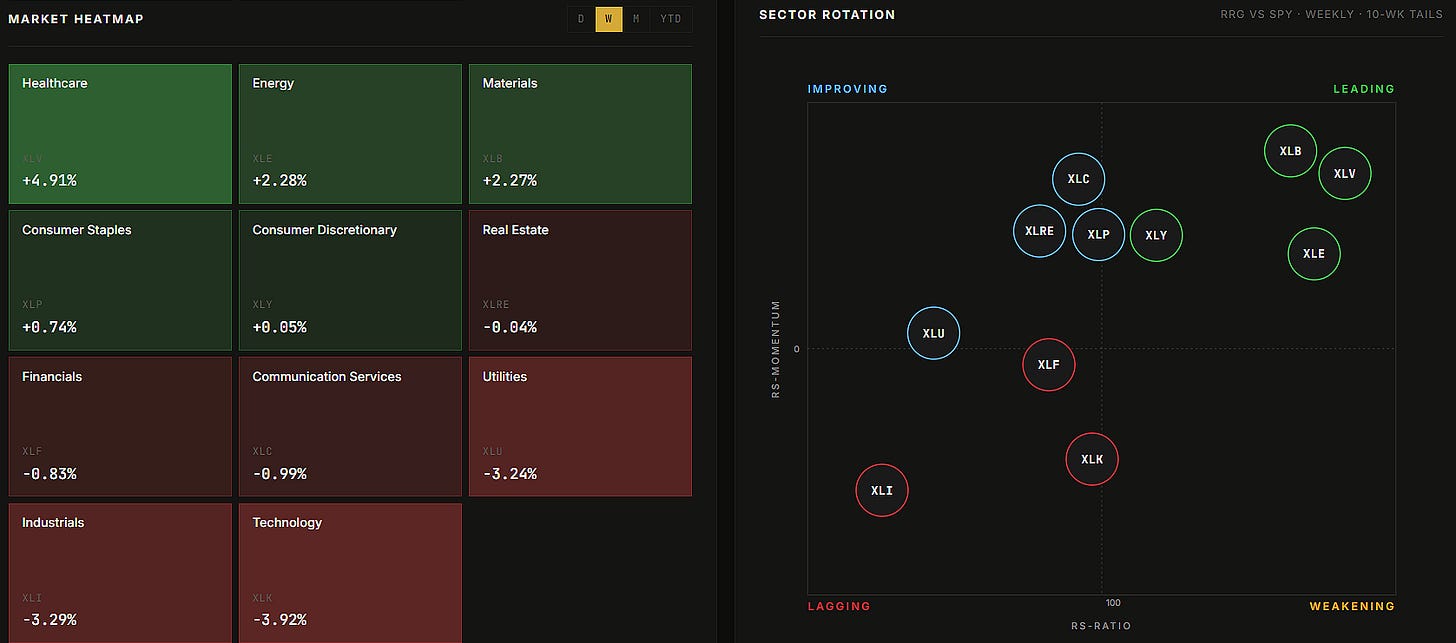
Here’s a look at this week’s market health, with a breakdown of index and sector performance.

We’re currently building the beta version of our app, and it’s already live.
It is not a generic solution for every market participant, but a platform built specifically for swing trading, momentum strategies, and short- to medium-term investing.
You can already sign up, access the beta, and start using it today.
As previously stated, all paid subscribers will receive full access to the platform at no additional cost.

Latest articles:
Each stock carries a risk badge: ⚠️ High | 📊 Medium | 🛡️ Low.
Based on volatility, float, technicals, and fundamentals. Size your positions accordingly.
📈 Free Setup: Make It Count
MDB: MongoDB Inc 📊
What they do: A developer data platform providing database software for building and running applications.
Why watch? A compound growth rate of 47% in fiscal 2023 collapsing to under 20% by fiscal 2025 is normally the epitaph of an enterprise software company rather than the setup for one. That drought is most of the reason MongoDB remains less closely followed than software names of a fraction of its structural importance, despite having graduated to category leader with more than 45% share of the NoSQL database market across several industry surveys.
The category deserves a moment of explanation. Traditional relational databases store information in rigid tables of rows and columns, and every new field means altering the schema for every existing record. NoSQL abandons that rigidity. MongoDB’s particular version is the document model, which holds data in flexible, self-describing structures that map directly onto how developers already think about objects in their code. That is the whole reason the technology spread, and developer adoption is how database companies actually win, because engineers choose the tool long before procurement ever sees a contract.
The revenue model explains the trajectory. MongoDB does not sell seats. It sells consumption, meaning customers pay for what they use rather than for how many employees hold a login. Growth therefore arrives from three directions: new customer acquisition, existing workloads scaling as applications get busier, and new use cases landing inside accounts that already run Mongo somewhere. That third one is the lifeblood. Selling a new use case and then enabling the customer to deploy it at scale is what turns a flat consumption line into an accelerating one, and it requires the slow, unglamorous work of familiarizing the development community with how the technology improves their productivity. That work started paying over the last year or so.
The metric that captures whether it is working is net ARR expansion, which compares what the existing customer base spends now against what the same base spent a year ago. Anything above 100% means customers are growing on the platform faster than others are leaving it. That figure reached 121% last quarter. In the same report, total revenue came in at $687.6 million, up 25% year over year, the company beat every line of its own guidance, and it raised its outlook for the balance of the fiscal year to a range of $2.92 billion to $2.96 billion.
There is still enormous controversy about whether advanced models have the potential to replace some or all of the classic applications sold under a per-seat pricing paradigm. However that argument resolves, MongoDB sits on the other side of the ledger. This is infrastructure software priced on usage and storage. An agent that writes and runs an application still needs somewhere to put the data, and it reads and writes far more aggressively than a human clicking through a form ever did.
Early last year the company acquired Voyage AI for $220 million, and the technology descended from that stack has meaningfully expanded what the platform can do. It brought multi-modal capability along with APIs for embedding and reranking. Embedding is the process of converting text, images, or audio into numerical representations that capture meaning rather than exact wording. Reranking is the step that reorders retrieved results according to how well they actually answer the question asked. Together they enable hybrid search, which combines the precision of full-text matching with the conceptual reach of vector search inside a single query.
Vector databases have moved quickly from niche to expected. They allow semantic search, where a query returns conceptually related results instead of requiring exact string matches, and they handle complex data types such as images, audio, and video far better than relational structures ever managed. MongoDB built Vector Search directly into Atlas and offers RAG natively with the popular AI toolkits. RAG, retrieval augmented generation, is the technique of giving a language model access to a company’s own documents at query time so that answers are grounded in proprietary data rather than in whatever the model absorbed during training. Every enterprise building on top of a model needs that plumbing, and the plumbing has to sit next to the data. Perhaps software and AI end up working together rather than one substituting for the other, and this is the cleanest expression of that possibility currently trading.
The next test arrives immediately. MongoDB reports second quarter fiscal 2027 results after the close on September 1, which places a binary event directly on top of the setup described below.
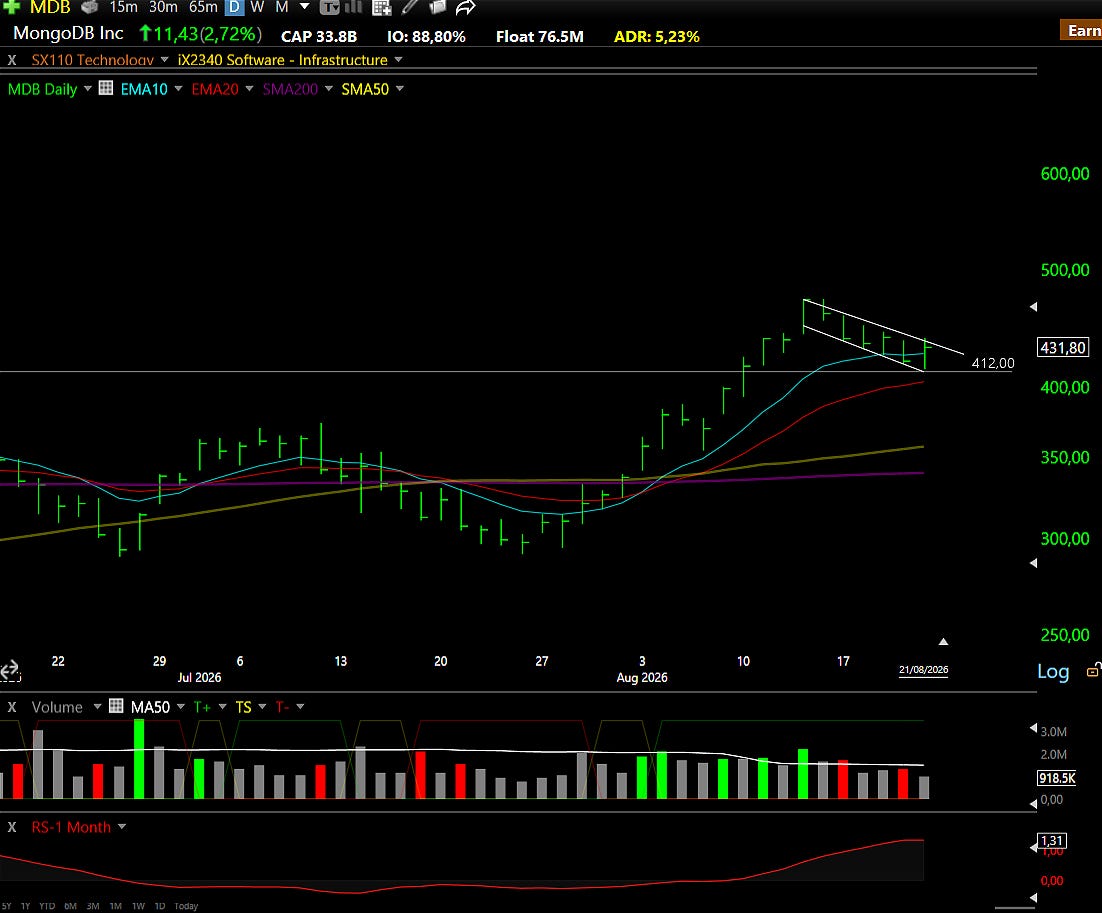
Technical Outlook: The stock has regained the $412.00 weekly level, and that number carries far more weight than most. It acted as heavy resistance throughout 2026 and was never broken for the entire year until August, when price pushed through and held. What is happening now is a retest of the same level on lower volume, with the 10-day EMA tracking underneath as support. Declining volume into a retest is exactly the behavior you want, because it suggests the sellers who defended that line for twelve months are no longer showing up in size. With price roughly 5% above the level, risk defined against $412.00 is tight relative to what sits above, and this is the first pullback after the recent run rather than the fourth. The September 1 report lands inside that window, so position accordingly.


Why We Don’t Wait for Sunday
Markets don’t move on your schedule. The best low-risk entries don’t announce themselves politely and wait for the weekend newsletter.
They show up when they show up. And if you’re not positioned, you miss them.
Paid members get real-time alerts: exact entries, stops, position sizing, and the thesis behind every trade. The same information we use to manage our own capital.
Free members get just one pick on Sunday.
Does that sound like an edge to you?
What’s Inside Premium
Free Access to TradeDeck
Premium members get early access to TradeDeck, the trading platform we’re building. The value of the platform alone already exceeds the cost of the subscription.
Watchlist Elite (5-7 Stocks)
Each selection undergoes rigorous financial analysis, technical evaluation, and strategic assessment.
Full Portfolio Transparency
Every position we hold. Entry price. Current P&L. Stop level. Real money, real risk.
Real-Time Trade Alerts (Chat Access)
This is where the edge lives. Exact entries, stops, and position sizing. Real-time. No lag
Quick Picks (5 Names)
Additional setups that just missed our main criteria but are worth watching.
Chat Access
See our thought process in real time. Ask questions. Watch how we manage risk.
The Tools We Actually Use
Member discounts on TC2000, Fiscal.ai, and other platforms: same tools, better pricing.
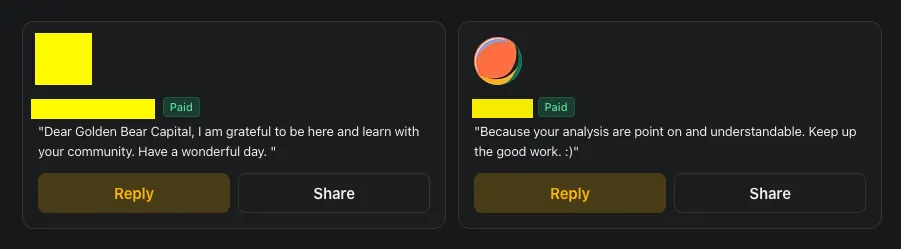
What Paid Members Say:
We’re entrepreneurs first, traders second. We’ve sat in the CEO chair. We know what real execution looks like and how to spot it.
€39/month or 299€/year. Less than one losing trade. Cancel anytime.
Portfolio updates and new positions:
Il resto di questo pezzo: i nomi, i livelli, la gestione.The rest of this piece: the names, the levels, how we manage it.
Ogni domenica dieci titoli con i livelli scritti, la lettura del mercato e la chat in cui pubblichiamo entrate e uscite mentre le facciamo. Disdici quando vuoi dal tuo account Substack.Every Sunday, ten names with the levels written down, the market read, and the chat where we post entries and exits as we make them. Cancel any time from your Substack account.
Già abbonato?Already a subscriber? Apri l'articolo su Substack →Open the article on Substack →