
Equity X-Ray: In-Depth Research #31
AI Doesn't Die From a Chip Shortage. It Dies From Heat.

Microfluidic Cooling: The Wall Everyone Will Hit.
The AI boom doesn’t die from a shortage of chips. It dies from heat.
Every new GPU generation runs hotter than the last. Every quarter, the market obsesses over silicon, power contracts, and data center square footage, and somehow keeps skipping the one physical constraint sitting underneath all of it. You can buy all the Blackwell and Rubin you want. If you can’t pull the heat off the die fast enough, the chip throttles, the rack underperforms, and the megawatts you paid for sit there cooking.
Cooling used to be an afterthought, the boring part of the bill of materials. It has now moved to the center of data center economics. And the most interesting fix on the horizon, the one Microsoft put a flag on last September, is microfluidics. Cooling that runs inside the chip.
This piece is for the retail investor who keeps seeing “microfluidic cooling” in headlines and wants to know what it is, how big the prize is, and whether there’s a way to actually own it.
We’ll keep the science plain.
Then we’ll put the lens on the two listed names worth watching, sitting at opposite ends of the same trade.
Fair warning up front. This is a fresh, high-risk theme with no clean way in yet.
That’s exactly why it’s worth understanding before the crowd does.
What This Technology Actually Is
Start with the problem in human terms.
A modern AI chip is a tiny city that runs a fever. The transistors generate heat, and that heat has to get out, or the city melts. For years, the answer was air: fans blowing across metal fins. Then came the cold plate, which is the standard today. Think of a cold plate as a metal block with water channels that you bolt onto the top of the chip. The water carries the heat away.
Here’s the catch. The cold plate sits on the outside. Between the hot transistors and the cooling water, there are several layers: the silicon itself, a lid, and a layer of paste. Heat has to crawl up through all of that before it ever reaches the water. It’s like trying to cool a fever by putting an ice pack on top of a wool hat. It works, but you’re fighting the insulation the whole way.
Microfluidics throws out the hat. Instead of cooling from the outside, you carve microscopic canals directly into the back of the silicon and run coolant through them, right where the heat is generated. No lid in the way. No paste bottleneck. The liquid touches the fever.
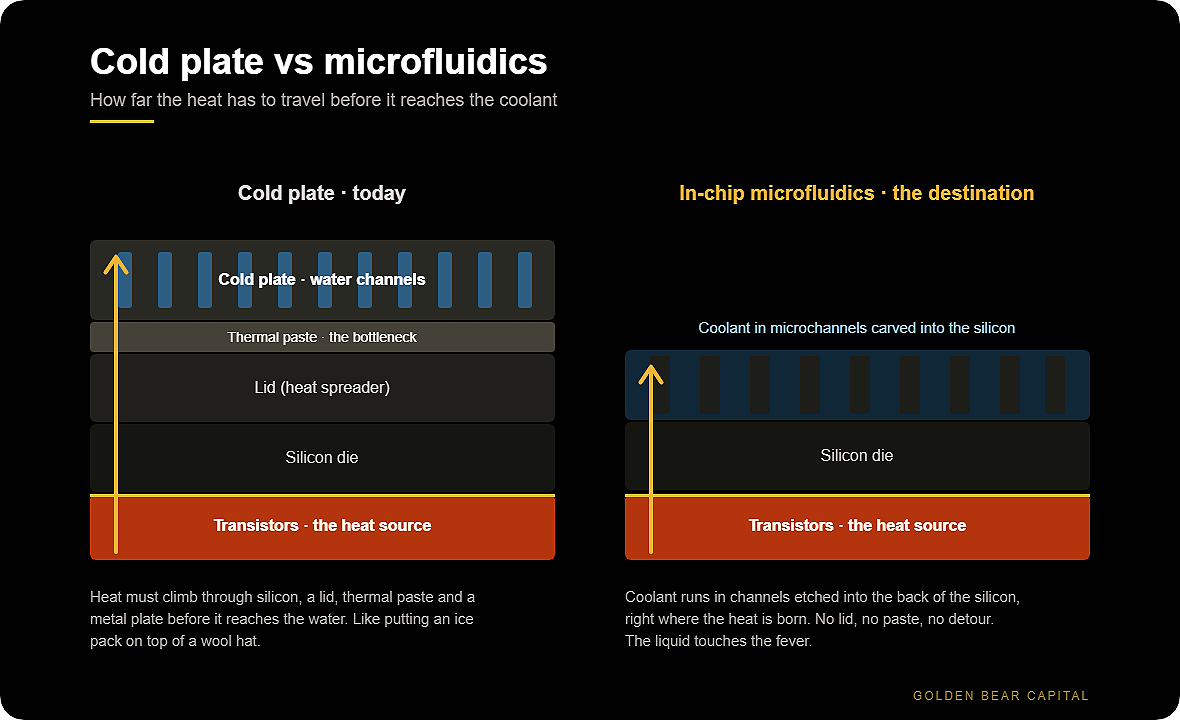
The clever part is the shape of the canals. Microsoft, working with the Swiss startup Corintis, used AI to map the unique hot spots on a chip and then designed channels that branch like the veins in a leaf, steering more coolant to the hottest zones and less to the cool ones. The result, in their lab tests, was heat removal up to three times better than the best cold plates, and a peak silicon temperature drop of around 65 percent.
Il resto di questo pezzo: i nomi, i livelli, la gestione.The rest of this piece: the names, the levels, how we manage it.
Ogni domenica dieci titoli con i livelli scritti, la lettura del mercato e la chat in cui pubblichiamo entrate e uscite mentre le facciamo. Disdici quando vuoi dal tuo account Substack.Every Sunday, ten names with the levels written down, the market read, and the chat where we post entries and exits as we make them. Cancel any time from your Substack account.
Già abbonato?Already a subscriber? Apri l'articolo su Substack →Open the article on Substack →