
Glass vs. organic substrates in AI chip supply chains | X-Ray 30b
The Glass Beneath The AI: How a material older than civilization is about to rewire the future of computing

In this new deep research, we’re breaking the topic into 2–3 parts since it’s pretty complex and we want to keep it as digestible as possible.
It’s also something we had to spend time researching ourselves, as it’s not an area where we have deep expertise. Like other topics we’ve covered in recent months, such as the space economy (Research #26) or the growing strain on electrical infrastructure from the rise of data centers (Research #27), it starts as a broad idea but can uncover new investable themes.
These themes can help identify publicly traded players positioned to benefit from the trend. In fact, in the second part of the analysis, which we’re aiming to release as early as next week, we’ll highlight at least one listed company that could be a strong opportunity if you believe this theme will play a meaningful role in the future of AI.
First part below, Equity X-Ray: In-Depth Research #30a.
THE MEGATREND, THE CONNECTIONS, AND THE MONEY GAME
Now that you understand what glass substrates are, let’s talk about why this matters as an investment theme, and why the second and third-order effects of this transition are far larger than most people realize.
The Fog of Direction
Before we get excited, let’s be honest about something. Unlike the transition from copper to optical interconnects, where the direction was clear and the only question was timing, the substrate battlefield is genuinely uncertain.
Multiple futures are competing simultaneously.
This is not a story about a guaranteed winner. It’s a story about a massive structural shift where the spoils will go to whoever can navigate the fog.
Three camps are fighting for the future of chip packaging.
The glass camp believes glass substrates will replace organic substrates as the foundation of AI chips. Intel has invested over a billion dollars and holds nearly half of all patents in this space. Samsung has assembled the most ambitious vertical integration of any player, with its SEMCO subsidiary handling glass-core substrates, Samsung Display contributing large-area glass-processing expertise, and Samsung Foundry covering packaging integration. Absolics, a subsidiary of SKC, built a $600 million factory in Georgia and secured $175 million in US government support through the CHIPS Act.
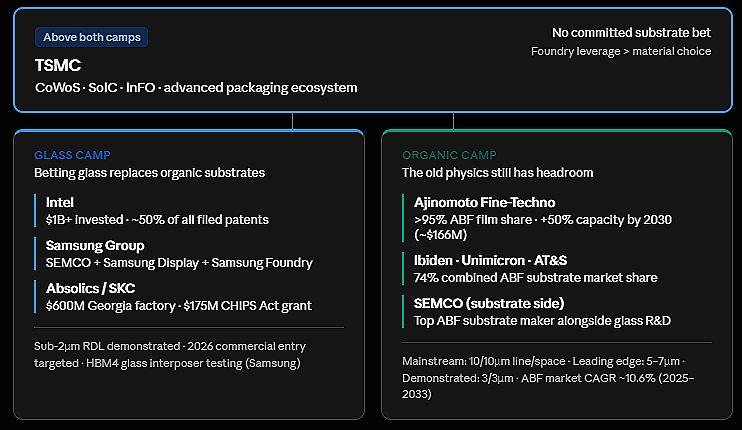
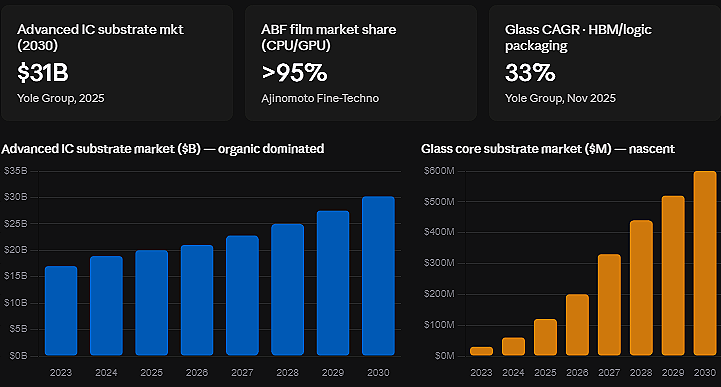
The organic camp argues that the old physics isn’t dead yet. Ajinomoto’s ABF film commands over 95% of the global market for organic substrate insulation material. Current mainstream products sit at a line/space of around 10 micrometers, but leading-edge processes are already hitting 5 to 7 micrometers. The industry has officially entered the sub-5-micrometer race, with 3/3-micrometer demonstrations already on the table. There’s still meaningful headroom before any physical wall.
And then there’s TSMC, which sits above both camps and plays all sides simultaneously!

TSMC: The Kingmaker Who Holds the Bottleneck
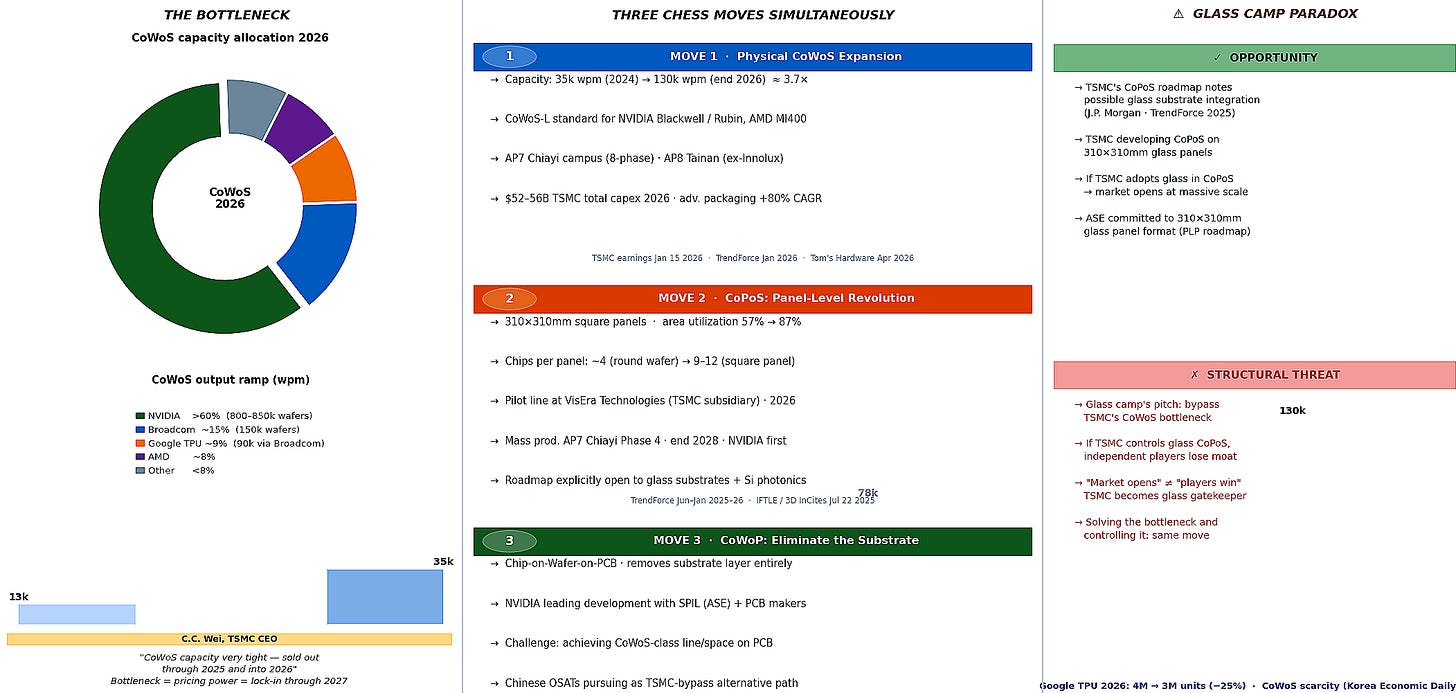
The single biggest reason glass substrates surged as a potential savior is TSMC’s crippling CoWoS bottleneck. As AI chip die sizes explode, the CoWoS lines producing silicon interposers cannot remotely keep up with demand. NVIDIA is estimated to consume over 60% of the total capacity. AMD, Broadcom, and Google split what remains.
Google, unable to secure sufficient CoWoS capacity, reportedly lowered its 2026 TPU production volume from 4 million units to 3 million.
Samsung is conducting marketing to offer advanced packaging as a turnkey solution bundled with DRAM and foundry services to Google, AMD, and Amazon.
The bottleneck is real, and it is reshaping the entire AI supply chain.
But here’s the second-order thinking that most people miss: TSMC has no urgent incentive to solve this bottleneck.
Bottlenecks are inherently cruel in their duality. When demand overwhelms supply, pricing power shifts entirely to the supplier. NVIDIA has pre-booked substantial CoWoS capacity through 2027. That is lock-in. That is pricing power. That is the most powerful weapon in the semiconductor industry.
TSMC is playing three chess moves simultaneously.
First, pure physical expansion of CoWoS production capacity, with plans to increase monthly output by over 60 to 70% compared to current levels by the end of 2026. Second, CoPoS, Chip-on-Panel-on-Substrate, which uses massive 310x310mm square panels instead of round wafers, minimizing wasted edge area. TSMC’s subsidiary VisEra Technologies will run a pilot line in 2026 and begin mass production by late 2028, with NVIDIA as the expected first customer. Third, CoWoP, Chip-on-Wafer-on-PCB, which would eliminate the substrate layer.
The critical insight: TSMC’s CoPoS roadmap explicitly leaves the door open for glass substrates or silicon photonics.
If TSMC adopts glass, the market opens. But the fundamental premise of the glass camp, offering an alternative that bypasses TSMC, begins to erode. For independent glass players, this is a painful double-edged sword.
The Six Signals to Watch
Rather than predicting winners, the smart approach is to watch for specific signals that will tell you which way the fog is clearing.
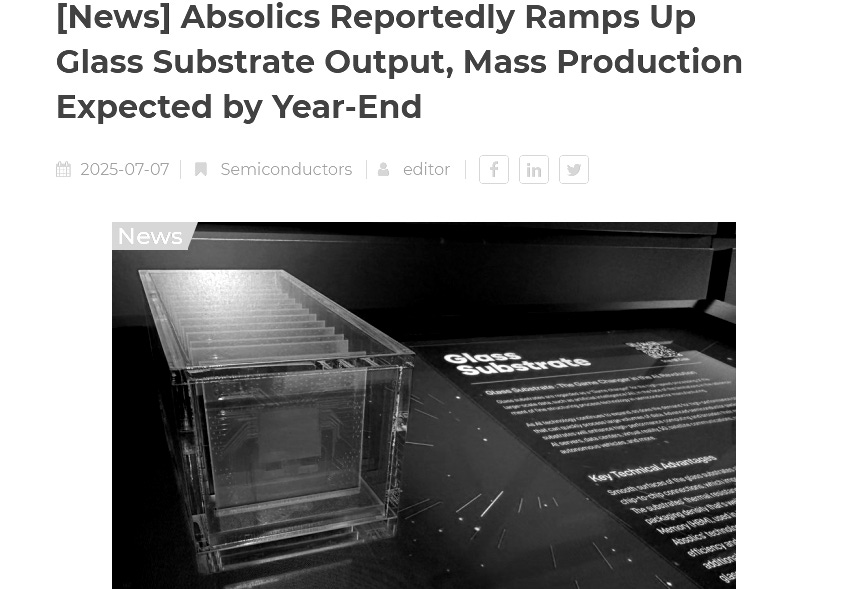
In the glass camp: Absolics’s first purchase order from AMD would be the first-ever glass mass production milestone in history, the moment experiment becomes industry. Samsung’s qualification gate matters because one company’s success is an experiment, but when a second player is verified, it finally becomes an industry.
In the organic camp, Ajinomoto ABF sub-5 micrometer mass production would prove the old guard holds. Intel EMIB going mainstream with Apple, Qualcomm, or MediaTek would prove that organic-based high-density packaging can handle next-gen chiplet integration without glass.
In the TSMC platform: VisEra CoPoS panel pilot utilization and CoWoP feasibility. The latter has a low probability but the highest destructive potential. If CoWoP reaches orbit, the substrate category itself ceases to exist. Glass, organic, every camp loses its reason for being simultaneously.
The Second and Third Level: Where the Real Money Is
Here’s where most retail investors stop thinking. They see “glass substrates” and think “buy glass substrate companies.”
But the real opportunity, and the real risk, is in the equipment layer.
Think about the early television broadcast era. Nobody got rich betting on which TV network would dominate the airwaves. CBS, NBC, and ABC fought each other for decades, spending fortunes on programming, talent, and distribution rights. The real fortunes were made by the companies that built the transmission towers, the broadcast antennas, and the signal amplifiers. Every network, no matter how the ratings war played out, had to buy the same infrastructure to get its signal out. The equipment makers collected a check from all of them.
The glass substrate transition requires entirely new manufacturing processes. You cannot make glass substrates with the same equipment you use to make organic substrates. You need specialized wet-process equipment for etching, plating, cleaning, and metallization. You need TGV formation equipment. You need chemical-mechanical polishing. You need plasma etching systems. Every glass substrate factory that gets built needs to be equipped from scratch.
This is the picks-and-shovels angle. And it applies whether glass wins, whether organic substrates evolve, or whether some hybrid approach emerges. Advanced packaging is getting more complex regardless of the material. The equipment to manufacture it is getting more specialized, regardless of who wins the substrate war.
The semiconductor equipment market is projected to grow to over $1 trillion by 2030, according to the Global Semiconductor Alliance. Advanced packaging equipment is one of the fastest-growing segments within that. The Boston Consulting Group projects the market for advanced microchip packaging to grow to more than $96 billion by 2030.
The Three Supercycles Converging
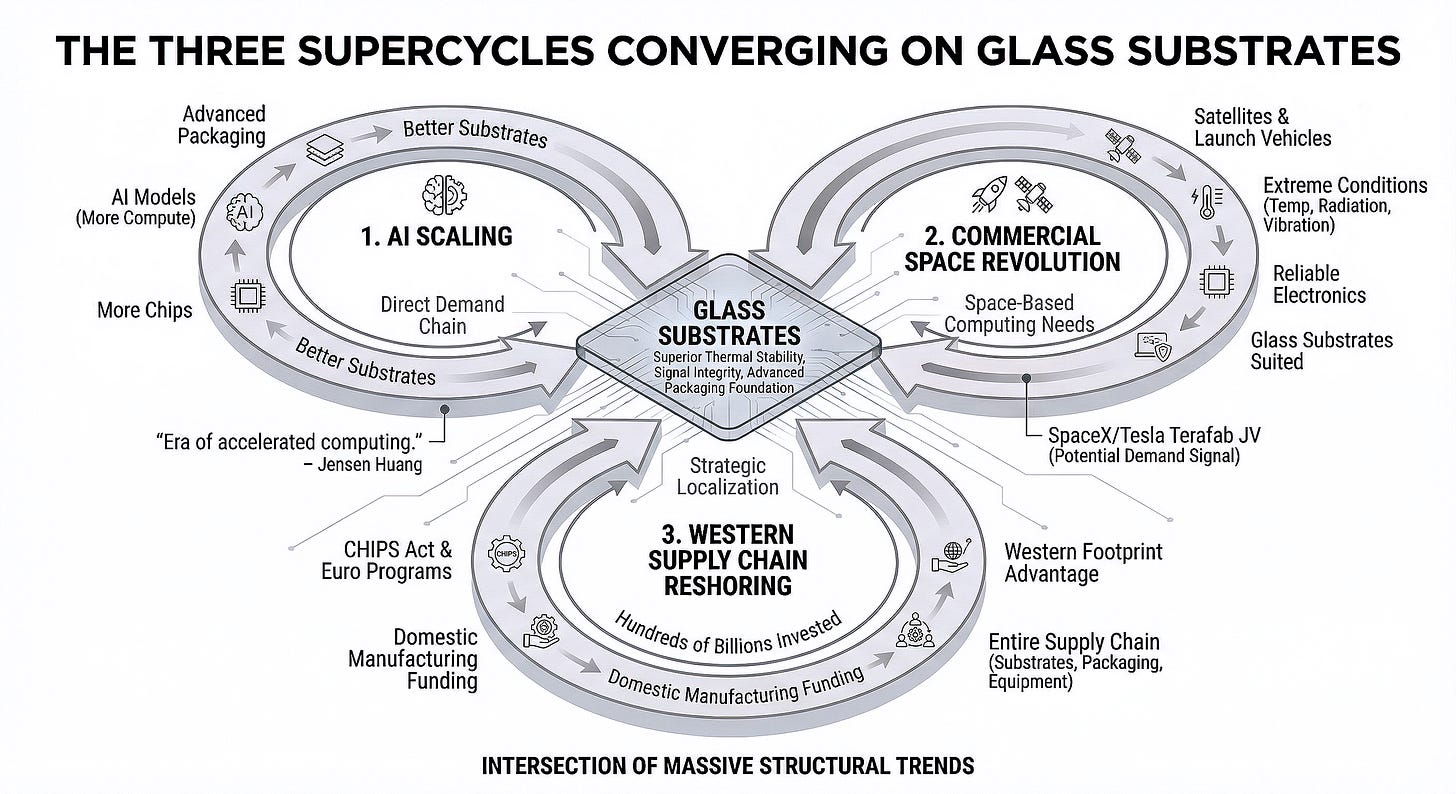
The glass substrate story doesn’t exist in isolation. It sits at the intersection of three massive structural trends that are all accelerating simultaneously.
The first is AI scaling. Every major AI model requires more compute. More computing requires more chips. More chips require more advanced packaging. More advanced packaging requires better substrates. The chain is direct, and the demand is not going away. NVIDIA’s Jensen Huang has been explicit: the era of general-purpose computing is over. We are in the era of accelerated computing, and that means the packaging layer becomes as important as the chip itself.
The second is the commercial space revolution. Satellites, launch vehicles, and space-based computing all require electronics that can survive extreme temperature swings, radiation, and vibration. Glass substrates, with their superior thermal stability and signal integrity, are naturally suited for these applications. There is significant speculation, backed by circumstantial evidence, that SpaceX is already a customer of certain advanced substrate equipment providers. The Terafab joint venture between Tesla and SpaceX, announced in early 2026, would represent an enormous demand signal for next-generation electronics manufacturing equipment.
The third is Western supply chain reshoring. The CHIPS Act in the United States and equivalent programs in Europe are pumping hundreds of billions of dollars into domestic semiconductor manufacturing. This is not just about wafer fabs. It’s about the entire supply chain, including substrate manufacturing, advanced packaging, and the equipment to produce all of it. Companies with established Western manufacturing footprints and the ability to support reshoring customers are in a structurally advantaged position.
The Embedded Trace Wildcard
There’s one more technology that deserves attention because it sits at the intersection of all these trends and is currently flying under the radar of most investors.
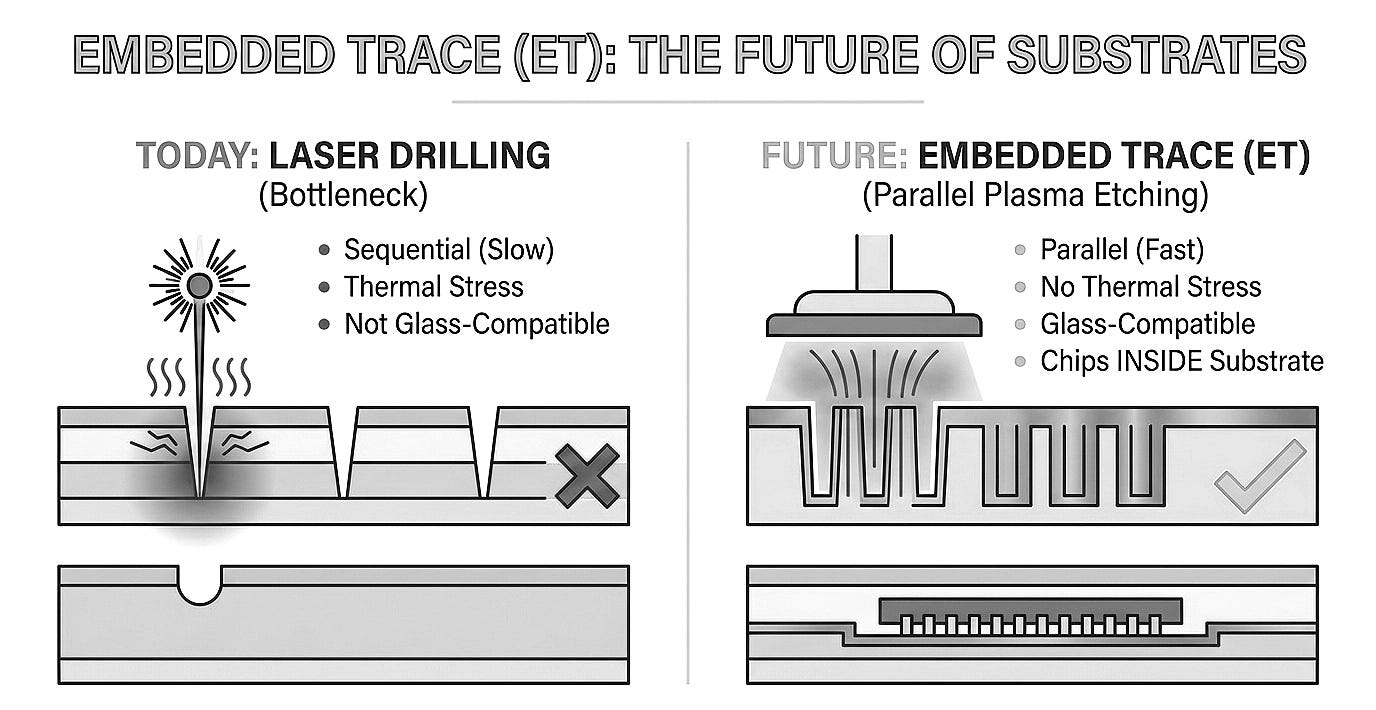
Embedded Trace technology, or ET, is a fundamentally different way to produce substrates and high-density PCBs. Instead of using laser drilling to create connections, ET uses parallel plasma etching processes. Traces are first embedded in the insulator material and then filled with copper in the already-etched structure.
Why does this matter? Because laser drilling is a bottleneck. It’s sequential, it’s slow, and it creates thermal stress in the material. Plasma etching is parallel, it’s faster, and it’s compatible with glass substrates. The ET process can also be combined with glass cores, allowing for an extension of its use for next-generation products.
The embedding concepts allow for the implementation of chips directly inside the substrates. Read that again. Chips inside the substrate. Not on top of it. Inside it. This is a fundamentally different architecture that could compress the entire packaging stack and deliver performance improvements that neither organic nor glass substrates can achieve on their own.
Our analyst put it bluntly: “We might not need laser drilling where we are going.”
The Photonics Angle: Light Inside the Substrate
The deepest long-term implication of glass substrates is one that almost nobody is talking about yet: optical interconnects inside the substrate itself.
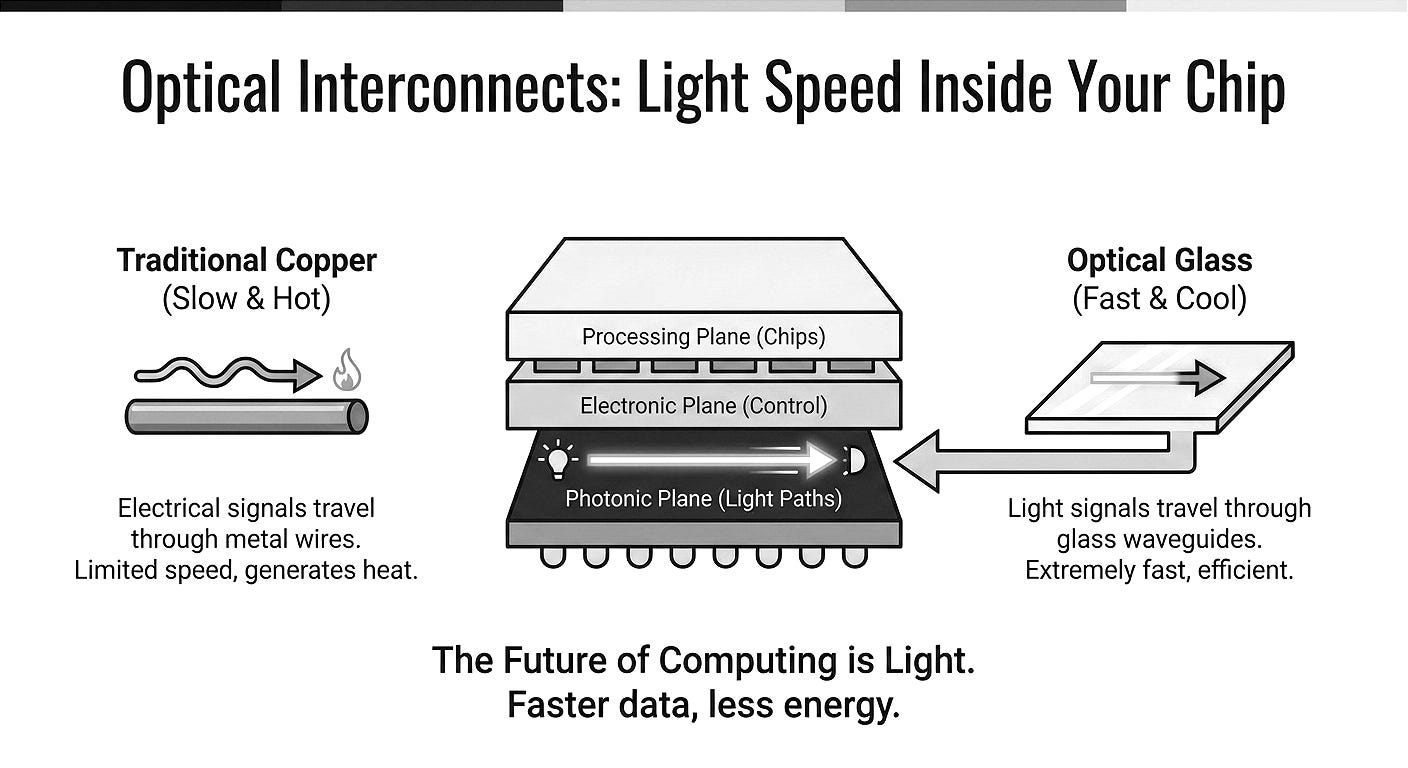
Today, optical interconnects are being deployed at the module level, replacing copper cables between servers. The next frontier is bringing optical interconnects inside the chip package, replacing copper traces between chiplets. The frontier after that is embedding optical waveguides inside the substrate itself, so that light travels through the glass foundation of the entire package.
Glass is transparent. It is the natural medium for optical waveguides. A substrate where electrical signals convert to optical signals and travel between chips at the speed of light is not science fiction. It is the logical endpoint of the trajectory that the industry is already on. New Silicon Corporation, a Singapore-based spinoff from MIT's co-research institute SMART, demonstrated over 20 times bandwidth density compared to copper by combining silicon nitride waveguides with micro-LED arrays at Asia Photonics Expo in February 2026.
The companies building the equipment to process glass substrates today are building the foundation for the photonic computing era of tomorrow. That is a very long runway.
Disclaimer: This analysis is for informational purposes only and should not be considered financial advice. Always conduct your research and consult with a licensed financial advisor before making investment decisions.
Questo pezzo era gratuito. Il prossimo arriva domenica.This piece was free. The next one lands on Sunday.
Dieci nomi con i livelli, la lettura del mercato, la chat con le posizioni in diretta. Con l'abbonamento leggi tutto; senza, ricevi la parte gratuita via email.Ten names with their levels, the market read, the chat with live positions. Subscribers read everything; free readers get the free part by email.