


The call came through at 3:47 AM London time. Not a phone call, those don’t matter anymore. A Bloomberg terminal alert, the kind that makes your stomach drop before your brain catches up. Tehran. Khamenei. Dead. Coordinated strikes. Forty days of mourning were declared before the smoke cleared.
I’ve been in this business long enough to know that the first casualty of war isn’t truth: it’s sleep. The second is certainty. By the time most people were pouring their morning coffee, oil futures had already rewritten the day’s script.
Brent crude didn’t wait for confirmation. It never does.
Here’s what they won’t show you in the sanitized market commentary: while state broadcasters in Tehran were announcing two hundred casualties, traders in Singapore were already repositioning. Not because they’re callous (though some are) but because capital doesn’t observe moments of silence. It moves in the dark, repricing risk while the rest of us are still trying to figure out what just happened.
When the Door Was Open
I remember the first time I understood this, really understood it.
It was 2011, watching screens flicker with news from Tripoli while my colleague (a guy who’d spent three years building a North Africa energy book) sat frozen at his desk. His entire thesis was evaporating in real time, and all he could do was watch the numbers bleed. That’s the thing about geopolitical events: they don’t care about your models. They don’t care about your conviction. They just are.
Iran has been in a ghost position for decades. A country that exists in the market imagination as pure potential energy—massive reserves, educated population, strategic geography—all of it locked behind a door nobody could quite figure out how to open. Every few years, someone would pitch the “Iran normalization trade” with the enthusiasm of a prospector who’d just found color in the pan.
And every time, the door stayed shut.
The Shah’s Iran, Mohammad Reza Pahlavi’s version, was the last time the door swung wide. Rapid industrialization, women in universities, a modernization campaign that looked, from a distance, like progress on fast-forward. But progress built on a foundation of political concrete has a way of cracking. Dissent didn’t disappear; it went underground, gathering pressure like water behind a dam. When Khomeini returned from exile in 1979, that dam didn’t just break, and it obliterated the landscape.
What followed was forty-five years of a different kind of calculus. The Islamic Republic became a study in how ideology and economics can coexist in permanent tension. By late 2025, the toman was trading at 140,000 to the dollar: not a currency, really, but a slow-motion confession of structural failure. For anyone trying to model Iranian risk, that number told you everything: this was a system running on fumes and willpower.
Now, in the wreckage of Saturday morning, a different name is circulating. Reza Pahlavi. The son. The exile. The guy who’s been waiting in the wings for longer than most traders have been alive. Some protesters have been waving the old Lion and Sun flag, the pre-revolutionary symbol that carries the weight of a different national memory. Whether that’s nostalgia or a genuine appetite for restoration is impossible to say from here.
Revolutions are easy to start. Building what comes after, that’s the hard part. And markets, for all their supposed efficiency, are terrible at pricing the difference between collapse and renewal. They can tell you what just broke. They can’t tell you what might grow in its place.
The Cost of Rationed Possibility
I’m writing this from a European perspective, which means I carry my own biases. I grew up in a world where institutions bend but rarely shatter, where change happens through negotiation and incremental reform. That lens makes it hard to fully grasp what it means to live for decades under a system that rations not just goods, but possibility itself. The economic cost of that isn’t just measurable in currency depreciation or capital flight: it’s in the ideas never pursued, the businesses never started, the human potential that atrophies in the absence of oxygen.
If Khamenei is truly gone (and the fog of war makes certainty a luxury), then Iran is entering a period where the only thing guaranteed is uncertainty. Markets will try to price it. They’ll build scenarios, assign probabilities, and hedge exposures. But the truth is messier than any model can capture.
This isn’t a binary outcome. It’s not “regime change equals opportunity” or “instability equals risk.” It’s both, simultaneously, with a thousand variables nobody can see yet.
What Gets Built in the Dust
Iran has the resources. It has the people. What it hasn’t had, for a very long time, is the political architecture that allows those two things to combine into something productive. Whether Reza Pahlavi—or anyone else—can build that architecture is the question that will define the next chapter.
Trump says operations will continue. Iranian sources are still counting bodies. And somewhere, in a quiet room far from the headlines, someone is already building the model for what comes next.
Because that’s what we do. We don’t stop. We can’t afford to.
We are currently developing an application.
It is not a generic solution for every market participant, but a platform built specifically for swing trading, momentum strategies, and short to medium-term investing.
If we see meaningful interest, we will open a limited number of testing spots and allow selected users to access the platform early.
As previously stated, all paid subscribers will receive full access to the platform at no additional cost.

Latest articles:


Each stock carries a risk badge: ⚠️ High | 📊 Medium | 🛡️ Low.
Based on volatility, float, technicals, and fundamentals. Size your positions accordingly.
📈 Free Setup: Make It Count
ATOM: Atomera Incorporated ⚠️
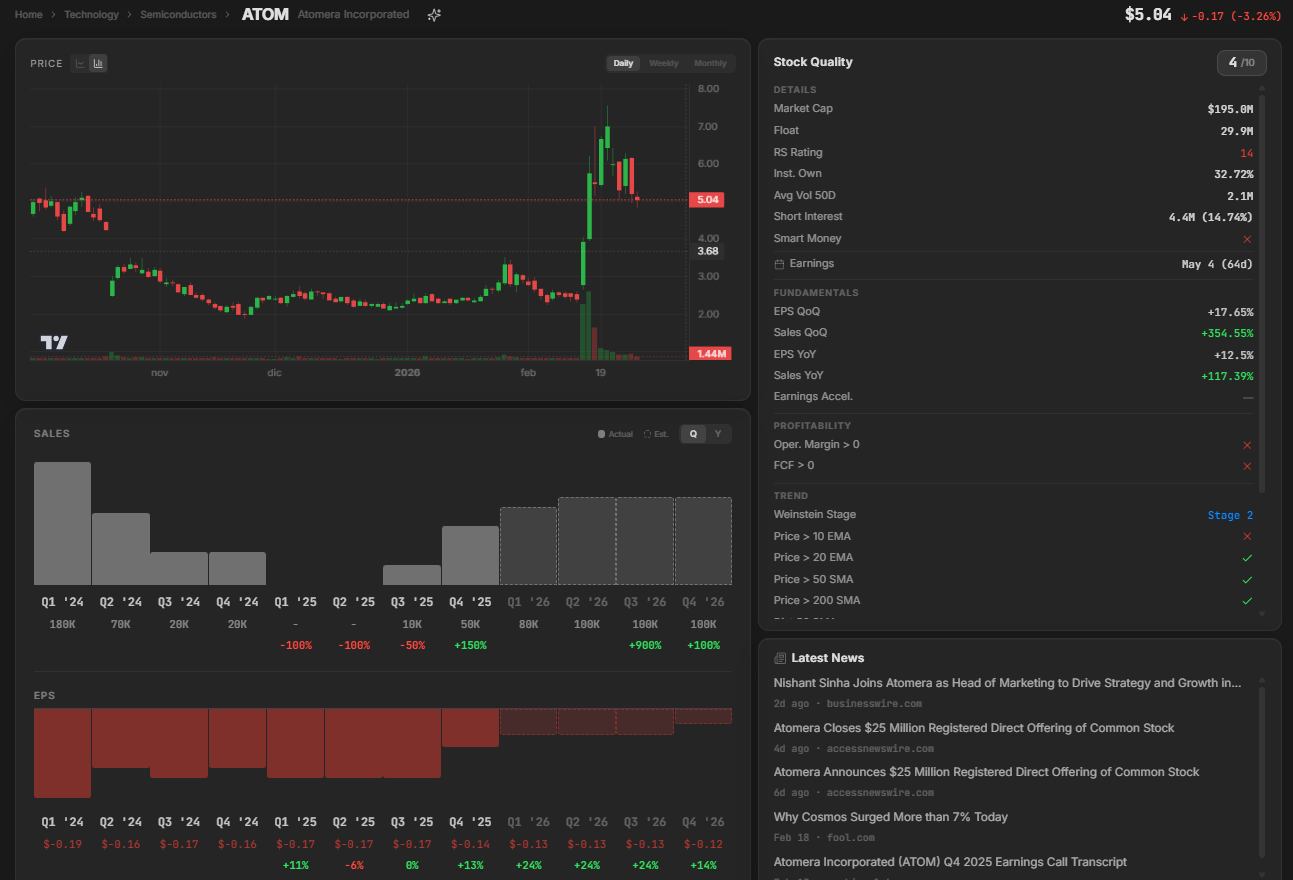
What they do: A semiconductor materials and technology licensing company
Why watch? Atomera operates in one of the most consequential corners of the semiconductor industry right now. The company’s core technology, called MST (Mears Silicon Technology), is a materials-level innovation that can be applied during the chip manufacturing process to improve yield, control dopant diffusion, enhance performance, and reduce variability. For non-engineers: think of it as a coating or treatment applied during chip production that makes the final product more reliable and efficient, without requiring chipmakers to redesign their entire manufacturing process.
The timing couldn’t be more relevant. The semiconductor industry is pushing toward increasingly miniaturized transistor architectures, including Gate-All-Around (GAA) transistors, which are critical for the next generation of AI GPUs, CPUs, and networking chips. At these extreme scales (2 nanometers and below), manufacturing becomes extraordinarily difficult, and yield (the percentage of chips that come out of production working correctly) becomes the defining competitive variable. Atomera has established a strategic partnership with a large equipment OEM specifically to address these manufacturing challenges, a meaningful validation of the technology’s relevance at the frontier of chip production.
The company is also making progress in DRAM and RF-SOI markets, two additional high-value segments where MST’s diffusion-blocking capabilities could command premium licensing fees. Government-funded collaborative development programs represent another emerging opportunity, diversifying the company’s customer pipeline beyond traditional commercial chipmakers.
Now, the elephant in the room: Samsung. The Korean giant is currently laser-focused on improving margins by concentrating on high-margin, high-yield products: server DRAM, High Bandwidth Memory (HBM), and advanced nodes. To hit 50% profit margins, Samsung must improve yield, reduce defects, and maximize performance per wafer. Atomera’s MST technology directly addresses each of these pain points. If the technology delivers on its promises at Samsung’s scale, the licensing revenue potential would be transformative for a company of Atomera’s size. That said, it’s important to be clear-eyed: this remains a compelling story with significant execution risk. No licensing agreement has been announced, and the company is still in the process of proving commercial adoption at scale.
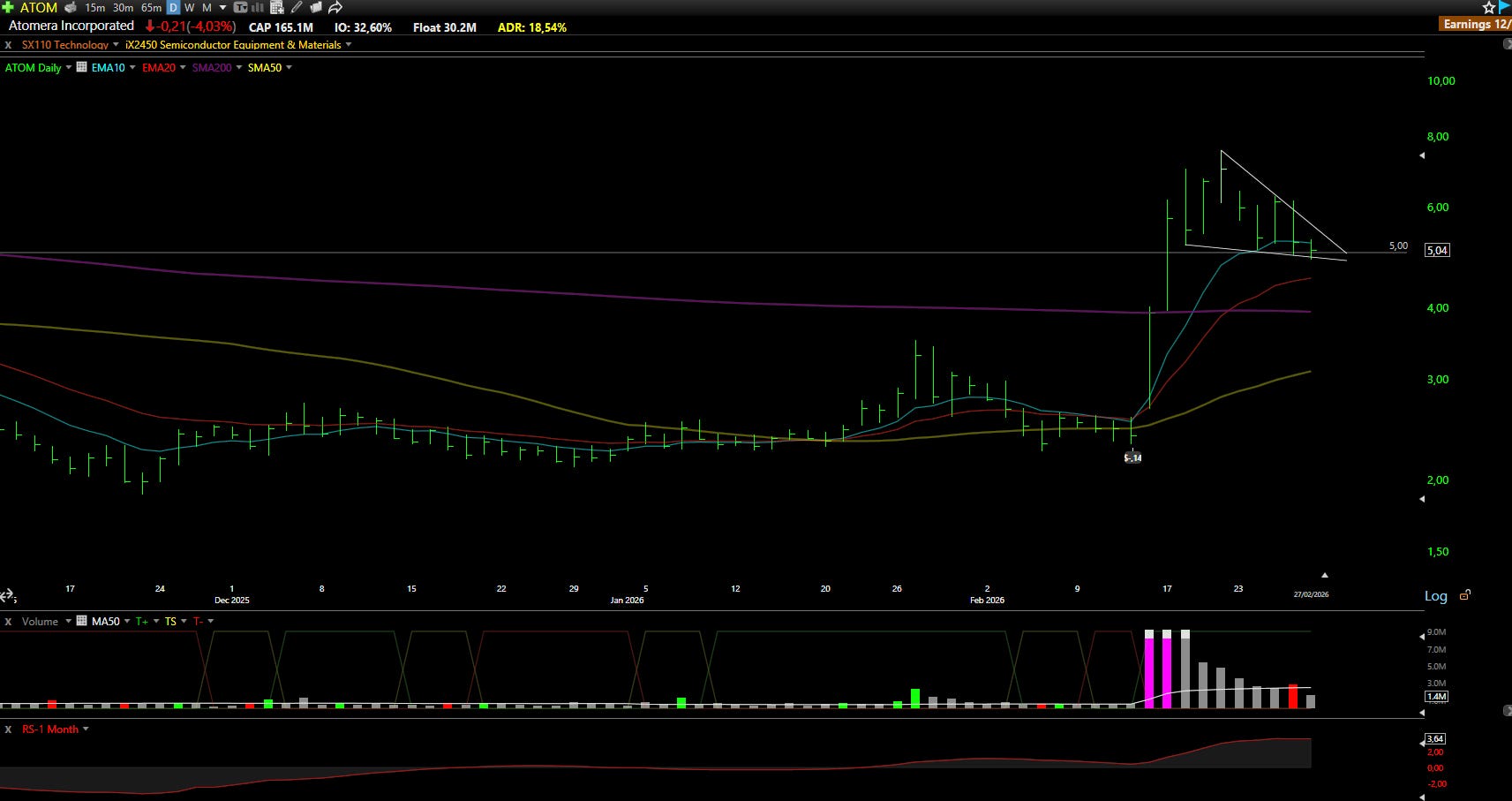
The company recently closed a $25 million registered direct offering at $5.00 per share with institutional investors. This capital raise provides runway to continue development and customer engagement while the licensing pipeline matures.
Technical Outlook: After an extraordinary 200% run accompanied by the highest weekly volume in the company’s history (over 30 million shares one week, followed by over 60 million the next, compared to a previous peak of just 13 million), the stock is now experiencing its first meaningful pullback. This is exactly the kind of consolidation you want to monitor closely. Notably, volume on the pullback has been light, suggesting sellers are not aggressively distributing shares. The $5.00 level is the critical weekly support that buyers must defend. The stock may seek the 20-day EMA rather than the 10-day as its natural resting point before the next move. A clean break above $5.50 would signal resumption of the uptrend, but patient investors can look for an earlier entry on a strong defense of $5.00—or a brief shakeout below that level followed by a swift recovery, which would be an even more constructive signal.
Why We Don’t Wait for Sunday
Markets don’t move on your schedule. The best low-risk entries don’t announce themselves politely and wait for the weekend newsletter.
They show up when they show up. And if you’re not positioned, you miss them.
Paid members get real-time alerts: exact entries, stops, position sizing, and the thesis behind every trade. The same information we use to manage our own capital.
Free members get just one pick on Sunday.
Does that sound like an edge to you?
What’s Inside Premium
📊 Watchlist Elite (7-9 Stocks)
Each selection undergoes rigorous financial analysis, technical evaluation, and strategic assessment.
💼 Full Portfolio Transparency
Every position we hold. Entry price. Current P&L. Stop level. Real money, real risk.
⚡ Real-Time Trade Alerts (Chat Access)
This is where the edge lives. Exact entries, stops, and position sizing. Real-time. No lag
🎯 Quick Picks (5 Names)
Additional setups that just missed our main criteria but are worth watching.
💬 Chat Access
See our thought process in real time. Ask questions. Watch how we manage risk.
🛠️ The Tools We Actually Use
Member discounts on TC2000, Fiscal.ai, and other platforms. Same tools, better pricing.
What Paid Members Say:
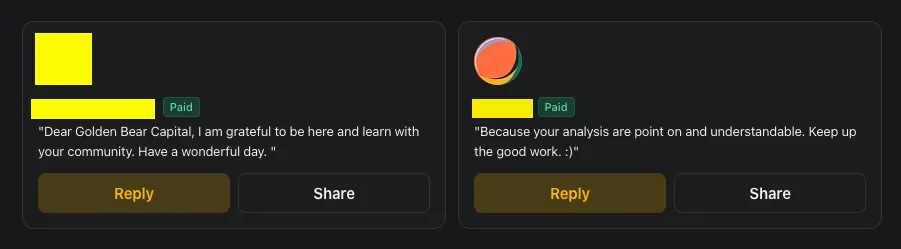
We’re entrepreneurs first, traders second. We’ve sat in the CEO chair. We know what real execution looks like and how to spot it.
€39/month or 299€/year. Less than one losing trade. Cancel anytime.
