
2026 investment themes: space, AI and infrastructure | X-Ray 29
2026 Investment Frontiers: The Themes That Will Shape the Future

“The future is already here. It’s just not evenly distributed.”
William Gibson
We do not attempt to predict the future. Markets have a long history of humbling anyone who claims to see too far ahead. What we do aim to do is identify signals, tensions and structural shifts that are beginning to emerge, often quietly, at the edges of consensus.
The investment themes presented here are not forecasts for 2026, nor are they timelines. Some of these trends may take longer to fully materialize. Others may evolve in ways that differ from today’s expectations. What they share is relevance, each represents a set of forces that we believe will matter increasingly over the coming years.
These themes are intended as lenses through which to observe markets differently. They are tools for reflection and deeper analysis, designed to challenge conventional framing and highlight areas where long-term change may be underestimated or misunderstood.
Some of these themes are already moving toward the mainstream.
Others focus on dynamics that, in our view, have not yet received sufficient attention from investors. Together, they offer a structured way to think beyond short-term narratives and consider where durable opportunities may gradually take shape.
The following six themes reflect our current thinking on where it may be worth paying attention, not only in 2026, but well beyond.
THEME 1: THE SPACE ECONOMY & ORBITAL INFRASTRUCTURE REVOLUTION
The next leg of the space economy won’t be defined by satellites alone. It will be defined by infrastructure in orbit (computing, energy, defense, and logistics) and the economics are moving faster than most investors realize.
The most underappreciated opportunity is orbital data centers and space-based computing. AI workloads are on track to consume roughly 8% of U.S. electricity by 2030, pushing terrestrial power grids and cooling systems toward their limits. Space solves both problems at once. In orbit, solar power is continuous and cooling is effectively free. No land costs. No massive HVAC systems. No local energy bottlenecks.
This isn’t theoretical at all. Starlink’s latest V3 satellites already operate with terabit-class onboard data processing, functioning as distributed computing nodes in space. Nvidia-backed Starcloud and Alphabet’s Project Suncatcher are pushing in the same direction. Once computation moves closer to where data is generated, orbital infrastructure stops being a science project and starts looking like a cost advantage.
Want the full picture on the space economy and its biggest opportunities? Check out our detailed deep dive here.
The SpaceX IPO is the inevitable catalyst that forces the market to take all of this seriously. A public listing around 2026 at a valuation rumored near $1.5 trillion would do more than unlock liquidity, it would validate the entire sector. Starlink alone generates roughly $6.6 billion in annual revenue from over six million subscribers, and that figure doesn’t include any future orbital computing revenue. Once SpaceX trades publicly, institutional investors will be forced to build space exposure. Capital won’t stop at one ticker. It will flow downstream into suppliers, infrastructure providers, and adjacent platforms.
At the same time, space is becoming militarized, and defense spending is accelerating accordingly. The U.S. Space Force budget is growing at roughly 15% per year, focused on satellite defense, space domain awareness, and counter-space capabilities. The companies best positioned here are those with dual-use technologies, commercial platforms that also serve national security needs. Historically, that overlap is where the fastest and most durable growth occurs.
All of this is happening against the backdrop of collapsing launch costs. The economics have shifted dramatically. Launch costs have fallen from roughly $65,000 per kilogram during the Space Shuttle era, to about $1,500 per kilogram with Falcon 9, and potentially to $100 per kilogram with Starship. That’s a 650-fold reduction. It’s the space equivalent of the bandwidth explosion in the 1990s, and it enables entirely new business models: orbital manufacturing, space tourism, asteroid mining, and even point-to-point Earth transport via suborbital flights.
Finally, there’s the satellite constellation arms race. Amazon’s Project Kuiper, China’s Guowang, and OneWeb’s continued expansion are turning satellite internet into a multi-trillion-dollar market. But the real opportunity isn’t necessarily in owning the constellations themselves. It’s in the picks and shovels: ground station equipment, satellite components, launch services, and orbital servicing. The satellite industry today looks a lot like semiconductors in the mid-1990s: early, fragmented, and on the verge of exponential scale.
MACRO TAILWINDS
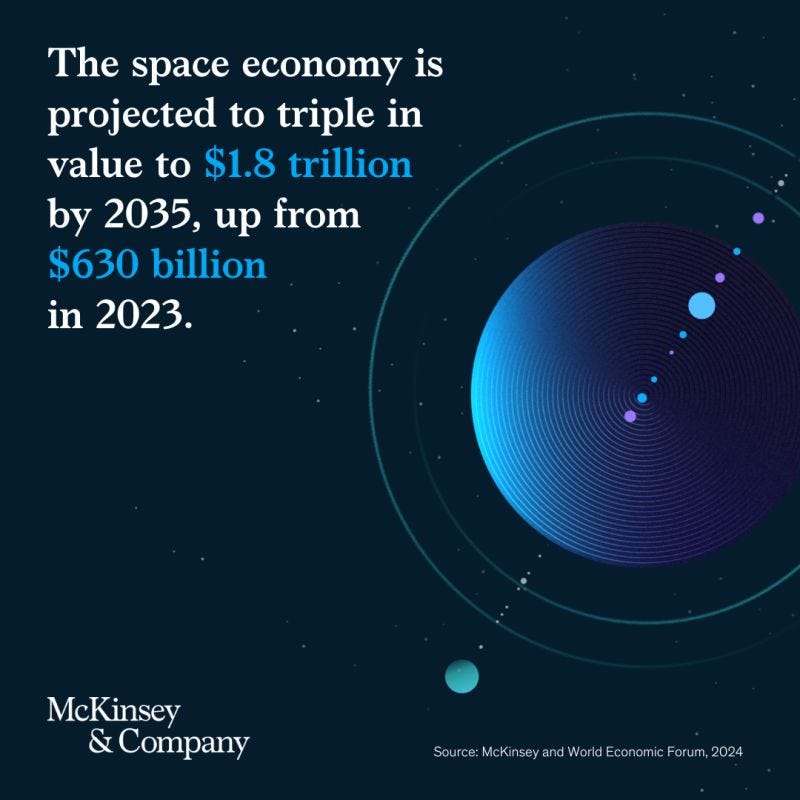
The macro picture is unambiguous. The global space economy is expected to grow from roughly $630 billion in 2023 to $1.8 trillion by 2035. Commercial activity now accounts for nearly 80% of all space activity, upending decades of government dominance. More than 60 countries have active space programs, compared to just 10 at the turn of the century. Since 2013, private investors have deployed over $270 billion into space-related ventures. This is no longer a niche. It’s an industrial transition.
RISKS
None of this is risk-free. Regulatory uncertainty remains a real overhang, particularly around spectrum allocation, orbital debris, and space traffic management. Technical execution risk is non-trivial: Starship delays, satellite failures, and scaling challenges can derail timelines. Geopolitical tensions introduce another layer of complexity as space becomes a contested domain. And valuation risk is real: if the SpaceX IPO underwhelms, sentiment across the sector could compress quickly.
Still, when costs collapse, infrastructure scales, and capital is forced in by benchmark pressure, entire industries get repriced. Space is entering that phase now.
STOCK PICKS:
1. Rocket Lab USA (RKLB)
Only pure-play public launch company
Electron rocket: 50+ successful launches
Neutron rocket (2026 debut): Falcon 9 competitor
Space systems division: satellites, components, reaction wheels
Valuation: $8B (vs SpaceX $180B) = massive upside if execution continues
2. Lockheed Martin (LMT)
Largest space revenue of any public company ($12B annually)
Builds GPS satellites, missile defense systems, Orion spacecraft
60-year track record of government contracts
Space segment growing 8% annually with 95%+ margins
Dividend aristocrat with 3% yield
3. Intuitive Machines (LUNR)
First private company to land on the Moon (Feb 2024)
$4.8B contract backlog (NASA, DoD, commercial)
Pivoting to lunar infrastructure: communications, navigation, data relay
Trading at $1.5B market cap vs $4.8B backlog
Binary outcome: either 10x or bankruptcy
4. Iridium Communications (IRDM)
66-satellite constellation providing global voice/data
Government contracts (DoD, intelligence agencies): 30% of revenue
IoT growth: tracking ships, planes, trucks, containers globally
FCF yield: 12% with minimal capex (constellation fully deployed)
Recession-resistant: government + mission-critical commercial

5. Redwire Corporation (RDW)
Only public pure-play space infrastructure company (solar arrays, components, in-space manufacturing)
Roll-Out Solar Arrays (ROSA) on ISS + commercial satellites
In-space manufacturing on ISS: producing fiber optics, pharmaceuticals, and semiconductors in microgravity
Strong Backlog despite share decline and underwhelming recent earnings
Stalker and Penguin UAS platform is giving them an additional drone-focused theme
THEME 2: RENEWABLE ENERGY & GRID MODERNIZATION
The power grid wasn’t built for AI, and it’s starting to break under the load. A single large-language-model query consumes roughly ten times the electricity of a standard search. At scale, that matters. Hyperscalers are no longer marginal buyers of power; they are becoming the grid’s dominant customers. Microsoft, Google, Amazon, and Meta are projected to consume close to 8% of total U.S. electricity by 2030, up from roughly 3% today.
From AI’s massive energy demands to grid upgrades, we’ve mapped the opportunities. Dive into the full analysis here.
To secure supply, these companies are signing 20-year power purchase agreements measured in gigawatts, not megawatts. That demand is arriving faster than nuclear can be built and far faster than renewables alone can support. The immediate beneficiaries are technologies that can deliver reliable baseload power now, not in a decade. Gas turbines, grid infrastructure, and hybrid renewable-plus-storage systems are moving from “energy transition” talking points to hard requirements.
Natural gas turbines are the unavoidable bridge. Renewables are intermittent, coal is politically dead, and nuclear timelines stretch beyond ten years. Gas is the only scalable solution that can come online quickly and operate flexibly. Modern turbines are radically more efficient than legacy fossil infrastructure. High-efficiency combined-cycle units reach roughly 64% efficiency versus around 33% for coal and can ramp output in minutes, not hours. That flexibility is critical for balancing solar and wind. These assets are not short-cycle trades; they run for decades and generate long-tail service revenue.
Energy storage is the other half of the equation, and arguably the most misunderstood. Solar and wind are now the cheapest forms of electricity ever produced, but without storage, they don’t scale beyond a certain penetration. To push renewable penetration past 50%, the grid needs roughly 400 gigawatt-hours of storage by 2030. Today, it has about 20. Lithium-ion batteries dominate current deployments, but their economics and chemistry limit them to roughly four hours of duration. That’s not enough for multi-day outages or seasonal shifting.
Long-duration storage is the real prize. Technologies capable of eight to one hundred hours of discharge fundamentally change grid behavior, enabling renewables to replace baseload generation rather than just supplement it. This is where risk and reward diverge sharply. Zinc-based, iron-air, and other non-lithium chemistries promise lower costs and longer duration, but execution risk is real. If even one of these platforms proves commercially viable at scale, the upside is massive.
Most will fail. A few won’t, and those winners will matter disproportionately.
Underneath generation and storage sits the most neglected asset of all: the grid itself. The U.S. transmission network is more than fifty years old, designed for centralized coal and nuclear plants, not distributed generation and two-way power flows. To make the energy transition work, utilities will need to invest an estimated $2.5 trillion by 2035, upgrading transmission lines, substations, transformers, and grid management software. This isn’t discretionary spending. Without it, the new generation can’t connect, and demand can’t be met.
Grid modernization is a quiet infrastructure supercycle. High-voltage direct current transmission, grid-forming inverters, and real-time orchestration software are becoming mission-critical. Utilities earn regulated returns on these investments, typically around 10% ROE, which makes this one of the more attractive risk-adjusted areas in energy. Once capital spending is approved, it tends to persist for decades.
Offshore wind sits at the edge of this theme: battered, but not broken. The sector went through a brutal reset in 2023 and 2024 as inflation, supply chain disruptions, and financing costs forced project cancellations and renegotiations. The fundamentals, however, haven’t changed. The U.S. still has roughly 30 gigawatts of offshore wind in the pipeline. Europe has about 150 gigawatts, and Asia has closer to 300. These projects will restart once economics normalize. When they do, capacity additions will come in large, discrete steps, not gradually.
MACRO TAILWINDS
For the first time in two decades, U.S. electricity demand is growing meaningfully, at roughly 2.5% annually. Federal policy is reinforcing that trend. The Inflation Reduction Act allocates approximately $369 billion in clean energy incentives, providing long-dated visibility into project economics. Twenty-nine states have renewable portfolio standards, and corporate power purchase agreements have accelerated sharply, with more than 50 gigawatts signed since 2020. The demand signal is clear, sustained, and contractual.
RISKS
Policy remains the most obvious swing factor. Changes to subsidy regimes, tariffs, or permitting timelines could disrupt project economics. Supply chain constraints are real, particularly for transformers and large turbines, where lead times can stretch beyond two years. Higher interest rates matter because these are capital-intensive assets with long payback periods. Execution risk also can’t be ignored, especially for newly independent operators and emerging storage technologies that haven’t yet proven themselves at scale.
Still, when demand accelerates faster than infrastructure can respond, pricing power emerges. Grid reliability, not ideology, is becoming the dominant constraint.
STOCK PICKS:
1. GE Vernova (GEV)
Pure-play energy infrastructure: gas turbines, wind, grid solutions
$110B backlog (2.5x revenue), 60% services (recurring, high-margin)
Trading at 18x 2026 EPS vs 25x for industrials
Spin-off discount will close as execution proves out
10-year infrastructure supercycle ahead
2. Vistra Energy (VST)
Largest independent power producer in the U.S. (39 GW capacity)
Nuclear + gas fleet provides 24/7 baseload for data centers
Signed multi-GW PPAs with hyperscalers at premium pricing
Trading at 8x EBITDA vs 12x for utilities
5% FCF yield with buybacks
3. Eos Energy Enterprises (EOSE)
Zinc-based batteries: 12-hour duration, 40% cost advantage vs lithium
Partnerships with Enel, Holtec, and Ameresco
Pre-revenue to $500M revenue by 2027 (management guidance)
$400M market cap vs $2B+ TAM
Binary: either 50x or zero
4. NextEra Energy (NEE)
Largest renewable operator: 30 GW wind/solar, 3 GW storage
Regulated utility (Florida Power & Light) provides a stable cash flow
10% annual dividend growth for 28 consecutive years
Trading at 22x earnings (fair value for quality)
Recession-proof with 6-8% annual EPS growth
5. Fluence Energy (FLNC)
JV between Siemens and AES, IPO’d 2021
Market leader in utility-scale battery storage (6 GW deployed)
Software platform (Fluence IQ) creates recurring revenue
Backlog: $3.5B (3x revenue), growing 40% annually
Trading at 2x sales vs 4x for software companies
THEME 3: INDUSTRIAL AUTOMATION & ROBOTICS REVOLUTION
Robotics is hitting its inflection point. For decades, progress was real but slow, constrained by brittle software, poor perception, and high integration costs. That bottleneck is gone. Vision, grasping, and navigation — the hard problems — are now largely solved thanks to modern AI.
Humanoid robots are the clearest signal that the industry has entered its “iPhone moment.” After years in research labs, commercial pilots are turning into production roadmaps. Humanoids are a pragmatic response to a messy, human-designed world. Warehouses, factories, hospitals, and retail environments were never built for rails, cages, or fixed automation. Humanoids can climb stairs, open doors, navigate shelves, and use existing tools without requiring facilities to be redesigned.
That flexibility radically expands the addressable market. Any job involving physical manipulation becomes automatable: manufacturing, logistics, healthcare, hospitality, agriculture, and maintenance. In the U.S. alone, that’s roughly 50 million jobs representing about $2.5 trillion in annual labor costs. Even a conservative 5% penetration by the mid-2030s implies a $125 billion market, and that excludes software, maintenance, and service layers. The early deployments at logistics firms and automotive plants are not experiments; they are proofs of economic viability.
Nowhere is the pressure to automate more intense than in warehouses. E-commerce penetration is still only around 16% of retail, yet it continues to grow at roughly 10% annually. Every incremental point of penetration requires roughly ten million additional square feet of warehouse space. Labor accounts for close to 60% of operating costs, while turnover often exceeds 40% per year. This is not a labor optimization problem; it’s a structural shortage problem.
Warehouse automation has shifted from “nice to have” to existential. AI-driven robotic systems that move, sort, and stack goods faster than humans and with near-perfect accuracy are winning contracts because they work. Long-term contracted backlogs measured in decades, not quarters, are becoming the norm. The market continues to price these businesses as hardware vendors, even as their economics increasingly resemble mission-critical infrastructure with high switching costs and recurring revenue.
Collaborative robots represent the next layer of adoption. Traditional industrial robots are powerful but inflexible: caged, dangerous, and expensive to deploy.
Cobots invert that model.
They are safe to operate alongside humans, easy to program, and adaptable to short production runs. That makes them viable for small and mid-sized manufacturers that were previously locked out of automation.
This category is expanding rapidly across machine tending, pick-and-place operations, inspection, welding, and packaging. Growth rates north of 30% annually are sustainable because the value proposition is straightforward: faster deployment, lower training costs, and immediate productivity gains. Importantly, these systems are often purchased by operators, not engineers, accelerating adoption further. The market still undervalues companies with meaningful exposure here because robotics remains buried inside broader industrial portfolios.
Underpinning all of this is a quiet platform shift. Robotics is becoming a software-defined industry, and the companies that control the software stack will capture outsized value. Simulation, perception models, motion planning, and edge computing are no longer bespoke. They are standardized platforms. The parallels to the PC era are obvious: hardware fragments, software consolidates, and ecosystems form around the dominant operating layer.
The total robotics market is projected to reach roughly $160 billion by 2030, but the real leverage sits in the software and compute layers that scale across every form factor: humanoids, mobile robots, arms, and drones. As adoption accelerates, the economics shift decisively toward recurring software revenue, licensing, and embedded compute rather than one-off hardware sales.
The final unlock is the business model. Historically, robotics adoption has been constrained by upfront capital costs. Paying $50,000 to $150,000 per robot makes ROI calculations slow and adoption lumpy.
Robotics-as-a-Service changes that equation entirely. Customers pay hourly rates below fully loaded labor costs with no upfront investment. Vendors retain ownership, manage maintenance, and improve performance through over-the-air software updates.
This transforms robotics from a cyclical capital goods business into a recurring revenue model with SaaS-like characteristics. Predictable cash flows, higher lifetime value per unit, and expanding margins follow. It also aligns incentives: vendors are paid for uptime and performance, not just shipments. As more companies adopt this model, valuation frameworks will adjust accordingly.
MACRO TAILWINDS
The labor backdrop is unambiguous. The U.S. is short roughly ten million workers, with the tightest gaps in warehousing, manufacturing, and logistics. Wage inflation in these categories continues to run near 5% annually. At the same time, the cost curve for robotics hardware has collapsed. Sensor costs are down roughly 80% since 2015, and compute costs have fallen close to 90%. Meanwhile, AI breakthroughs in vision, manipulation, and navigation have removed the last major technical blockers. The economics now favor deployment.
RISKS
This transition is not without risk. Humanoid robots remain largely unproven at a massive scale, and early failures could slow adoption. Regulatory frameworks for workplace safety will evolve, and labor unions will push back in certain sectors. Competition is intensifying, particularly from heavily subsidized Chinese robotics firms willing to price aggressively. Valuation risk is real, especially among early-stage names that assume flawless execution.
Still, when labor is scarce, wages rise, and technology finally works, automation doesn’t slow; it accelerates.
5 STOCK PICKS:
1. Symbotic (SYM)
AI-powered warehouse robotics: $20B backlog, 10+ years of revenue
40% revenue growth, 25% EBITDA margins, path to 35% margins
Walmart owns 17% (strategic partnership + validation)
Trading at 3x sales vs 8x for software peers
Expanding from grocery to general merchandise, cold storage, and e-commerce
2. Teradyne (TER)
Owns Universal Robots: 75% market share in cobots (developing Vulcan for Amazon)
Robotics division: $300M revenue, growing 30% annually
Trading at 20x earnings (cheap for 30% growth)
The semiconductor test business (60% of revenue) provides stability
Robotics will be 50% of revenue by 2030, re-rating multiple to 30x
3. UiPath Inc (PATH)
Robotic Process Automation (RPA): software bots automating repetitive tasks
$10B market cap, $1.4B revenue, growing 20% annually
10,000+ customers, including 75% of Fortune 500
Approaching profitability
TAI integration (UiPath Autopilot) driving next growth wave
4. Xpeng Inc (XPEV)
Leading Chinese EV manufacturer, focused on intelligent, software‑defined vehicles
Proprietary autonomous driving software and sensors integrated across fleet (hardware + AI stack)
Positive gross margins; investing in robotic automation and smart factory initiatives to lower costs
Trades at a discount vs global EV peers despite tech differentiation and scaling production
Advanced driver-assistance systems and robotic production automation are expected to contribute ~20% of value by 2027
5. Ouster (OUST)
Robotics proliferation: Every autonomous mobile robot, delivery robot, and humanoid needs LiDAR (1-4 sensors per robot at $500-2,000 each)
Automotive pivot: Robotaxis (Waymo, Cruise, Zoox) use 5-7 LiDAR sensors per vehicle; Tesla is the outlier (camera-only)
Warehouses, factories, and ports use LiDAR for safety systems, inventory tracking, and collision avoidance
Ouster's technology is solid-state (no moving parts), more reliable, and cheaper than mechanical LiDAR
Dividend yield: 2.5%
$400M market cap, $150M revenue, trading at 2.7x sales (down from 15x at SPAC peak)
THEME 4: THE MENTAL HEALTH REVOLUTION
Mental health treatment is undergoing its most significant transformation in half a century. For decades, the standard of care has been static: SSRIs that take six to eight weeks to work, achieve response rates around 40%, and require daily adherence with significant side effects.
Therapy access has been constrained by supply: half of U.S. counties have zero psychiatrists, and wait times in urban areas stretch months. Meanwhile, the crisis has deepened. Fifty million Americans live with mental illness, 60% of them untreated. Suicide rates are up 30% since 2000. Among Gen Z, depression rates have hit 42%, compared to 28% for Millennials.
New treatment modalities, delivery mechanisms, and business models are converging to reshape the entire sector. The result is a largely stagnant market, now entering a period of rapid innovation and adoption, with implications across biotech, digital health, and employer benefits.
Psychedelic medicine represents the most dramatic shift in psychiatric pharmacology in decades. MDMA for PTSD and psilocybin for treatment-resistant depression are waiting for FDA approval, backed by Phase 3 and Phase 2b data showing remission rates of 67% and 37%, respectively, multiples of placebo and far superior to existing therapies.
They are administered in one to three supervised sessions, with effects lasting six to twelve months. The treatment paradigm is fundamentally different: intensive, short-duration, high-efficacy.
The mental health market is roughly $280 billion annually. If psychedelics capture even 20% to 30% of treatment-resistant cases and expand into adjacent indications (anxiety, addiction, end-of-life distress), the addressable opportunity is $60 billion to $80 billion by the mid-2030s. Regulatory momentum is building.
The FDA has granted Breakthrough Therapy designation to multiple programs, and the first approvals are expected within the next 12 to 24 months.
Parallel to pharmacological innovation, digital therapeutics are maturing.
The FDA now approves software as medicine, creating a new category of prescription apps for ADHD, insomnia, substance use disorder, and anxiety. Early entrants struggled with reimbursement and went-to-market execution, but the model is evolving. The key insight is that digital therapeutics work best when integrated with pharmaceutical treatments, not as replacements. Pharma companies are partnering with digital health firms to offer combination therapies that improve outcomes and justify premium pricing.
Big Pharma will ultimately acquire the winners, but timing and execution remain uncertain.
Telepsychiatry has moved from an emergency stopgap during COVID to a permanent infrastructure. Virtual therapy and psychiatric consultations are now reimbursed by Medicare and most commercial insurers. Platforms with hundreds of thousands of subscribers are generating significant recurring revenue at high margins. The model works because it solves a fundamental access problem: there simply are not enough providers, and geography is a binding constraint. Consolidation is underway as larger telehealth platforms acquire smaller competitors to build scale and negotiate better reimbursement rates.
Ketamine, already FDA-approved for anesthesia, is being used off-label for depression with remarkable speed and efficacy. It works in hours, not weeks, and is particularly effective for acute suicidal ideation. Esketamine, a related compound, is FDA-approved and generating over $1 billion annually with 40% growth.
The at-home ketamine market is expanding rapidly through telemedicine models, though regulatory scrutiny is increasing. Demand, however, is undeniable, and the treatment fills a critical gap for patients who cannot wait weeks for SSRIs to take effect.
Employers are also driving change. Depression and anxiety cost U.S. businesses roughly $210 billion annually in lost productivity. Traditional Employee Assistance Programs are underutilized and ineffective. Employers are now contracting directly with specialized mental health platforms that offer personalized therapy matching, outcomes-based pricing, and preventive wellness programs. These companies operate with 70% to 80% gross margins and are growing at triple-digit rates.
The convergence of these trends (new pharmacology, digital delivery, employer adoption, and improved reimbursement) is creating a multi-vector growth environment. Companies with exposure to more than one of these drivers are positioned to capture disproportionate value.
MACRO TAILWINDS
The mental health crisis is worsening, not stabilizing. Suicide rates continue to climb. Gen Z is experiencing depression at rates 50% higher than prior generations. Employer spending on mental health benefits is growing 15% annually as companies recognize the productivity and retention costs of untreated illness. Regulatory tailwinds are strong: the FDA is prioritizing mental health approvals, and Medicare has permanently expanded telehealth coverage.
RISKS
Regulatory risk is significant.
FDA approval timelines for psychedelics could slip, and DEA scheduling decisions could restrict access. Reimbursement remains inconsistent, particularly for digital therapeutics and at-home ketamine treatments. Clinical risk is real also; late-stage trials can fail, and safety signals can emerge. Execution risk is high in digital health, where customer acquisition costs and churn can destroy unit economics.
Finally, the sector is attracting speculative capital, and valuations for early-stage names assume flawless execution.
Still, when the standard of care is failing, new modalities are proving superior in trials, and access barriers are being dismantled by technology and policy, the direction of change is clear. Mental health is no longer a neglected corner of healthcare.
It is becoming a priority for patients, providers, payers, and employers alike.
5 STOCK PICKS:
1. COMPASS Pathways (CMPS)
Synthetic psilocybin for treatment-resistant depression
Phase 2b: 37% remission vs 10% placebo (highly significant)
Phase 3 trials ongoing, FDA approval possible 2026-2027
$800M market cap vs $10-20B opportunity
Binary outcome: 10x if approved, -70% if trials fail
2. Mind Medicine (MNMD)
Dual-asset psychedelic portfolio: MM120 (LSD) for anxiety disorders + MM402 (R-MDMA) for PTSD
LSD has a faster onset (4-6 hours vs 6-8 hours for psilocybin), easier outpatient administration, and lower healthcare system burden
If MM120 succeeds, MindMed becomes the first LSD-based therapy to market
R-MDMA program provides a second shot on goal if LSD stumbles
Possible acquisition target for Big Pharma if the data is strong
3. Teladoc Health (TDOC)
BetterHelp: 500K subscribers, $1.5B revenue, 30% EBITDA margins
Stock down 90% from peak (COVID hangover, growth slowdown)
Trading at 2x sales vs 5x historically
Mental health is 40% of revenue, growing 20% annually
Approaching profitability (FCF positive 2025)
4. Talkspace (TALK)
Virtual therapy platform: 140K subscribers, $200M revenue
Partnerships with insurers (Cigna, Optum, Humana)
Growing 20% annually, EBITDA positive
$300M market cap vs $2B+ TAM
Acquisition target for Teladoc or Amwell
5. ATAI Life Sciences, now AtaiBeckley (ATAI)
Holding company model: 10+ psychedelic drug programs
Lead asset: PCN-101 (R-ketamine for treatment-resistant depression), Phase 2
Other programs: DMT for depression, salvinorin for opioid addiction, MDMA analogs
Trading near cash value
Diversified risk: multiple shots on goal vs single-drug risk
THEME 5: WATER INFRASTRUCTURE & SCARCITY
Water is becoming the constraint. For decades, it was treated as abundant, cheap, and infinitely available. That assumption is breaking. Two billion people lack access to safe drinking water.
The Western U.S. is experiencing its worst megadrought in 1,200 years.
Thirty percent of global aquifers are in distress, with groundwater depletion accelerating. Climate change is amplifying volatility, creating simultaneous floods in some regions and severe droughts in others. Meanwhile, demand is surging from population growth, industrial expansion, and the explosive rise of water-intensive technologies like AI data centers and semiconductor fabs.
The result is a structural supply-demand imbalance that cannot be solved by conservation alone. It requires massive infrastructure investment, technological innovation, and fundamental changes in how water is priced, allocated, and managed. This is a multi-decade secular trend driven by physical scarcity, regulatory mandates, and the increasing economic value of water as an input to critical industries.
AI is creating an unexpected water crisis. A single large data center consumes between 300,000 and 5 million gallons of water daily for cooling. Evaporative cooling is 30% more efficient than air cooling, making it the preferred method for hyperscale facilities. Microsoft’s data centers in Arizona, a state facing severe water stress, use 56 million gallons annually. Google’s global data center footprint is more than that.
As AI model training and inference workloads scale, water consumption is projected to double by 2030.
Communities are pushing back. Local governments in drought-prone regions are denying permits for new data centers or imposing strict water use caps. Hyperscalers are responding by investing in closed-loop water recycling systems, advanced cooling technologies like liquid immersion, and water-efficient facility designs. This is creating a new growth vertical for industrial water treatment companies.
The shift is being driven by regulatory pressure, community opposition, and the reputational risk of being seen as exacerbating water scarcity. Companies that provide water recycling, treatment, and monitoring solutions are positioned to capture a significant share of the hundreds of billions being invested in data center infrastructure over the next decade.
Agriculture remains the largest consumer of freshwater, accounting for 70% of global withdrawals. Yet 60% of that water is wasted through inefficient flood irrigation. Precision irrigation technologies (drip systems, micro-sprinklers, soil moisture sensors, and variable-rate application) can reduce water use by 30% to 50% while increasing crop yields by 10% to 20%.
The market is enormous. There are 700 million acres of irrigated farmland globally, and roughly 80% still rely on flood irrigation. Even a 10% conversion rate represents a $50 billion opportunity. The business model is also evolving. Equipment sales are being replaced by irrigation-as-a-service models, where farmers pay for water savings rather than upfront capital expenditures. This creates recurring revenue streams and aligns incentives around efficiency. Adoption is accelerating in the U.S., Australia, and parts of the Middle East, driven by drought conditions and rising water prices.
U.S. municipal water infrastructure is in crisis. There are 240,000 water main breaks annually, resulting in 6 billion gallons of treated water lost every day. The American Society of Civil Engineers estimates that $1 trillion in investment is needed by 2035 just to maintain current service levels. The Bipartisan Infrastructure Law allocated $55 billion for water infrastructure, but that covers only 5% of the total need. The gap will be filled by rate increases. Water utilities are raising rates 5% to 7% annually to fund system upgrades, and regulators are approving these increases because the alternative is system failure.
This creates a long-duration investment opportunity in companies that provide the equipment, technology, and services required for infrastructure replacement. Smart water meters that detect leaks in real time, advanced pumps that reduce energy consumption, and pipe repair systems that extend asset life are all seeing sustained demand. Regulated water utilities are also benefiting, as they earn returns on capital invested in infrastructure.
This is a 20-year supercycle with predictable cash flows and inflation-protected returns.
Desalination has moved from niche to mainstream. Israel derives 85% of its drinking water from desalination. Saudi Arabia, the UAE, and Australia have scaled desalination rapidly. The U.S. is following. California has 12 desalination plants operating and 10 more proposed. Technological progress has been significant: energy consumption per gallon has fallen 50% since 2000, and costs have dropped 60%. Desalination is now cost-competitive with long-distance water transport in many regions.
The key enabling technology is energy recovery devices, which capture and reuse pressure from the desalination process, reducing energy consumption by 60%.
Water reuse (treating wastewater to drinking standards) is the parallel trend. Both are being driven by the same dynamic: traditional freshwater sources are insufficient, and alternatives must be deployed at scale.
Water rights are appreciating like real assets. In the Western U.S., water rights trade separately from land and are increasing in value 10% to 15% annually. Farmland with senior water rights (first priority during droughts) trades at two to three times the price of comparable land without water. This is creating a new asset class: agricultural real estate valued not just for soil quality or location, but for water access. Investors are acquiring farmland with permanent crops and strong water rights, leasing it to operators, and capturing both rental income and long-term appreciation in the underlying water entitlements.
MACRO TAILWINDS
Two billion people lack access to safe drinking water, and that number is growing. The Western U.S. megadrought is the worst in 1,200 years, with no end in sight. Groundwater depletion is accelerating globally, with 30% of aquifers in distress. Climate change is increasing the frequency and severity of both droughts and floods, making water supply less predictable. Industrial demand is surging from AI, semiconductors, and advanced manufacturing. Regulatory frameworks are tightening, with stricter limits on withdrawals and higher penalties for waste.
RISKS
Water rights litigation is increasing, and rate case approvals can be delayed or denied. Technology risk exists; breakthroughs in desalination or atmospheric water capture could disrupt incumbents. Climate risk is real: extreme weather events can damage infrastructure and create unpredictable demand shocks. Political risk is rising as water becomes more contested, with conflicts between agricultural, industrial, and municipal users intensifying.
Still, when a resource is physically scarce, demand is growing, and infrastructure is failing, the direction of investment is clear. Water is no longer taken for granted. It is being priced, managed, and valued as the critical input it has always been.
5 STOCK PICKS:
1. Xylem (XYL)
Water technology leader: pumps, treatment, smart meters, leak detection
Acquired Evoqua (2023) for $7.5B, adding industrial water treatment
60% recurring revenue (parts, services, software)
Trading at 22x earnings (fair for 8% growth + infrastructure tailwinds)
1.5% dividend yield, 10% annual dividend growth
2. American Water Works (AWK)
Largest U.S. water utility: 14 million customers in 14 states
7% annual rate base growth (infrastructure investment)
Regulated returns: 9.5% ROE authorized
Trading at 24x earnings (premium for quality)
2.5% dividend yield, 8-10% annual dividend growth
3. Energy Recovery Inc. (ERII)
Pressure exchangers: 90% market share, 60% gross margins
The desalination market is growing 10% annually
Expanding into industrial wastewater, oil & gas
$1.5B market cap vs $10B+ TAM
Trading at 30x earnings (expensive but justified by growth + moat)
4. Lindsay Corporation (LNN)
Center-pivot irrigation: 30% global market share
Transitioning to irrigation-as-a-service (recurring revenue)
The infrastructure division (road safety, barriers) provides diversification
Trading at 18x earnings vs 25x for ag-tech peers
1.5% dividend yield
5. Gladstone Land (LAND)
168 farms, 112K acres, focus on permanent crops (almonds, berries, pistachios)
Water rights in Western U.S. (California, Arizona, Colorado)
4.5% dividend yield + 8-10% land appreciation = 12-15% total return
Trading at 1.1x NAV (fair value)
Inflation hedge + water scarcity play
BONUS THEME A: THE FERTILITY CRISIS & REPRODUCTIVE TECHNOLOGY
Fertility rates are collapsing globally at a pace that was unthinkable a generation ago. The U.S. total fertility rate has fallen to 1.62 births per woman, well below the 2.1 replacement level. South Korea hit 0.72 in 2023, the lowest ever recorded for any nation. China’s population declined for the second consecutive year despite abandoning the one-child policy. Europe, Japan, and most developed economies are experiencing similar trajectories.
The economic implications are profound. Aging populations strain pension systems, reduce labor force growth, and shift consumption patterns. Governments are responding with pro-natalist policies: tax credits, subsidized childcare, parental leave mandates, and direct cash payments for births. Yet these measures have shown limited effectiveness. What is changing the equation is technology. Reproductive technology is advancing rapidly, extending fertility windows, improving success rates, and creating entirely new pathways to parenthood.
In vitro fertilization has moved from niche to mainstream. One in every 50 U.S. births now involves IVF, up from one in 100 a decade ago. Success rates have improved dramatically due to better embryo selection, genetic screening, and optimized protocols. Preimplantation genetic testing allows parents to screen embryos for chromosomal abnormalities and genetic diseases, increasing live birth rates by 20% to 30%. The cost remains high ($15,000 to $25,000 per cycle), but insurance coverage is expanding. Seventeen U.S. states now mandate some level of fertility coverage, and large employers are adding IVF benefits to attract and retain talent.
Egg freezing is experiencing explosive growth. Women are delaying childbirth for career and personal reasons, and egg freezing provides optionality. The number of egg freezing cycles in the U.S. has grown 30% annually since 2018. Companies like Apple, Google, and Meta offer egg freezing as an employee benefit. The procedure costs $10,000 to $15,000 plus annual storage fees, but demand is price-inelastic among high-income professionals. This is creating a recurring revenue model: women freeze eggs in their late 20s or early 30s, store them for 5 to 10 years, and then use them for IVF. Clinics are capturing both the upfront procedure revenue and the long-term storage and IVF revenue.
Male fertility is also declining. Sperm counts have fallen 50% globally since the 1970s, driven by environmental toxins, obesity, stress, and lifestyle factors. Male infertility now accounts for 40% to 50% of all infertility cases, yet it receives far less attention and investment than female infertility. This is changing. At-home sperm testing, telemedicine consultations, and targeted supplements are creating a new market. Companies are developing treatments for low sperm count and motility, including hormonal therapies and regenerative medicine approaches.
This is a largely untapped market with significant growth potential as awareness increases and stigma decreases.
Surrogacy and gestational carriers are becoming more accessible. Legal frameworks are evolving, and costs are declining due to increased supply and competition. The U.S. surrogacy market is growing 20% annually, driven by same-sex couples, single parents, and women with medical conditions preventing pregnancy. International surrogacy is also expanding, particularly in countries with favorable legal and cost structures. This is creating a global market for reproductive services, with cross-border fertility tourism becoming common.
The business models are also evolving. Traditional fertility clinics operate on a fee-for-service basis, with high variability in outcomes and unpredictable revenue. The new model is outcome-based pricing: patients pay a fixed fee for unlimited IVF cycles until pregnancy is achieved, or they receive a partial refund. This shifts risk to the provider, incentivizing better protocols and patient selection. It also creates more predictable revenue and higher lifetime value per patient. Clinics with superior outcomes and efficient operations can scale this model profitably, while weaker competitors struggle.
Employer-sponsored fertility benefits are becoming standard. Companies are offering $10,000 to $50,000 in fertility coverage as part of benefits packages, recognizing that fertility challenges affect 15% to 20% of employees. This is driving demand for fertility benefit managers that handle navigation, cost management, and outcomes tracking. These platforms operate with high gross margins and are growing 50% to 100% annually. Several are expected to go public within the next years.
MACRO TAILWINDS
Global fertility rates are below replacement in nearly every developed economy and falling in most developing economies. The average age of first birth continues to rise, now exceeding 30 in many countries. Infertility rates are increasing due to delayed childbearing, environmental factors, and lifestyle changes. Government spending on pro-natalist policies is accelerating, with some countries offering $10,000+ per birth. Employer benefits are expanding rapidly as companies compete for talent. Social acceptance of IVF, egg freezing, and alternative family structures is increasing.
RISKS
Fertility treatments face varying legal restrictions across states and countries, and changes in abortion laws could impact IVF access. Reimbursement risk exists: insurance coverage is inconsistent, and mandates can be repealed. Ethical concerns around genetic screening, embryo selection, and surrogacy create political and social risk. Technology risk is real, also, breakthroughs in artificial wombs or gamete generation could disrupt current business models.
Still, when fertility rates are collapsing, family formation is being delayed, and technology is improving outcomes, the direction of investment is clear.
STOCK PICKS
The Cooper Companies (COO)
Leading fertility and women’s health company: IVF media, genetic testing, and surgical devices
Fertility division growing 15% annually, now 25% of Cooper Companies’ revenue
Acquired Cook Medical’s reproductive health business (2020) and Generate Life Sciences (2023)
Trading at 25x earnings (reasonable for a diversified medical device company)
0.1% dividend yield, but strong FCF generation
2. Progyny (PGNY)
Fertility benefits manager: 400+ employer clients, 7 million covered lives
Outcome-based pricing model: Smart Cycle bundles unlimited services per cycle
1.5B market cap vs 10B+ TAM as employer benefits expand
30% revenue growth, approaching profitability
Trading at 3x sales (down from 15x at peak)
3. Vitrolife Group (VITR.ST - Stockholm)
Pure-play IVF consumables: culture media, time-lapse imaging, genetic testing
40% market share in IVF media (consumable with 70% gross margins)
Acquired Igenomix (genetic testing) for $1B
European listing but 40% revenue from the U.S.
BONUS THEME B: THE PROGRAMMABLE DOLLAR & PRIVATE-SECTOR MONETARY INFRASTRUCTURE
For centuries, currency has been physical, then digital representations of physical, always mediated by banks and constrained by legacy payment rails. Settlement took days. Cross-border transfers were expensive and slow. Programmability was impossible. The dollar’s dominance rested on military power, reserve currency status, and the SWIFT network: infrastructure that is increasingly contested, inefficient, and vulnerable to geopolitical fragmentation.
Stablecoins are changing this fundamentally. They are not cryptocurrencies in the speculative sense. They are dollar-denominated digital bearer instruments that settle instantly, operate 24/7, cost fractions of a cent to transfer, and can be programmed with smart contract logic. They bypass correspondent banking, eliminate settlement risk, and provide global dollar access to anyone with internet connectivity.
The scale is already significant and accelerating. USDC, the second-largest stablecoin, has a market capitalization exceeding $50 billion. Tether (USDT) exceeds $140 billion. Combined, stablecoins represent over $200 billion in tokenized dollars, growing 40% annually. Daily transaction volume exceeds $100 billion, rivaling Visa and Mastercard.
What makes this geopolitically significant is the reserve backing. Stablecoin issuers hold dollar reserves in short-term U.S. Treasuries and cash equivalents. Circle, the issuer of USDC, holds over $50 billion in reserves, making it one of the largest holders of short-term U.S. government debt globally. As the USDC market cap grows, Circle buys more Treasuries. This creates a direct transmission mechanism: global demand for digital dollars translates into demand for U.S. debt.
This is happening at a critical moment. The U.S. government is running trillion-dollar deficits and needs buyers for its debt. Traditional buyers (China, Japan, foreign central banks) are reducing holdings. BRICS nations are actively pursuing de-dollarization.
The dollar’s share of global reserves has declined from 70% to 58% over two decades.
The U.S. needs new mechanisms to export dollar demand, and stablecoins provide exactly that.
Stablecoins extend dollar hegemony in ways traditional banking cannot. They reach populations without bank accounts, operate in countries with capital controls, and provide an escape valve from local currency devaluation. A merchant in Argentina or Turkey can hold USDC instead of pesos or lira, instantly accessing dollar stability without a U.S. bank account. This is dollar adoption at scale, bypassing the traditional banking system entirely.
The U.S. government has recognized this. The GENIUS Act and subsequent regulatory clarity have created a pathway for stablecoin issuers to obtain federal charters and integrate directly with the Federal Reserve system.
The business model is extraordinarily profitable. Stablecoin issuers earn interest on reserves while providing instant redemption to users. With short-term Treasury yields at 4% to 5%, Circle earns $2 billion to $2.5 billion annually on $50 billion in reserves. Operating costs are minimal: software, compliance, and infrastructure. Gross margins exceed 90%. As market cap grows, revenue scales linearly with zero marginal cost. This is a money-printing business in the most literal sense.
The network effects are also compounding. USDC has become the settlement standard for crypto markets, decentralized finance, cross-border payments, and increasingly traditional finance. Visa settles transactions in USDC. Banks are launching USDC-denominated accounts.
Once a stablecoin achieves network effects (ubiquitous acceptance, deep liquidity, trusted brand), it becomes nearly impossible to displace.
The private market is already pricing this in. Venture capital funding for stablecoin infrastructure has exploded. Neobanks built on USDC rails, payment processors integrating stablecoin settlement, and treasury management platforms offering USDC yield are raising hundreds of millions at billion-dollar valuations.
Stripe’s $1.1 billion acquisition of Bridge (a stablecoin payment platform) signals that traditional fintech giants view stablecoins as existential infrastructure, not optional features.
The public market has not yet priced this in. Circle went public at an $18 billion valuation, trading at roughly 7x to 9x revenue. Compare this to Visa at 15x revenue, Mastercard at 18x revenue, or PayPal at 2x revenue. Circle’s business model is superior to all of them: higher margins, faster growth, zero credit risk, and strategic importance to U.S. monetary policy. The valuation disconnect is stark.
Circle operates with an implicit sovereign backstop, similar to Fannie Mae and Freddie Mac before the financial crisis.
The regulatory trajectory supports this. The SEC has provided clarity that properly-backed stablecoins are not securities. The OCC is granting federal charters to stablecoin issuers. The Federal Reserve is exploring direct integration with stablecoin rails. Congress is drafting stablecoin legislation that will formalize this infrastructure. The direction is clear: stablecoins are being absorbed into the regulated financial system, not excluded from it.
The competition is limited and structurally disadvantaged. Tether (USDT) is larger but operates offshore, lacks transparency, and faces regulatory scrutiny. It will not receive a U.S. federal charter. PayPal USD (PYUSD) has the brand but lacks network effects and is late to market. Bank-issued stablecoins face legacy infrastructure constraints and lack the agility to compete. Circle has a first-mover advantage, regulatory positioning, and nearly insurmountable network effects.
The adjacent opportunity is the infrastructure layer. Companies building on top of stablecoin rails (payment processors, treasury management platforms, cross-border remittance services, and DeFi protocols) are capturing value as stablecoin adoption scales.
These are the “picks and shovels” plays.
Several are public or approaching IPOs, offering exposure to stablecoin growth without direct regulatory or reserve management risk.
MACRO TAILWINDS
U.S. government debt is growing, requiring new buyers. De-dollarization efforts are accelerating, creating urgency for digital dollar infrastructure. Cross-border payment volumes are growing 10% annually, and stablecoins are capturing increasing share. Regulatory clarity is improving, reducing uncertainty and enabling institutional adoption. Traditional finance is integrating stablecoins into payment rails, treasury management, and settlement infrastructure. Crypto adoption is broadening, with stablecoins serving as the primary on-ramp and medium of exchange. Interest rates remain elevated, making stablecoin economics highly profitable.
RISKS
Regulatory risk remains significant. Legislation could impose capital requirements, reserve restrictions, or operational constraints that reduce profitability. Competition could intensify if banks or other fintech giants launch competing stablecoins with better distribution. Technology risk exists: smart contract vulnerabilities, reserve management failures, or operational errors could undermine confidence.
Geopolitical risk: foreign governments could ban stablecoins or impose capital controls limiting adoption. Interest rate risk is material: if rates fall to zero, stablecoin economics deteriorate significantly.
Still, when the dollar needs digital infrastructure, stablecoins are achieving network effects, and the U.S. government is providing regulatory support, the direction is clear. Stablecoins are not a fintech product; they are becoming a monetary infrastructure.
STOCK PICKS
1. Circle Internet Financial (CRCL)
USDC issuer: $50B+ market cap, growing 40% annually
Earns 4-5% on reserves ($2-2.5B annual revenue at current rates)
90%+ gross margins, minimal operating costs, scales linearly with market cap
Trading at $18B valuation (7-9x revenue) vs Visa at 15x, Mastercard at 18x
Implicit sovereign backstop: U.S. cannot afford USDC failure (national security interest)
Federal charter expected in 2025, direct Fed integration, and regulatory clarity improving
Network effects: Visa, Stripe, banks settling in USDC — standard is set
10x+ opportunity as stablecoin market grows to $500B-1T by 2030
2. Coinbase (COIN)
Primary exchange for USDC trading and custody
Earns transaction fees on $50B+ daily USDC volume
Strategic partner with Circle (co-founded USDC, revenue-sharing agreement)
Trading at 30x earnings (down from 100x in 2021)
Stablecoin growth drives transaction volume without customer acquisition cost
Regulatory clarity post-2024 election improving sentiment
Base blockchain (Coinbase L2) is becoming an infrastructure for stablecoin applications
3. Robinhood (HOOD)
Launching stablecoin products and crypto payment features in 2025
24 million funded accounts provide distribution for USDC adoption
Acquired crypto infrastructure companies to build stablecoin rails
Trading at 30x earnings
Stablecoin integration adds high-margin revenue with the existing user base
Targeting younger demographics already comfortable with crypto
Disclaimer: This analysis is for informational purposes only and should not be considered financial advice. Always conduct your research and consult with a licensed financial advisor before making investment decisions.
Questo pezzo era gratuito. Il prossimo arriva domenica.This piece was free. The next one lands on Sunday.
Dieci nomi con i livelli, la lettura del mercato, la chat con le posizioni in diretta. Con l'abbonamento leggi tutto; senza, ricevi la parte gratuita via email.Ten names with their levels, the market read, the chat with live positions. Subscribers read everything; free readers get the free part by email.