
Wall Street Radar: Stocks to Watch Next Week
Volume 99

Supercooled
Take very clean water and cool it slowly in a very clean glass, and it will refuse to freeze. Take it past zero, past minus five, past minus ten, and it stays liquid, because ice needs somewhere to start and you’ve removed every speck of dust, every scratch, every excuse. Chemists call it supercooled. It’s water that should already be ice and is waiting for permission.
Then you tap the glass. And it freezes in front of you, all of it, in about a second.
That’s the market on Friday night. Past the point where it should have moved, with nothing to start the reaction. On Wednesday the Fed taps the glass.
Here’s how the water got this cold.
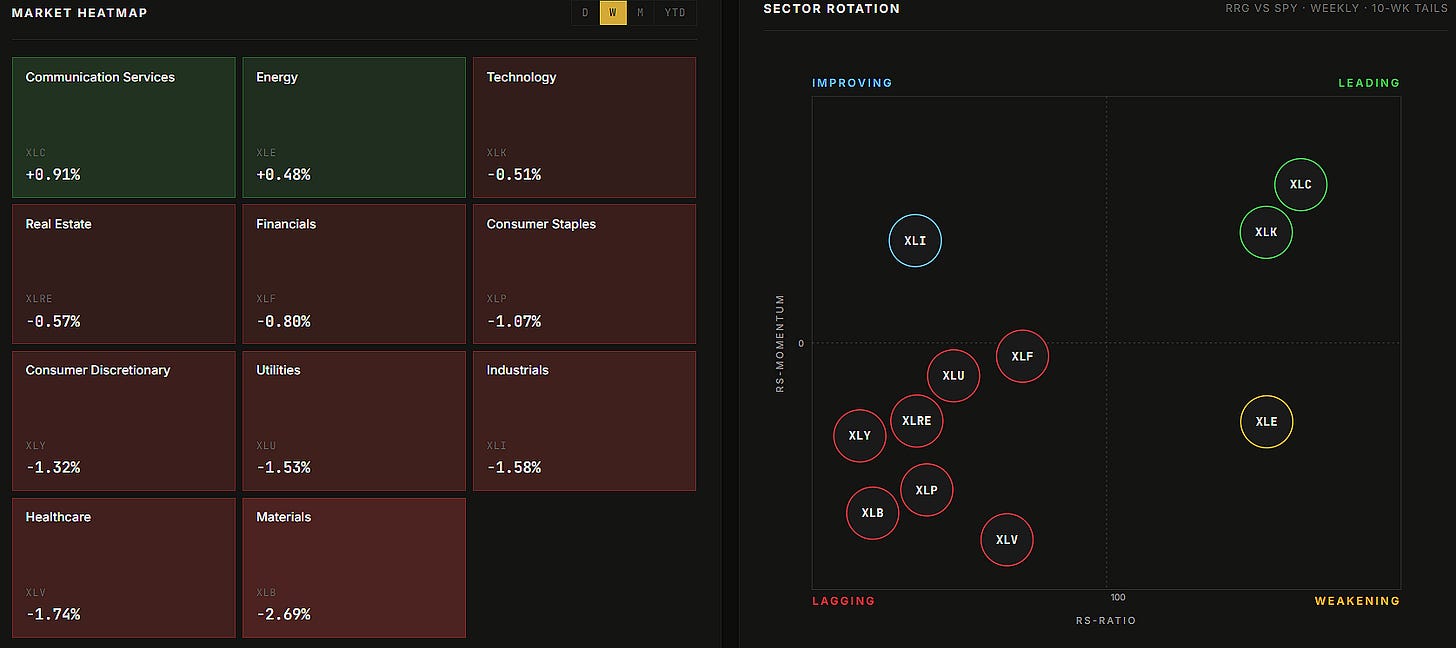
Four red sessions in a row, then a Friday bounce that saved the headline and nothing else. The Dow still had its worst week since March, small caps lost another two percent, and the only index that held up was the Nasdaq, which is now the tallest man on a sinking floor.
The real week happened outside equities. Brent ran toward $110 on the Iran headlines and Hormuz, gave some back on Friday and still closed up eight percent. The ten year touched five percent. PPI came in hot on Thursday, core CPI printed 0.3 against 0.2 on Friday, and the market walked into the weekend with a rate hike priced at better than eighty percent for Wednesday’s meeting. Oracle reported, popped, and reversed inside the session, which tells you what this tape does even to good news.
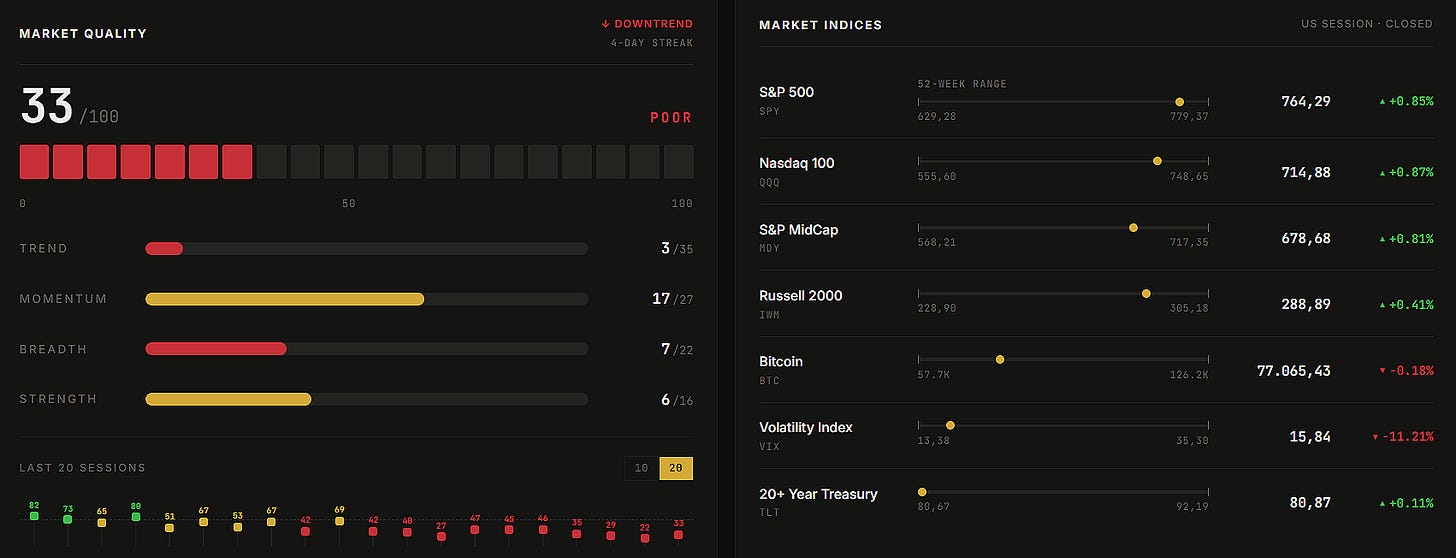
So: still chop, but chop with the range tightening every week. This is compression now, and compression resolves. We don’t know which way. We do know one number. Of the last twenty sessions, our quality score has cleared 70, the level below which we don’t consider the market worth trading, exactly three times. And those three are three of the four oldest sessions in the window. Sixteen straight sessions under the bar.
Sit with that for a second, because we have. The book stays light until the glass gets tapped.

A few things about what we’re building in the meantime, because most of them are for you.
The new site is live at gb.capital.
It’s more than a new front door for the newsletter. It’s the base for everything we’ll add over the coming months: two courses, one on swing trading and one on growth investing, written the way we work rather than the way textbooks do, and one-to-one calls with us directly. Those calls are for anyone who needs support at any level, on the method, on a specific problem in their trading, or on running a company. We were CEOs before we did this full time, and that half of the conversation is often the one people actually need.

TradeDeck keeps improving, and the paid subscribers who use it know the pace.
The news we’re most excited about: within thirty to forty five days we’re launching a YouTube channel, completely free. Deep, 360 degree coverage of companies, one at a time, starting as always with the ones we find interesting rather than the ones everybody already covers. If you like the long research pieces here, you’ll like where this is going.
None of this happens without you.
The emails and chat messages we get from many of you are the most useful input we have, and that includes the critical ones. Especially the critical ones. Keep them coming.
Here’s a look at this week’s market health, with a breakdown of index and sector performance.
📈 Free Setup: Make It Count
DCTH: Delcath Systems
What they do: An oncology company treating primary and metastatic liver cancers.
Why watch? Killing a tumour in the liver would be far easier if you could flood the organ with a chemotherapy dose no patient could survive systemically. Delcath does precisely that. The procedure is percutaneous hepatic perfusion: catheters isolate the liver’s blood supply, a concentrated dose of melphalan goes directly into it, and the blood leaving the organ passes through filters that strip the drug out before it rejoins general circulation. The liver receives a dose that would otherwise be lethal. The rest of the body never sees it.
The approved use is metastatic uveal melanoma, a cancer that starts in the eye and spreads to the liver in roughly half of patients. The product sells as HEPZATO KIT in the United States, where it is regulated as a drug and carries a boxed warning, and as CHEMOSAT in Europe, where the device-only configuration is approved as a Class III medical device. The business spent two years absorbing pricing pressure and soft patient volumes. Both have now passed, and the second quarter is the first clean look at what is underneath.
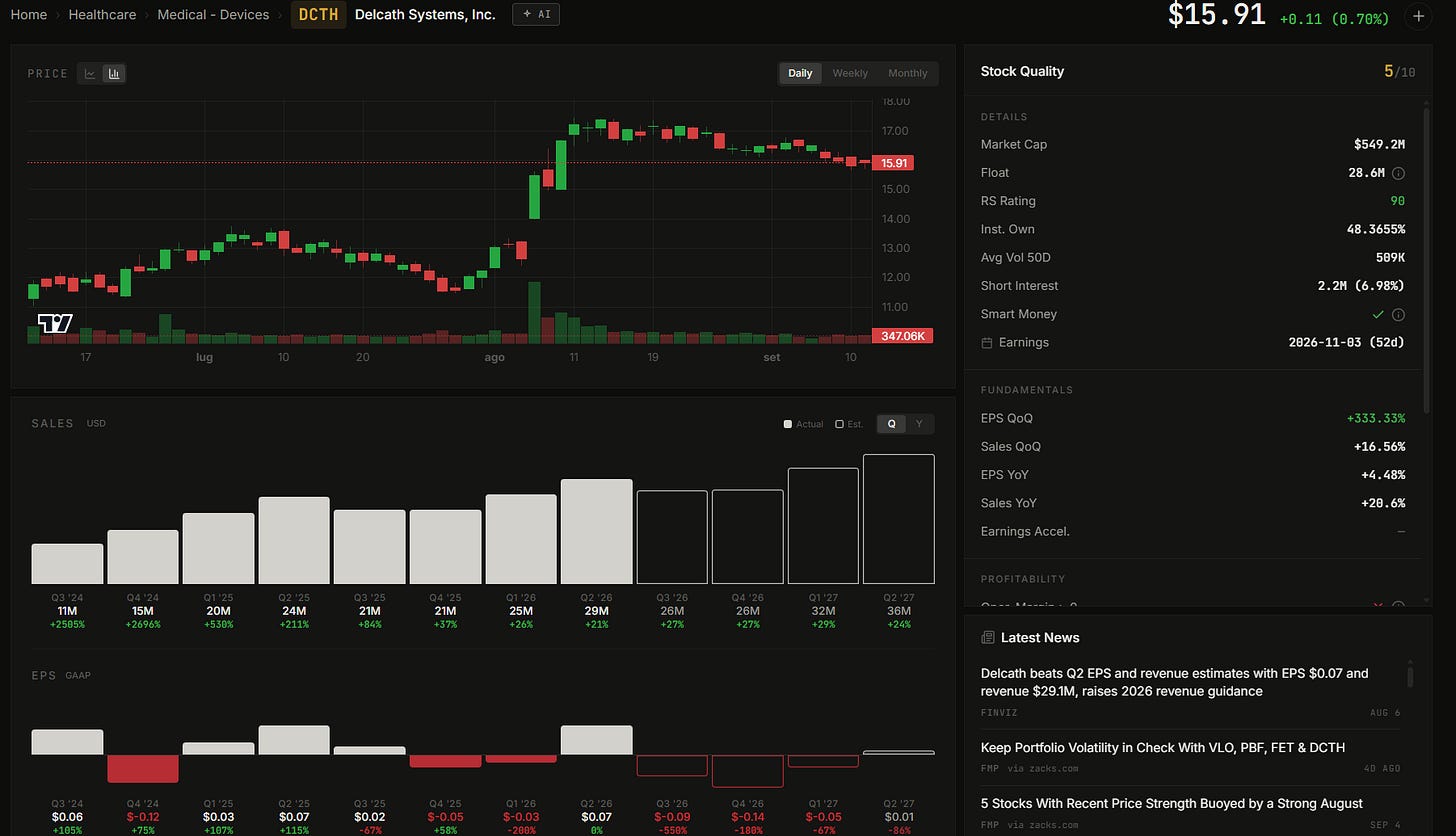
The August 6 report showed total revenue of $29.1 million against $24.2 million a year earlier, up 20%. HEPZATO KIT contributed $27.1 million, up 21% from $22.5 million, with CHEMOSAT adding $2.0 million against $1.7 million. Gross margin reached 90% against 86%. Net income was $2.7 million, or $0.07 per share, operating cash flow was $5.7 million, and the quarter closed with $95.9 million in cash and investments while a $25 million share repurchase programme ran alongside.
HEPZATO volumes grew about 30% while its revenue grew 21%. The nine-point gap is 340B pricing, introduced in July 2025. The 340B programme obliges manufacturers to sell outpatient drugs at steep statutory discounts to hospitals serving large numbers of low-income patients, and a meaningful share of US cancer centres qualify. More kits shipping at a lower average price per kit produces exactly this shape, and the effect washes out of the year-over-year comparison after this year.
Full-year guidance rose to a range of $104 million to $108 million in combined HEPZATO KIT and CHEMOSAT revenue, implying at least 28% growth in HEPZATO volume over 2025. Chief financial officer Sandra Pennell guided full-year gross margin to between 86% and 89% and said the company expects positive adjusted EBITDA for the year. The raise came from a first half that ran ahead of plan.
The commercial build is the engine behind all of it. Two centres were activated in the second quarter, bringing the network to 31, with a year-end target of 37 that includes MD Anderson and Mayo Clinic Scottsdale. Chief executive Gerard Michel pointed to growing use of HEPZATO in combination with systemic therapies rather than on its own, and that shift got its clearest support from the CHOPIN Phase 2 data, which showed that adding ipilimumab and nivolumab to percutaneous hepatic perfusion significantly improves progression-free survival in metastatic uveal melanoma. Those two drugs are checkpoint inhibitors, which release the brakes a tumour applies to the patient’s own immune cells. Progression-free survival measures how long a patient lives without the disease advancing, and it is the endpoint that drives adoption in a setting where overall survival takes years to read out. The commercial consequence runs past efficacy. If patients can start systemic therapy first and receive HEPZATO afterward, referrals stop clustering into the same months of the year.
Seasonality is a real constraint in this business. The procedure needs a trained interventional team, and when that team takes summer holidays the treatment slots vanish. Management is training backup teams to soften the step-down, and told investors that center activation and early third-quarter visibility supported a milder seasonality assumption than previously modelled.
Beyond uveal melanoma the expansion is early and uneven. Independent investigators presented retrospective data at ESMO Breast Cancer 2026 covering fifteen heavily pretreated patients with liver-dominant metastatic breast cancer, nine of whom showed a hepatic partial response, meaning measurable tumour shrinkage confined to the liver. Two investigator-initiated trials-in-progress abstracts appeared at ASCO 2026, one pairing HEPZATO with tebentafusp in metastatic uveal melanoma and one combining it with nivolumab and relatlimab in cutaneous melanoma with liver metastases. The company dosed its first patient in a global Phase 2 trial of HEPZATO alongside standard of care in liver-dominant HER2-negative metastatic breast cancer.
Management was candid about what is not working. Enrollment in the sponsored trials has run below expectations, though the colorectal study now has thirteen centres actively screening after added sites and revised onboarding. New patient starts average roughly half a patient per site per month, and forward visibility runs only two to three weeks because claims data arrives with a lag. A company with a two-week window into its own demand can raise guidance on a strong first half and still be caught out by a quiet October.
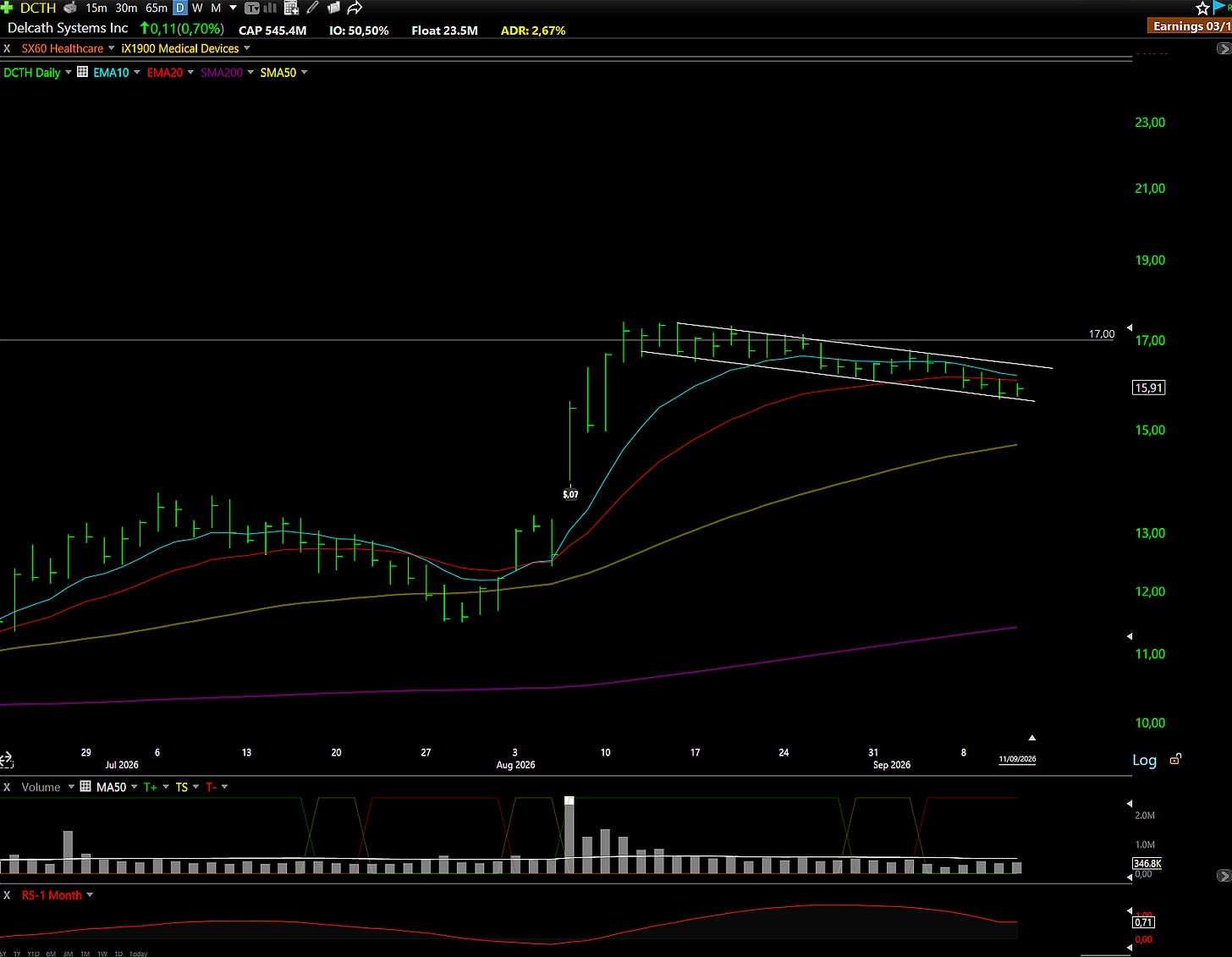
Technical Outlook: Delcath is the best setup of the week, in a week with very few good ones. We would rather bring you the best and leave space empty than pad the list with mediocre charts. The stock ran 40% after earnings and is now printing the first real flag since that move. Price has come back to the 20-day EMA, and that average is the line that has to hold. Above it sits $17.00, a level visible on both the weekly and the monthly chart. The stock attacked it at least twice during 2025 and again on the recent earnings run: three attempts, three failures. We think the fourth resolves differently. Volume through the consolidation is below normal, which points to holders sitting still rather than distributing into the move. The plan is to open a position on the flag break and reassess at $17.00 depending on how the stock behaves when it arrives.

What €39/month (or 299€/year) buys:
Free Access to TradeDeck
Premium members get full access to the trading platform we’re building. The value of the platform alone almost exceeds the cost of the subscription.
Watchlist Elite (5-7 Stocks)
Each selection undergoes rigorous financial analysis, technical evaluation, and strategic assessment.
Full Portfolio Transparency
Every position we hold. Entry price. Current P&L. Stop level. Real money, real risk.
Real-Time Portfolio ( and Chat Access)
This is where the edge lives. Exact entries, stops, and position sizing. Real-time..
The Tools We Actually Use
Member discounts on TC2000, FMP, and other platforms: same tools, better pricing.
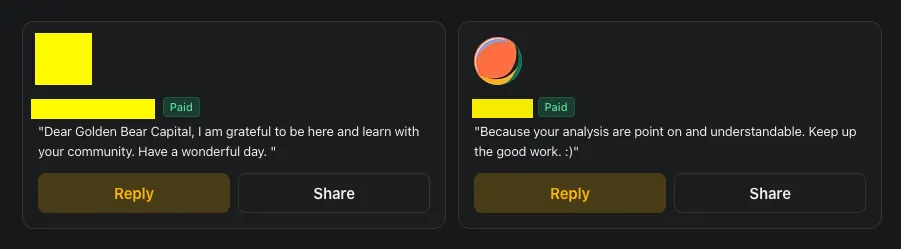
What Paid Members Say:
Portfolio updates & Full Watchlist:
Il resto di questo pezzo: i nomi, i livelli, la gestione.The rest of this piece: the names, the levels, how we manage it.
Ogni domenica dieci titoli con i livelli scritti, la lettura del mercato e la chat in cui pubblichiamo entrate e uscite mentre le facciamo. Disdici quando vuoi dal tuo account Substack.Every Sunday, ten names with the levels written down, the market read, and the chat where we post entries and exits as we make them. Cancel any time from your Substack account.
Già abbonato?Already a subscriber? Apri l'articolo su Substack →Open the article on Substack →