
Equity X-Ray: In-Depth Research #24
Palantir: A Great Company At A Price Divorced From Reality

Introduction
I have been analyzing technology stocks for 10 years, and I can honestly say that I've never seen a valuation that is as far removed from reality as Palantir's (NYSE: PLTR) is right now at over 180$ a share. The stock price has been greatly impacted by theemarket's enthusiasm regarding the AI opportunity, and the company recently moved into the realm of speculation in a way that no financial model, even one that is the most bullish of blue skies, can perhaps ever deliver to investors.
I recognize Palantir has top-tier technology and is cash-flow generative.
However, even a top-tier technology platform and an ability to generate cash are insignificant compared to a market capitalization that has front-run ten consecutive years of perfect execution. I tried to find the bull case and very carefully built a number of assumptions into a model that was the most generous I could reasonably defend.
My price target was well above where a bear case would leave you!
I am starting coverage with a Sell and a price target of $85 a share.
Company Background
The easiest way to think about Palantir is to think about it like they are building a central nervous system for an organization.
Consider a big government agency or a multinational corporation. The agency's or corporation's information is everywhere: distributed in an unlimited number of spreadsheets, legacy databases, reports from field agents, sensor logs from factory equipment, and customer feedback forms. It is like having a brain, a heart, and lungs that each function independently. Making intelligent, fast-paced decisions is virtually impossible because nobody can see the situation in total. Palantir builds the software that fills the gaps between siloed data and connects all of that mess into one single operational reality. This reality allows a human user, whether analyst, executive, or general, to ask incredibly difficult questions and get answers that would otherwise be buried.
To put Palantir in perspective, you need to understand its background in the early 2000s. Palantir was founded by a group including Peter Thiel, one of the co-founders of PayPal. Thiel and his innovative peers had gained immense experience in fighting complex international financial fraud while working at PayPal. They designed systems that could ingest enormous streams of transaction data, filtering real-time data "as it happened" to find the more subtle crime signaling patterns buried in the data.
After the September 11th attacks, it was apparent that the exact technological approaches to the fight against financial crime could be applied to fight terrorism. The well-known 9/11 Commission Report showed that several U.S. intelligence agencies had the pieces but could not connect the dots. Palantir was created to solve the problem of connecting the dots with the goal of constructing software and integrating data from dozens of incompatible sources and formats.
From those roots, the Palantir business has grown to now feature two primary software platforms.
The first is Gotham, Palantir's original operating system for the defense and intelligence communities. Gotham takes large unstructured datasets from a variety of sources (signal intelligence, informant reports, financial records, and satellite imagery) and organizes this information as a single map or graph so that an analyst can visually explore relationships among people, places, events and objects. Think of it as a digital detective corkboard, with billions of data points and the ability to search and analyze it in seconds. Its use extends well beyond counter-terrorism to military logistics, disaster response management, and complicated investigations into various law enforcement situations.

The second platform is Foundry, which adapts this advanced technology to the commercial world. Foundry is to a corporation what Gotham is to a government. It is the way for an organization to connect their entire data ecosystem (factory floor, supply chain, sales CRM, and finance) into one model (called "ontology"), creating a representation or digital twin of the organization. Just as an example, an airline executive with access to the company's data on Foundry could spot a chronic part failure and trace it back through the supply chain to a specific factory, on a specific day, when a specific machine was running at a slightly incorrect temperature. Instead of taking weeks or months of investigation, they could fix the problem in a matter of hours. Companies like Airbus use it to streamline production, and energy companies use it to manage operations in ways that minimize emissions.
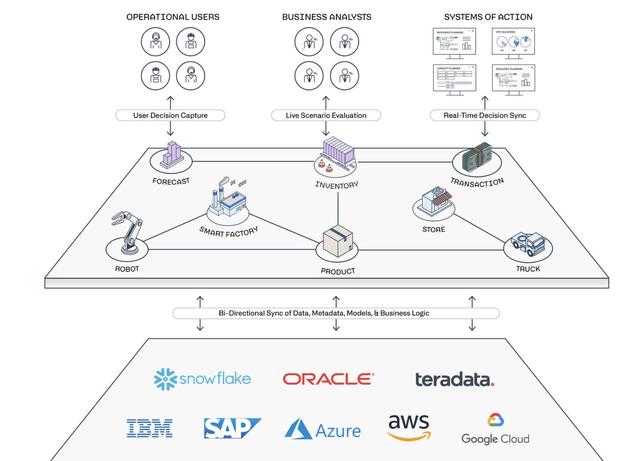
Where Palantir is different from other data companies is their base-level approach. Their real strength is in the challenging foundational work of data integration, which is connecting the "pipes" between the hundreds and hundreds of incompatible systems. Their philosophy is about augmenting human intelligence, NOT replacing it.
Palantir doesn't sell simple dashboards but gives those with the world's most complex organizations an operating system that makes sense of their particular reality and enables them to act.
Financials
To really get to the nitty-gritty of Palantir, we must consider its financial statements and treat them not as simple records. What comes into perspective is a company with a well designed, cash-generating machine that is being ask to power the equivalent of an intergalactic vehicle while it is still working to prove it can reliably orbit the planet (which is pretty good, by the way).
The Income Statement
The income statement gives a simple and compelling story for the company on its surface. Q2 2025 revenue of $712 million, up 21% year over year is strong. However, as always, the devil is in the details.
Looking through the Q2 Business Update, there was an important divergence. The legacy Government business although still foundational, grew at a decent but decelerating 15%. The Commercial segment, however, grew by 27%, with the important US Commercial segment (the critical battleground for the AI platform) surging 40%.
What that tells me is that Palantir is successfully executing a pivot. The story is no longer one of slow, steady government contracts: it is now one of a high-performance commercial land grab.
The gross margin, which has remained consistently in the low-80% range, is remarkable and suggests the software is fundamentally profitable. However, that is where the cognitive dissonance begins on the journey down to the bottom line. Palantir has had the distinct privilege to achieve four consecutive quarters of GAAP profitability with a net income of $98 million. It was an important event and resolves a key bear case argument. However, as an analyst, I do not view this as an end point but as a single point along a drastically long road. The net margin of just under 14% is decent, but this is not the world-class figure that someone would expect of a company valued far in excess of its software peers.
For me, the most important part of the analysis is the operating expenses: Stock-Based Compensation (SBC).
In Q2, Palantir's income from operations was $81 million; their "Adjusted Operating Income" is $261 million, because they added back $180 million in SBC!
Let me be clear: there's nothing wrong with it, but this is a framing choice that has to be considered by investors. Bulls will tout SBC as a non-cash expense that aligns employees with shareholders.
However, I see SBC as a real, dilutive expense that is directly paid for by existing shareholders. Let's consider this: the company is not paying its brilliant engineers all in cash; the company is paying them with tiny fractions of the ownership of the company. This has the effect of preserving cash on the balance sheet but has the effect of forcing every other shareholder to own a little bit less of the company. This heavy and consistent SBC is the primary reason for the large disconnect between Palantir's GAAP metrics and the "adjusted" metrics. It tells the tale of a company that has achieved profitability, but only by distributing a large compensation cost among its shareholder population.
Valuation
Building the Bull Case to Prove the Bear Thesis
Valuing a business like Palantir is not just a matter of putting the numbers in a spreadsheet, it is an attempt to translate a potent, quasi-mythical narrative into a dollar value.
I shelved my skepticism and carried out a specific exercise: build the best, most generous, but still reasonable, Discounted Cash Flow (DCF) model possible. I wanted to establish the highest price that the fundamentals could justify, by assuming almost perfect execution. What I have found is that even the best narrative has a mathematical limit, and Palantir stock has gone beyond that limit by a very large margin.
Before we build our model, we need to first look at the evidence before our eyes.
The Bloomberg graph below is arguably the single most important data point for any vigilant Palantir investor.
It shows the forward price-to-earnings ratio plotted against the forward price-to-sales ratio of the S&P 500. What we see is a dense cluster of companies in the lower-left corner—where we would identify normal valuations. We see well-known high-flyers like Nvidia and Tesla, pushing out from the rest of the crowd and earning their premium valuations through fast growth and market leadership. And then, all by itself, in a completely different quadrant of the chart is Palantir. This chart visually overwhelms the viewer with the strong impression that Palantir is being evaluated by a different set of rules than any other major company in the market.
My valuation, therefore, is a means to determine what those rules are (or might be) and if they can actually be defended.

My first step is to attempt to write the financial story that potentially leads to the stock price Palantir is currently valued at $182.
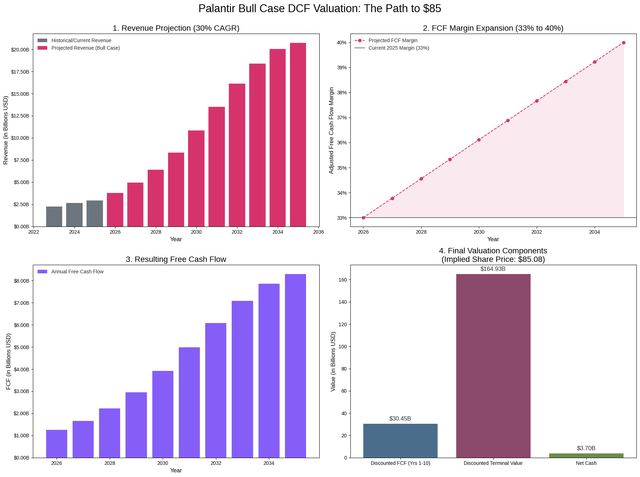
The first chapter of that story is about revenue growth. The bull-case, drawing on the Q2 Business Update, rightfully points out 40% growth in the U.S. Commercial segment as proof that the AI Platform is a true game-changer. To give maximum story credit, I will assume this type of unconstrained growth infects the whole company. So I am modeling a compound annual growth rate (CAGR) of 30% for the next 5 years. To be clear, this is a heroic assumption. This requires Palantir to first significantly accelerate from its current overall growth rate of 21% and then maintain that blistering pace for five years.
Few companies of any scale have ever sustained that.
The next chapter is about profitability. Palantir's current adjusted free cash flow margin of 33% is already very respectable. However, for our bull-case story to be believable, it needs to become legendary. I am modeling the margin to grow steadily over the next 10 years, with the overall margin actually going from an average of 33% to 40%.
A 40% free cash flow margin relative to revenues would put Palantir among the most profitable software businesses to ever exist. This assumes not just that the AI Platform is widely deployed but also is potentially infinitely more profitable than anything else that Palantir has ever sold, and that Palantir can simply scale revenue without any meaningful growth in the cost base. This would be the ideal form of infinite operating leverage, and again, I am putting this into my model directly.
Next, we will take this future scenario and discount it back to something that we would think about in today's valuation setting using a discount rate, which is the rate of return that an investor would expect from other investments that have the same risk profile. Since Palantir is sitting on a great balance sheet with no debt, I will take a decidedly rosy weighted average cost of capital (WACC) of 6.32%. To be very clear, this is an astounding low rate for a tech stock, implying nearly risk-free future cash flows. Another heroic assumption we are making in the bull case just to see if we can explain the current price.
Next we have to complete our story, which is the terminal value, so I am assuming a 3.5% perpetual growth rate, which means after Palantir's initial decade of aesthetically enticing growth, it will always grow in nominal dollars, faster than the growth rate of the entire global economy forever.
After spending this time talking about pure and extreme growth, ridiculously high profitability, and scant risk, I set myself to run the numbers.
The math's conclusion is as eye-popping as it is sobering. In the end, even with these plainly absurdly good assumptions, the intrinsic valuation of Palantir's business calculates to approximately $85 per share.
The fact that I consciously arrived at a perfectly optimistic, bull-case $85 valuation today, is now a whole 53% lower than the actual current market price for Palantir and, for me, is the most convincing evidence of all.
It literally mathematically validates what the Bloomberg chart is showing us visually. If anything, counting a market price of $182, it's not just pricing perfection, it's pricing at a reality that is fundamentally better than perfection.
Key Investment Risks
If Palantir's AIP becomes the definitive operating system for AI in the enterprise, resulting in growth and margin acceleration that are far greater than my optimistic model assumes, then my thesis can be wrong. A government project that expands rapidly and significantly or an acquisition are also possible changes in the financials.
However, these are also improbabilities that do not justify the price today.
Final Takeaway
Palantir is an incredible company, but PLTR is dangerously priced over any possible bull thesis I can imagine.
The current valuation demands a level of future success that is almost without precedent in corporate history.
My analysis shows that even if you believe the most optimistic version of the company's story, the stock is still worth less than half of its current price. The gap between my generous $85 price target and the market's $182 price is a chasm of pure speculation. Investors buying at this level are not investing in fundamentals, they are gambling on a narrative. I rate Palantir a Sell with 85$ per share target.
It is crucial to view Palantir’s current stock price within the broader market context. Since April 2025, the bull market has been roaring, seemingly without pause, lifting nearly all assets. This rally has been supercharged by an intense and pervasive hype surrounding Artificial Intelligence. While AI is undoubtedly a transformative technology, the market’s enthusiasm has reached a point of frothiness, where valuations are often disconnected from a company’s actual or projected earnings. Investors are piling into anything AI-related, creating a speculative bubble that inflates prices far beyond reasonable expectations. PLTR has been a major beneficiary of this trend, but this also makes it vulnerable to a sharp correction when market sentiment inevitably shifts.
For investors who currently hold Palantir in their portfolios, this may be an opportune moment to re-evaluate the position. Given the extreme valuation, it would be prudent to consider selling the position to realize substantial gains or, at the very least, reducing the allocation to mitigate risk. Locking in profits after such a powerful run-up is a sound strategy, especially when the risk of a significant pullback is this pronounced.
Disclaimer: This analysis is for informational purposes only and should not be considered financial advice. Always conduct your research and consult with a licensed financial advisor before making investment decisions.
Questo pezzo era gratuito. Il prossimo arriva domenica.This piece was free. The next one lands on Sunday.
Dieci nomi con i livelli, la lettura del mercato, la chat con le posizioni in diretta. Con l'abbonamento leggi tutto; senza, ricevi la parte gratuita via email.Ten names with their levels, the market read, the chat with live positions. Subscribers read everything; free readers get the free part by email.