
Equity X-Ray: In-Depth Research #25
The Printing Press for DNA: Fueling the Entire AI-Drug Discovery Boom

Introduction
I believe that Twist Bioscience (NASDAQ: TWST) is a great long-term investment opportunity, and I am initiating coverage with a Buy rating. The market, still cautious from being burned during the 2021 genomics bubble, is not assigning an adequate price to the company’s proven ability to execute operationally, its near inflection to profitability, and its position as the key infrastructure enabling the AI revolution in biotechnology. While many of its peers have disappointed, Twist has quietly developed a robust, high-margin business that is now poised to enter a new era of compound growth.
🌱 Support Our Work: Buy Us a Coffee🌱
Your small gesture fuels our big dreams. Click below to make a difference today.
Twist Bioscience can best be described as the company that built the printing press for the genetic code. For biology to become a truly programmable engineering science, scientists needed a means of “writing” DNA, that is, synthesizing it from scratch, as easily and cheaply as the semiconductor industry manufactures microchips. By developing a way to synthesize DNA on silicon chips rather than on traditional plastic sheets, Twist has radically transformed the speed, scale, and cost of this vital process, making it an essential partner in enabling the innovation taking place in all areas of healthcare, in industrial chemicals, and in academic research.
I arrive at a fair value estimate of $65 per share, representing significant upside from the current stock price.
Company Background
To understand the investment thesis that drives Twist Bioscience, it is necessary to understand the underlying problem that it was created to solve. For decades, the field of biotechnology existed in a profound imbalance. Scientists had become experts at “reading” DNA, the instruction manual for all living things, encoded in a simple four-letter language (A, T, C, and G) because of next-generation sequencing technology. This led to the ability to “decode” genomes and to understand the genetic basis of disease. “Writing” DNA, synthesizing it from scratch to build new biological tools, however, was still a slow, expensive, and artisanal process.
This was the single biggest bottleneck that hindered the development of the entire field of biotechnology. To engineer biology successfully, scientists did not need to merely be “readers” but needed to be “writers.” They needed to build a printing press for DNA. In 2013, Dr. Emily Leproust, one of the founders of Twist Bioscience, along with engineers Bill Banyai and Bill Peck, founded Twist Bioscience to build that printing press.
The Core Innovation: Writing DNA on Silicon
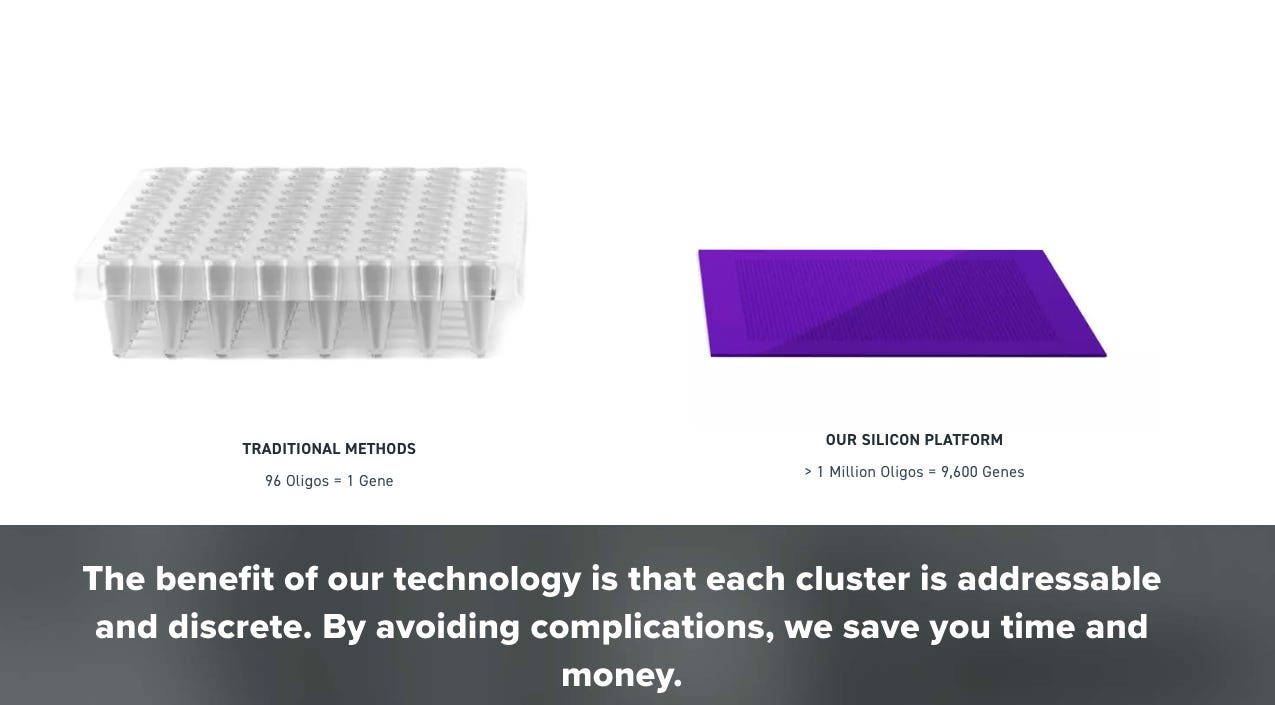
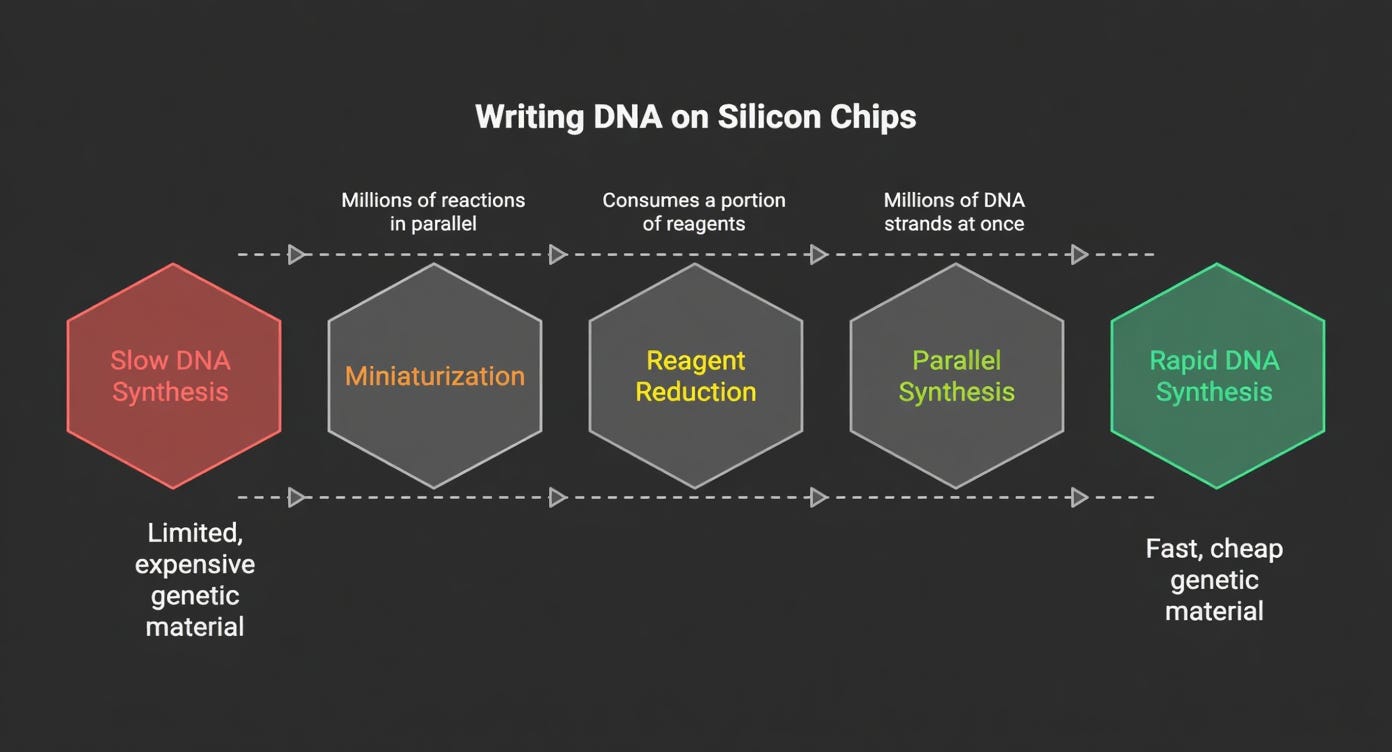
To grasp the advantage of Twist’s technological moat, one can do no better than compare it with the computing revolution. For years, synthetic DNA was made in 96-well plastic plates, a method like building a watch by hand, component by component. This was slow, yielded an extremely limited amount of genetic material, and was enormously expensive. Twist’s revolution was to completely re-conceive this process, basing it on the principles of semiconductor manufacture. Instead of plastic plates, they devised a system of writing DNA directly onto silicon chips.
This is not a step—this is a complete breakthrough.
Each silicon chip contains millions of microscopic wells, creating a vast array of parallel reaction chambers. This permits Twist to synthesize millions of individualized DNA strands at one time, in parallel. This stupendous miniaturization means that they consume only a portion of the expensive reagents needed in the old methods, and consequently, the costs are brought down enormously while at the same time the production is increased by several orders of magnitude. What this means to a scientist is that no longer are the old methods applicable. An experiment which before might have necessitated testing several dozen of genetic designs now can, because of the speed and price, test thousands—even millions or these designs within the course of four or five days and for a pittance. This is not only quicker, but it opens up new and entirely different problems which otherwise would be impossible to solve.
This platform is the motor that runs the whole show at Twist.
What The Company Does: The Applications of Synthetic DNA
Using its powerful DNA printing press, Twist has created a highly diversified business that represents the basic underlying infrastructure for a number of rapidly growing sectors of the life sciences business.
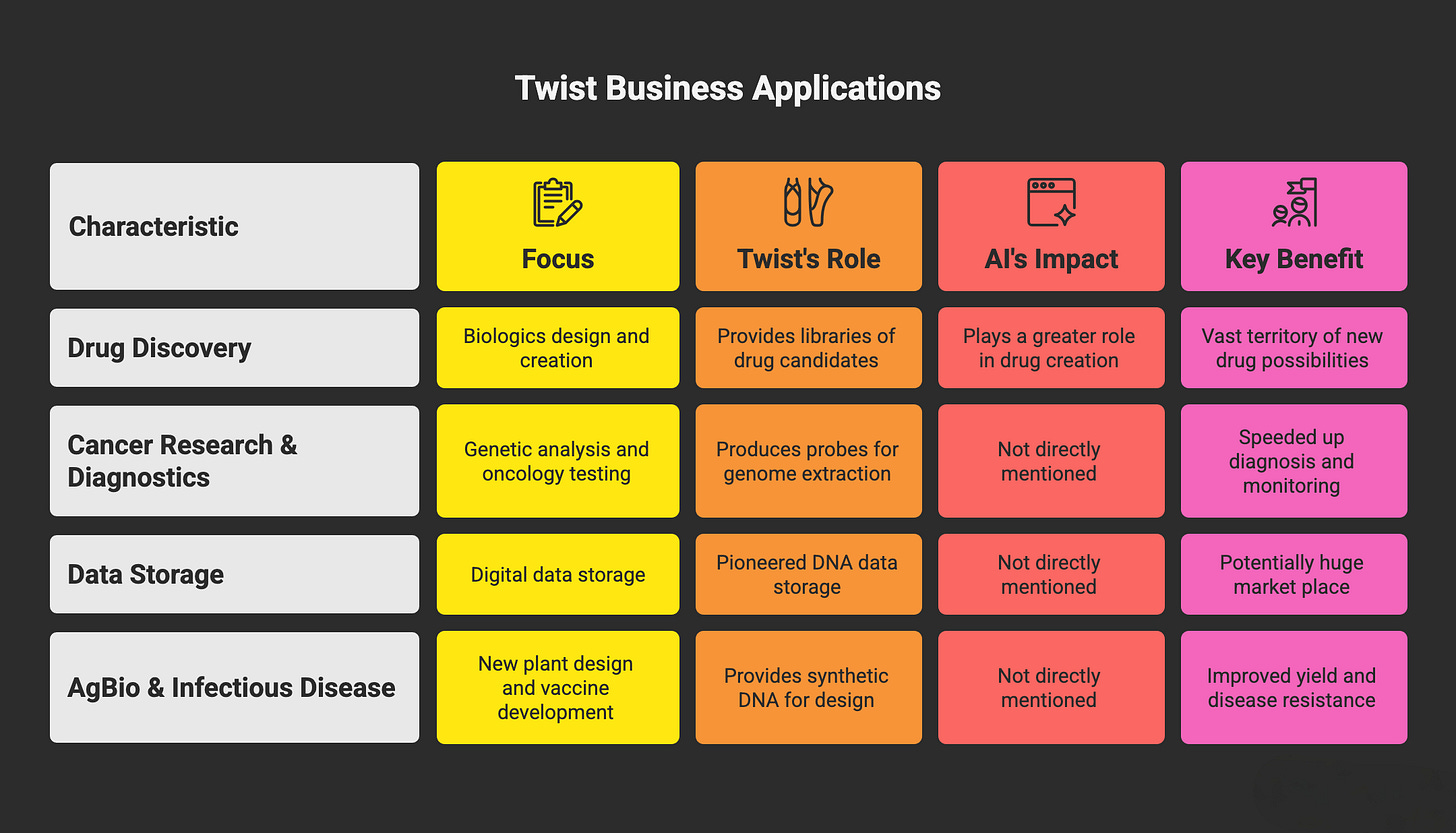
Drug Discovery: The drug discovery business of Twist is perhaps at the heart of its business. Pharma and biotech companies are increasingly focused on the design of “biologics,” mainly antibodybased drugs which can home in on a particular disease with great precision. Each company has to design and create mammoth libraries of drug candidates, seeking the one precious antibody. Twist provides the companies with their libraries, which they can synthesize in quantities of billions of variants, allowing its partners the ability to probe a vast territory of essential new drug possibilities to find viable candidates. It is critical to this that AI will play an even greater role because AI in creating new drugs has reached incredible heights. The new algorithms have advanced to the stage that they are capable of churning out a vast quantity of new digital designs for new drugs. And here again, it is Twist that offers up the critical service of taking those digital designs and engineering them into molecules that can be tested in the laboratory, which is the essential bridge from the algorithm to the real world.
Cancer Research and Diagnostics: Twist is a major supplier for the rapid increase in genetic analysis and oncology testing. Its Next-Generation Sequencing (NGS) tools are not dreamed up to help write new genes, but to help scientists and clinicians quickly, and to an incredible degree of precision, “read” existing ones. The human genome can be considered to be that 3 billion letter encyclopedia. Finding one teeny misspelling responsible for a cancer is practically impossible. Twist produces “probes” (short synthetic DNAs) that act as magnets for pulling out of the genome, from the library created in the previous step, only the specific sections of its choice that the clinician is interested in analyzing. This has allowed diagnostic tests to pay attention only to those cancer genes that are known, thus allowing the diagnosis of cancer (from a blood sample (liquid biopsy) or for its monitoring for recurrence (Minimal Residual Disease testing), has been sped up exponentially, thereby lowering the cost and making it more precise.
Data Storage: While this field of application is futuristic, the enormous power of the platform is clear. The world is currently generating an unmanageable amount of digital data. DNA, nature’s hard drive, offers an incredible solution: it is a high-density, low-energy storage medium that is stable for centuries, not just decades.
Twist pioneered this field, demonstrating that digital files (such as images, text, and video) could be converted from binary (0s and 1s) into the four letters of DNA’s code (A, T, C, G) and then synthesized. To maintain focus on its core business and preserve its long-term strategy, Twist spun off this division into a separate company, Atlas Data Storage, in which it retains a minority holding. This arrangement gives Twist investors a “free option” on a potentially huge marketplace without bearing the research and development costs at this stage.
AgBio and Infectious Disease: The versatility of the platform does not only focus on human health. In AgBio, the platform is used by scientists using Twist’s synthetic DNA to design new plants with higher yield and resistant to drought and insect infestations. In infectious disease research the capability of synthesizing sections of a viral or bacterial genome is a vast improvement in the development of new vaccines and the evelopment of diagnostic tests (the capability which was thrown into the limelight in the recent pandemic).
This innovation triggered a rapid course of scaling. After listing in 2018, Twist made substantial expenditures in growing its “Factory of the Future” in Wilsonville, Oregon. This highly automated, 110,000 square foot facility has made it possible to raise the manufacturing of DNA to an industrial scale.
This factory has a major role in the investment thesis as it is presently operating well below full 50 percent capacity, which gives it a vast runway for growth with minimal further capital expenditure.
If the production is raised, then the operational leverage of this model is considerable. In the years of the boom in genomics in 2021, Twist’s share price shot up, but as this bubble burst, the company proved its resilience. Whilst many competitors struggled, Twist made its revenues more diversified, now approaching over 3,500 customers, so that no customer will provide more than 10 per cent of revenues. This has made its transformation from a speculative growth company into a more disciplined margin margin-oriented business, having achieved the remarkable feat of either meeting or exceeding its own forecasts, which is a rare achievement in such a demanding sector.
Financials
The examination of the financial overview of Twist Bioscience reveals a company, in mid-stride, involved in enormous strategic change. After a program of aggressive expansion, gaining market share, the emphasis has indisputably changed to improving operating efficiency and developing a sustainable, focused business model. The figures portray a company trading high-cost expansion for a more orderly, though as yet unrealized, profitable future.
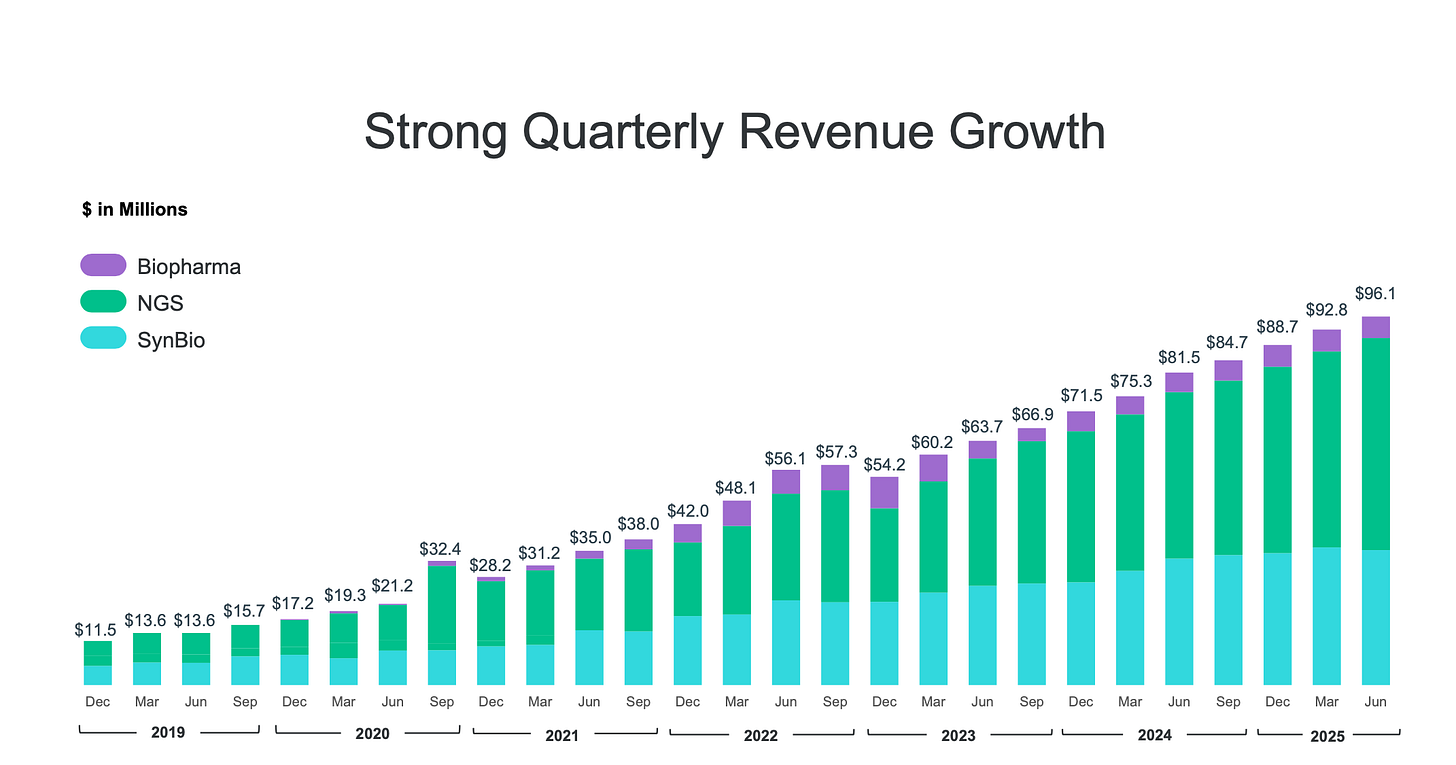
A prime indication of this change is the development of gross margin percentage. In the Q3 2025 earnings announcement, gross margin percentage had improved from 31% to 53.4% over the last two years. This is no niggling improvement but the result of a change of operational philosophy with larger use of the Oregon factory, a more favorable product mix to the higher margin NGS tools, and the in-housing of the raw material inputs to the manufacturing process. This means that the core technology of the company and manufacturing process will, at scale, support a profitably growing business structure.
A further indication of the possibilities of operating leverage, which is one of the keys to the long-term thesis, is apparent in the current numbers. In the last quarter, revenues have increased by 18% while total operating expenses increased by only 2.6%. The divergence of the revenue growth and expense increase is an indication that the large investment phase in the company is nearing an end. Further, management in speaking on the call to review the 3rd quarter results stated that 75-80% of the incremental revenues of the core SapBio products produced a direct contribution towards gross profit which indicates the favorable leverage effect of increasing productive capacity in line with the well demonstrated increases in product demand.
It is, however, proper to bluntly indicate that Twist is not yet a profitable company. The adjusted EBITDA for the third quarter was still a loss of $8 million. This is a terrific improvement from the profit loss of $22 million in the same quarter of one year ago, but the company is still consuming cash to supply the needs of its operations.
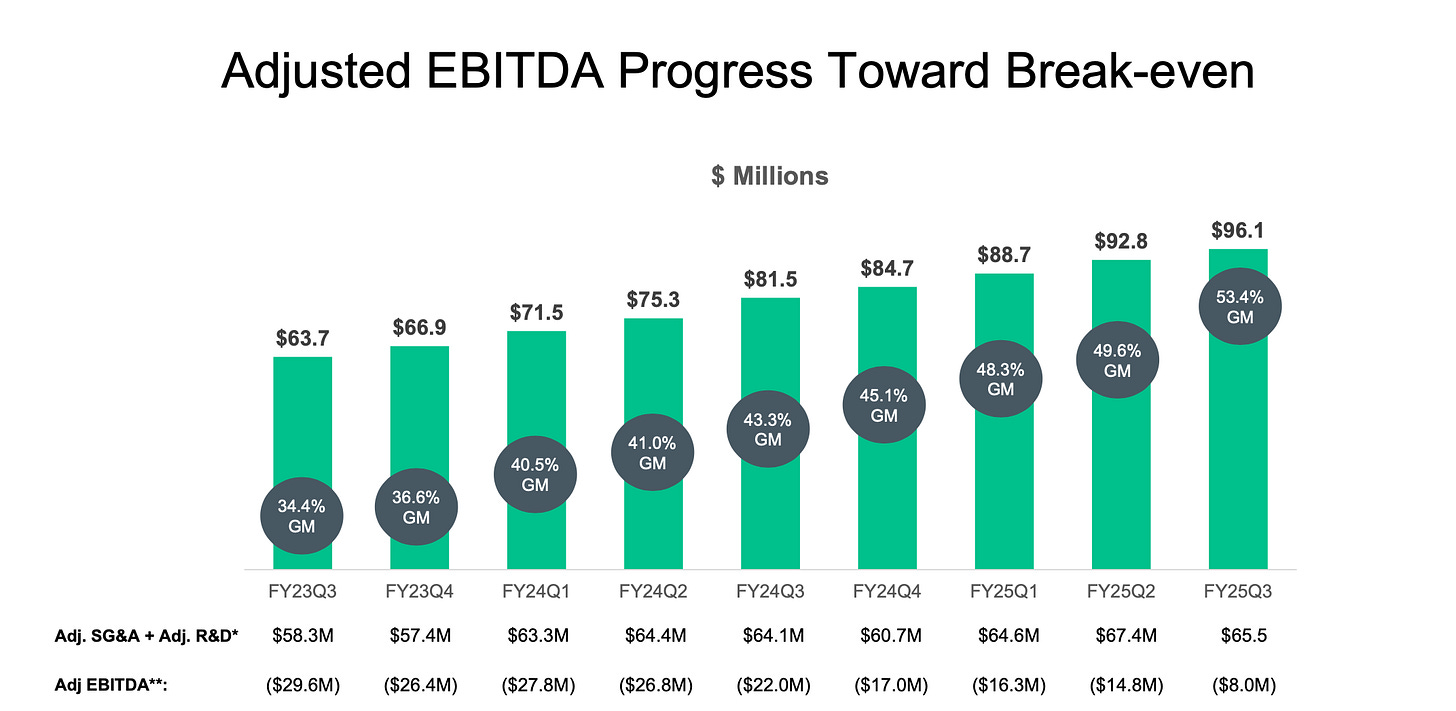
Therefore, an investment in Twist today is not a purchase of current earnings, but rather an investment in a project and a future state. The financial trajectory shows clear progress toward profitability and lends credibility to management’s forecast of reaching adjusted EBITDA breakeven by the fourth quarter of fiscal 2026. This projected path is supported by a solid balance sheet. The company ended the quarter with $250.8 million in cash and short-term investments. This level of liquidity appears sufficient to fund operations until the company reaches its breakeven target, mitigating the near-term risk of needing to raise additional capital.
Finally, the financial story is one of a bet on execution. The evaluation is based on the belief that management can well pilot this final phase of its transition period and can change great operational advantages and a growing business model into free cash flow. The evidence produced points very strongly to the contention of an ambitious and well-laid scheme for development, but the purchaser is really buying into a promising company concept with clearly splendid financial potential, sullied to a time in the future, rather than the present.
Valuation
Evaluating a company like Twist Bioscience at this inflection point is a difficult assignment for traditional metrics, as historical price-to-event multiples prove inadequate due to the tremendous operating leverage that is just beginning to develop in the financial results. Therefore, to properly evaluate the long-term prospects of the company, my valuation is based on a discounted cash flow (DCF)-like analysis that accounts for the company’s earnings power through 2030 and discounts it back to the present.
This is based on a set of key assumptions that come out of management’s guidance, the current momentum of the business, and industry trends. It is important to note that this is a projection of a future state, and the accuracy of this projection depends entirely upon the company’s ability to implement its strategic plan.
Step 1: Projecting 2030 Revenue
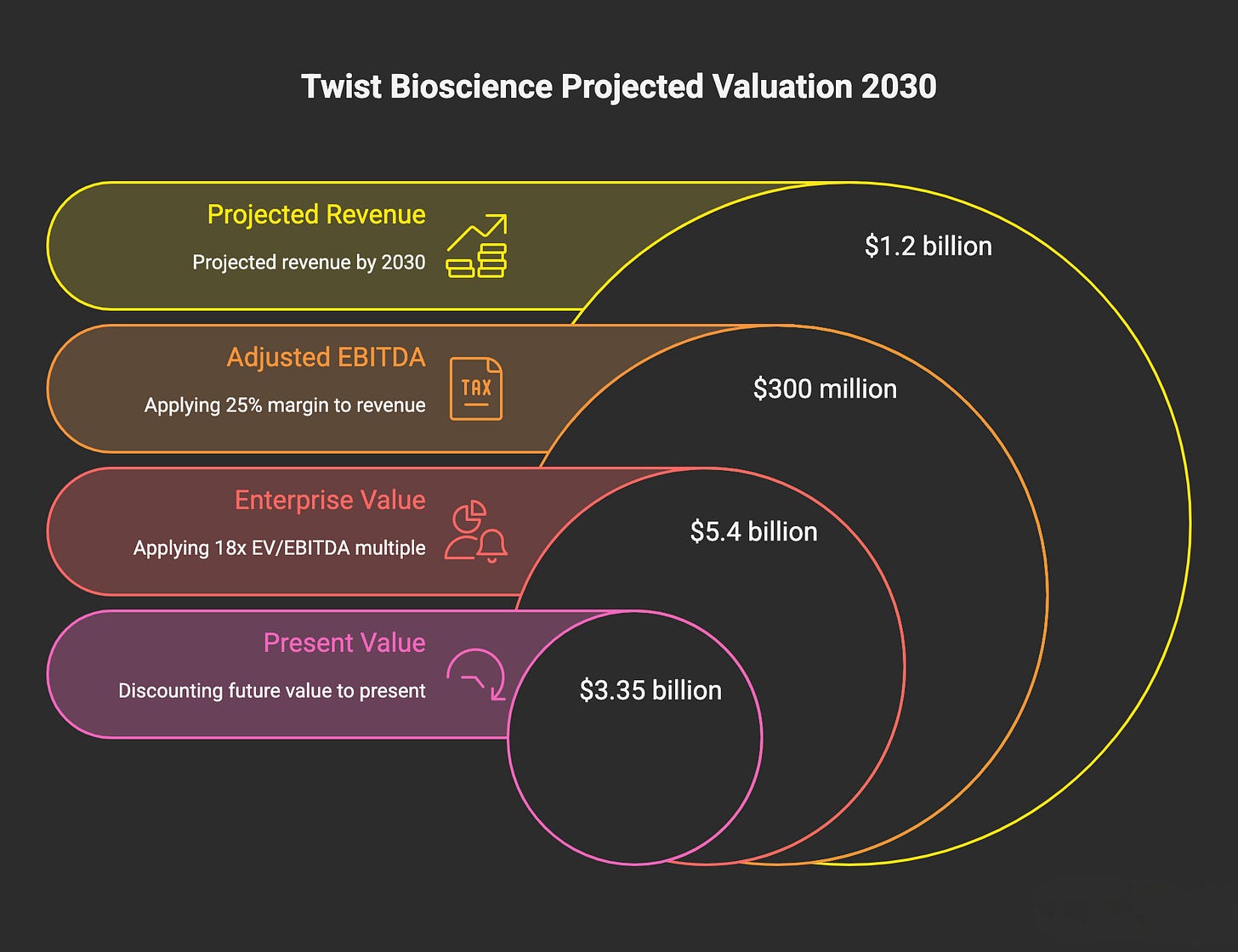
My model projects revenues of $1.2 billion by 2030.
Healthcare Segment: This is the engine of primary growth. According to the Q3 FY25 results, this segment is growing at least 30% annually. I am modeling for this segment a 30% compound annual growth rate (CAGR) for itself through 2030. This assumption is supported by the secular growth rates in clinical diagnostics (liquid biopsy, MRD testing) and the increased use of synthetic DNA in AI-assisted pharmaceutical discovery.
Other Segments (Industrial, Academic, etc.): These are more mature markets. I am modeling a more conservative 15% CAGR for these segments combined.
I view this forecast as realistic, balancing the high-growth clinical opportunity with the steadier nature of the research and industrial markets.
Step 2: Estimating 2030 Profitability
I project an Adjusted EBITDA margin of 25% by 2030. This assumption is grounded in two key data points from management:
Path to Breakeven: Management has provided a clear timeline to reach adjusted EBITDA breakeven by Q4 of fiscal 2026.
Inherent Leverage: They have stated that 75-80% of incremental revenue from their core SynBio products drops directly to gross profit.
As the company scales and its high-fixed-cost “Factory of the Future” operates at higher utilization, this powerful operating leverage should allow margins to expand significantly beyond breakeven. A 25% margin is consistent with best-in-class, mature life sciences tools and infrastructure companies.
Applying this 25% margin to the projected $1.2 billion in revenue yields a 2030 Adjusted EBITDA of approximately $300 million.
Step 3: Determining Terminal Value and Discounting to Present Day
To determine the company’s value in 2030, I am applying an 18x EV/EBITDA multiple to the projected $300 million in EBITDA. This multiple is appropriate for a market leader with a strong technological moat, high margins, and a dominant position in a secular growth industry. This yields a projected 2030 Enterprise Value of $5.4 billion.
To find today’s fair value, we must discount that future value back to the present. Using a discount rate of 10% (which accounts for the inherent risks of a growth-stage company and the time value of money) over five years, the present-day enterprise value is approximately $3.35 billion.
Step 4: Arriving at a Price Target
Based on the approximately 56 million shares outstanding, this translates to a price target of $65.00 per share.
It is crucial to note that this valuation does not assign any value to two significant “free options”: Twist’s minority stake in the Atlas Data Storage spinout and any future milestone or royalty payments from its 100+ biopharma partnerships. These represent potential sources of value that could provide additional upside to this target price if they are successfully commercialized.
Peer Analysis
Twist is in a unique competitive position that is frequently misunderstood.
The company’s business model is often compared to companies like Ginkgo Bioworks (DNA), but it is not only a different business model; it is a complementary one. Ginkgo is a customer of Twist. They run “foundries” that use synthetic DNA as a raw material to engineer organisms for customers who pay them to do so.
Twist is the platform on which Ginkgo gets that high quality raw material, which they sell to them and thousands of others.
Twist’s real competitors are legacy DNA synthesis companies, which in large part still use old, plastic plate-based procedures. Twist’s moat against these competitors is built on three pillars.
Proprietary Technology/Patents: The silicon-based platform, protected by more than 700 patents, gives it a fundamental manufacturing advantage, thereby providing a scale and cost structure that these other methods cannot compete against.
Industrial Scale Infrastructure: The high, computerized, “Factory of the Future” is an asset that cannot be replicated easily, as it took huge amounts of capital and years of expertise to build out and optimize.
Customer Integration: Twist becomes deeply embedded in their customers’ workflows. With respect to a clinical diagnostic test that receives regulatory approval using Twist’s components, it would be prohibitively expensive and time-consuming for that customer to switch suppliers to one of their competitors. This creates a very high degree of customer stickiness and a corresponding long-term revenue stream.
Key Investment Risks
While the proposition is compelling, investors must consider the inherent risks to it. The primary risk is still execution.
Management must still run its businesses with the same focus on operating discipline to continue with margin expansion as the factory utilization increases. Any unexpected operational hiccups could delay the profitability time frame.
Second, because this is such a dynamic area, technological risk is always present. While I do believe that Twist’s integrated ecosystem is years ahead, the potential for the emergence of a disruptive new synthesis technology (possibly enzymatic) must be thought about.
Finally, the company does retain some exposure to the biotech funding cycle, since a number of its smaller customers are startup companies that are reliant on venture capital. I do think this risk is mitigated considerably by the still large, growing and resilient, and non-cyclical revenue available from the large medical and diagnostic customers.
What If? Key Ideas from the Editor
This section moves beyond current operations to explore hypothetical growth scenarios and strategic pivots for the company. The editor puts forward several key, forward-looking ideas designed to provoke thought about untapped potential and alternative paths to success. It’s a speculative exercise in envisioning how the business could fundamentally evolve to create significant future value.
AI-driven R&D is structurally increasing DNA demand density
As AI models proliferate in drug discovery, protein engineering, and diagnostics design, researchers iterate through larger, more complex libraries and validation experiments: each requiring more and better DNA. Twist’s “printing press for DNA” directly benefits from this computational acceleration: more ideas become testable, experiments multiply, and the bottleneck shifts to high-quality DNA production with predictable turnaround, precisely where Twist excels.
Operating leverage drives a credible path to profitability
Twist has already demonstrated meaningful gross margin expansion by shifting from a growth-at-all-costs posture to disciplined execution. As fixed manufacturing costs are spread over growing volumes and yield scrap rates improve, every incremental dollar of revenue should fall to gross profit at a higher rate, creating operating leverage. Combined with disciplined opex, these points point to a clear glidepath toward sustained profitability.
DNA data storage “foundry” economics become material
A compact, cartridge-based synthesis node for on-premise use at pharma, biodefense, or BSL-3/4 labs (backstopped by cloud sequence screening and centralized QA) could enable same-day turnaround for sensitive programs. Twist could place hardware (low-margin or subsidized) to drive decades-long consumables and service revenue, deepen account lock-in, and diversify geographic risk without compromising biosecurity or quality standards.
Diagnostics “design-in” strategy creates royalty-like revenue streams
Twist already supplies custom capture panels and NGS tools. If it co-develops and “designs-in” bespoke panels for emerging diagnostics assays, contracts could include volume commitments, price floors, or performance-linked fees. As partners scale (e.g., liquid biopsy, MRD, or pathogen surveillance), Twist benefits from recurring consumables demand with long product cycles, functionally similar to a royalty tied to installed test volumes.
Gov. and defense biosecurity programs formalize a “trusted DNA” tier
As nations tighten biosecurity regimes, procurement frameworks may formalize a subset of “trusted DNA suppliers” with verifiable screening, provenance, and secure logistics. Twist’s infrastructure and compliance posture position it to win multi-year framework agreements for research, surveillance, and rapid-response programs. These contracts are sticky, mix-accretive, and can buffer cyclical swings in commercial research spending while elevating brand trust across all customer segments.
Final Takeaway
During the great gold rushes of the 19th century, it was not the thousands of prospectors who staked everything on a lucky strike who made the most reliable fortunes. It was the clever men who sold them the picks, shovels, and everlasting blue jeans. This is the one stamp through which there must be viewed Twist Bioscience today. The prospectors of the 21st century are the thousands of biotech firms and AI-driven startups, digging for the “gold” of a knockout drug or a revolutionary diagnostic. Twist is not betting on any one of them. It is selling the necessities, the synthetic DNA, to the whole business.
But to see the strength of this position, we must go all the way. Twist didn’t simply build a better shovel; it changed the way in which shovels are built. The shift from antiquated plastic plates to its proprietary silicon-chip platform is a paradigm shift akin to moving from handcrafted vacuum tubes to mass-produced microchips. It represents a fundamental revolution in manufacturing that brings unprecedented scale, speed, and cost-efficiency to the very foundation of modern biology. This is the fundamental story that the financials now reflect. The period of high risk, heavy investment was the cost of creating this revolutionary “foundry”, The Factory of the Future. The inflection to profitability we see today is the inevitable result of that factory scaling production, with each new order adding to a foundation of powerful operating leverage.
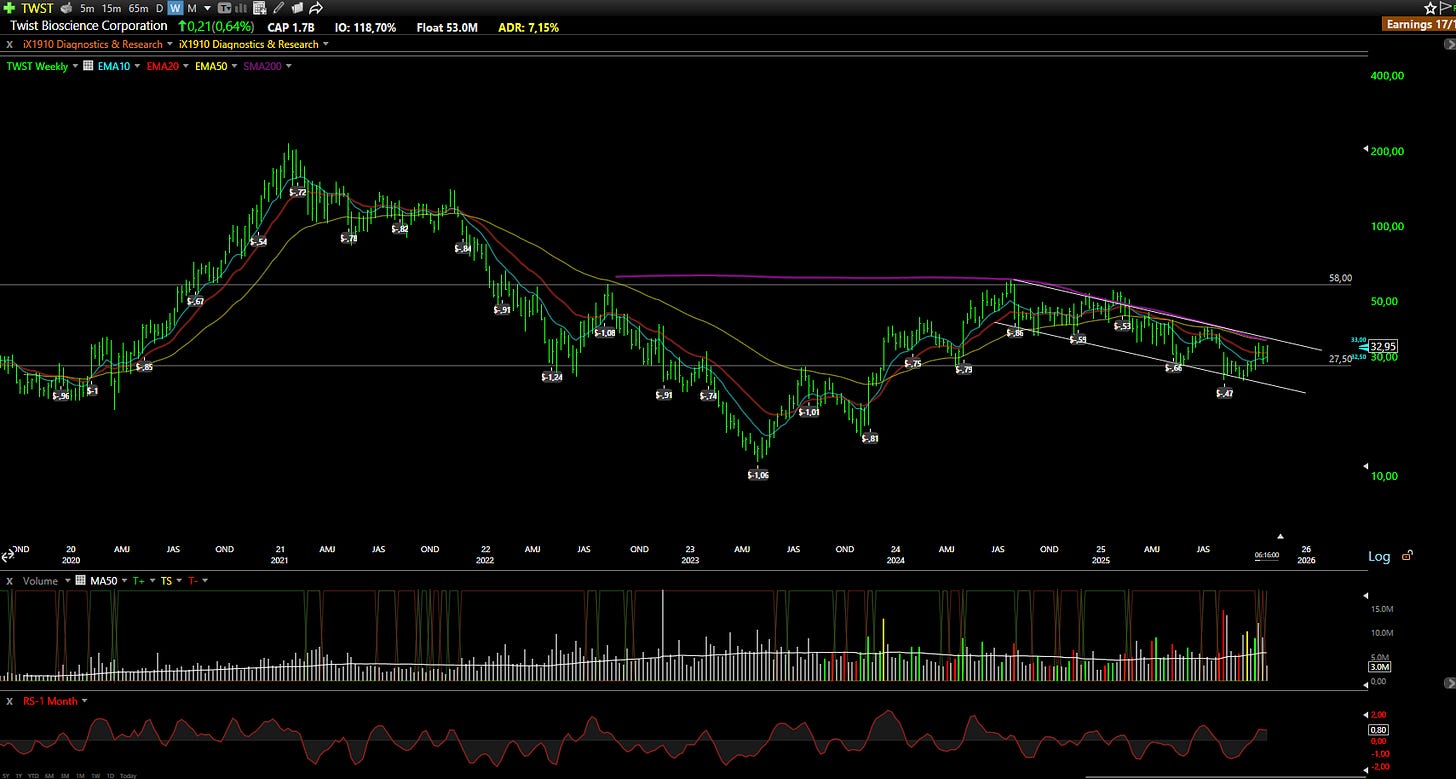
This interesting story is now meeting with a great shift in the market. After a long and bloody series of years’ bear market, the biotech business is showing signs of a new cyclical bull market. A rising tide lifts all boats, and this tailwind provides a favorable environment for the entire industry. More importantly, the technical picture for Twist itself suggests that smart money is taking notice. The pattern of higher lows on the monthly chart, combined with the massive increase in trading volume since August 2025, is the classic footprint of institutional accumulation. The market is quietly building a position before the story becomes obvious.

An investment in Twist is no longer a speculative bet on a distant promise. It is an investment in a proven, scalable manufacturing model whose most profitable days are directly ahead, timed with a potential new upswing in its sector.
My “Buy” rating and $65 price target are rooted in this conviction: the market still values the toolmaker like one of the many prospectors, failing to fully grasp that Twist owns the entire supply store for the gold rush. Investors today have an opportunity to recognize this fundamental distinction before the company’s accelerating financial results make it obvious to everyone.
Disclaimer: This analysis is for informational purposes only and should not be considered financial advice. Always conduct your research and consult with a licensed financial advisor before making investment decisions.
Questo pezzo era gratuito. Il prossimo arriva domenica.This piece was free. The next one lands on Sunday.
Dieci nomi con i livelli, la lettura del mercato, la chat con le posizioni in diretta. Con l'abbonamento leggi tutto; senza, ricevi la parte gratuita via email.Ten names with their levels, the market read, the chat with live positions. Subscribers read everything; free readers get the free part by email.